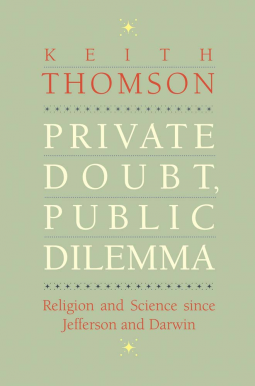
Private Doubt, Public Dilemma
Religion and Science since Jefferson and Darwin
This title was previously available on NetGalley and is now archived.
Buy on Amazon
Buy on BN.com
Buy on Bookshop.org
*This page contains affiliate links, so we may earn a small commission when you make a purchase through links on our site at no additional cost to you.
Send NetGalley books directly to your Kindle or Kindle app
1
To read on a Kindle or Kindle app, please add kindle@netgalley.com as an approved email address to receive files in your Amazon account. Click here for step-by-step instructions.
2
Also find your Kindle email address within your Amazon account, and enter it here.
Pub Date May 26 2015 | Archive Date Jun 4 2015
Description
Each age has its own crisis—our modern experience of science-religion conflict is not so very different from that experienced by our forebears, Keith Thomson proposes in this thoughtful book. He considers the ideas and writings of Thomas Jefferson and Charles Darwin, two men who struggled mightily to reconcile their religion and their science, then looks to more recent times when scientific challenges to religion (evolutionary theory, for example) have given rise to powerful political responses from religious believers.
Today as in the eighteenth century, there are pressing reasons for members on each side of the religion-science debates to find common ground, Thomson contends. No precedent exists for shaping a response to issues like cloning or stem cell research, unheard of fifty years ago, and thus the opportunity arises for all sides to cooperate in creating a new ethics for the common good.
Today as in the eighteenth century, there are pressing reasons for members on each side of the religion-science debates to find common ground, Thomson contends. No precedent exists for shaping a response to issues like cloning or stem cell research, unheard of fifty years ago, and thus the opportunity arises for all sides to cooperate in creating a new ethics for the common good.
A Note From the Publisher
Keith Thomson, professor emeritus of natural history at the University of Oxford and Executive Officer, American Philosophical Society, is an author, biologist, and historian of science. He has written extensively on the history of evolutionary ideas, on Charles Darwin, and most recently on Thomas Jefferson’s interests in science and nature. He lives in Philadelphia, PA.
Advance Praise
“Informative and engaging”—Publishers Weekly
“An engaging, thought-provoking work that engages big questions and important issues in an accessible manner.”—Frank Cogliano, author of Emperor of Liberty: Thomas Jefferson’s Foreign Policy
“An engaging, thought-provoking work that engages big questions and important issues in an accessible manner.”—Frank Cogliano, author of Emperor of Liberty: Thomas Jefferson’s Foreign Policy
Available Editions
| EDITION | Hardcover |
| ISBN | 9780300203677 |
| PRICE | $30.00 (USD) |
Available to Buy
Buy on Amazon Buy on BN.com Buy on Bookshop.org*This page contains affiliate links, so we may earn a small commission when you make a purchase through links on our site at no additional cost to you.
Average rating from 3 members
Readers who liked this book also liked:




Bob Newhart
Michael Seth Starr
Biographies & Memoirs, Entertainment & Pop Culture, Nonfiction (Adult)
Michael Seth Starr
Biographies & Memoirs, Entertainment & Pop Culture, Nonfiction (Adult)

The Shortest History of Innovation
Andrew Leigh
Business, Leadership, Finance, Nonfiction (Adult), Professional & Technical
Andrew Leigh
Business, Leadership, Finance, Nonfiction (Adult), Professional & Technical



Quite Possibly the Best Introduction to the Economy
Fola Yahaya
Business, Leadership, Finance, Nonfiction (Adult), Politics & Current Affairs
Fola Yahaya
Business, Leadership, Finance, Nonfiction (Adult), Politics & Current Affairs

A Brief History of Cities in 32 Inventions
Jonn Elledge
Computers & Technology, History, Nonfiction (Adult)
Jonn Elledge
Computers & Technology, History, Nonfiction (Adult)




The Henchperson's Guide to Unionizing
Marshall J. Moore
General Fiction (Adult), Horror, Sci Fi & Fantasy
Marshall J. Moore
General Fiction (Adult), Horror, Sci Fi & Fantasy