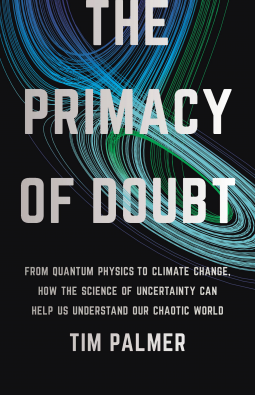
The Primacy of Doubt
From Quantum Physics to Climate Change, How the Science of Uncertainty Can Help Us Understand Our Chaotic World
This title was previously available on NetGalley and is now archived.
Send NetGalley books directly to your Kindle or Kindle app
1
To read on a Kindle or Kindle app, please add kindle@netgalley.com as an approved email address to receive files in your Amazon account. Click here for step-by-step instructions.
2
Also find your Kindle email address within your Amazon account, and enter it here.
Pub Date Oct 18 2022 | Archive Date Oct 18 2022
Description
“Quite possibly the best popular science book I’ve ever read” (Popular Science) shows how the tools that enabled us to overcome the uncertainty of the weather will enable us to find new answers to modern science's most pressing questions
Why does your weather app say “There’s a 10% chance of rain” instead of “It will be sunny tomorrow”? In large part this is due to the insight of Tim Palmer, who made uncertainty essential to the study of weather and climate. Now he wants to apply it to how we study everything else.
In The Primacy of Doubt, Palmer argues that embracing the mathematics of uncertainty is vital to understanding ourselves and the universe around us. Whether we want to predict climate change or market crashes, understand how the brain is able to outpace supercomputers, or find a theory that links quantum and cosmological physics, Palmer shows how his vision of mathematical uncertainty provides new insights into some of the deepest problems in science. The result is a revolution—one that shows that power begins by embracing what we don’t know.
Available Editions
| EDITION | Other Format |
| ISBN | 9781541619715 |
| PRICE | $30.00 (USD) |
| PAGES | 320 |
Available to Buy
Buy on Amazon Buy on BN.com Buy on Bookshop.orgAverage rating from 3 members
Readers who liked this book also liked: