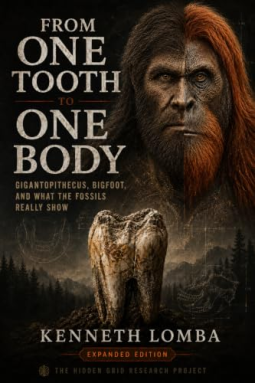
From One Tooth to One Body: Gigantopithecus, Bigfoot, and What the Fossils Really Show
Gigantopithecus, Bigfoot, and What the Fossils Really Show
This title was previously available on NetGalley and is now archived.
Send NetGalley books directly to your Kindle or Kindle app
1
To read on a Kindle or Kindle app, please add kindle@netgalley.com as an approved email address to receive files in your Amazon account. Click here for step-by-step instructions.
2
Also find your Kindle email address within your Amazon account, and enter it here.
Pub Date Oct 1 2026 | Archive Date Sep 25 2026
Talking about this book? Use #FromOneToothtoOneBodyGigantopithecusBigfootandWhattheFossilsReallyShow #NetGalley. More hashtag tips!
Description
What can nearly two thousand fossil teeth and four incomplete lower jaws really tell us about an animal whose skull, pelvis, limbs, hands, and feet have never been found?
From One Tooth to One Body investigates one of paleoanthropology’s most familiar—and anatomically incomplete—giants: Gigantopithecus blacki.
The fossils are real. The enormous teeth are real. The massive jaws are real.
The familiar complete body is largely reconstructed.
Author and investigator Kenneth Lomba follows the evidence from the Chinese apothecary “dragon-tooth” trade through modern cave discoveries, molecular testing, Denisovan reclassifications, and the long-running claim that Gigantopithecus might explain Bigfoot.
Later Gigantopithecus mandibles were found with enormous teeth still preserved in place, strongly connecting the jaw material to the original holotype. Yet the famous 2019 molecular result did not come from the holotype or a tooth still attached to one of those jaws. It came from CF-B-16, a referred, broken partial molar from Chuifeng Cave.
Ancient enamel proteins from that specimen strongly placed it on the pongine branch of the great-ape family tree, as a sister lineage to orangutans. But one molecularly tested tooth does not recover a skull, foot, pelvis, gait—or independently test every other fossil assigned to the species.
Inside, readers will examine:
What the Gigantopithecus fossil record actually contains—and what remains unknown.
How teeth preserved in the known jaws compare with the original 1935 holotype.
Why Paranthropus boisei, a human-line hominin, evolved individual molars in the same dimensional range as some Gigantopithecus molars.
How a twelve-foot stature proposal entered the literature despite the absence of postcranial bones.
Why changing the reference animal can produce radically different reconstructed bodies from the same dental evidence.
How CF-B-16 became the molecular anchor for a much larger morphology-based fossil collection.
Why the G. blacki holotype, CA 733, still has no published ancient-enamel-protein phylogenetic result.
Why 24 Chuifeng teeth remain classified only as Hominoidea indeterminate—a category that includes humans and nonhuman apes.
How fossil human teeth entered the same historical medicinal-fossil trade that produced the original Gigantopithecus tooth.
What Denisovan discoveries show about fossils changing identity when new molecular methods become available.
Why the evidence does not presently support identifying Bigfoot as Gigantopithecus blacki.
What discoveries could prove the current interpretation right—or force it to change.
This is not a book claiming that Gigantopithecus was human. It does not claim Bigfoot has been scientifically established, and it does not argue that Gigantopithecus survived into modern North America.
Instead, it conducts an identity audit.
No accepted fossil corridor connects the southern Asian animal to Beringia or North America. The chronological gap is enormous. No accepted modern biological specimen supplies the missing molecular bridge.
At the same time, rejecting the Bigfoot identification does not turn the familiar giant-orangutan reconstruction into recovered anatomy. The skull, face, limbs, hands, feet, pelvis, and locomotion remain incompletely known.
Written for readers of primatology, paleontology, paleoanthropology, cryptozoology, human evolution, and scientific mysteries, From One Tooth to One Body asks:
Where does the evidence end—and where does the reconstructed animal begin?
One tooth can open a question. It cannot supply a body.
Available Editions
| EDITION | Ebook |
| ISBN | 9100295291166 |
| PRICE | $4.99 (USD) |
| PAGES | 254 |