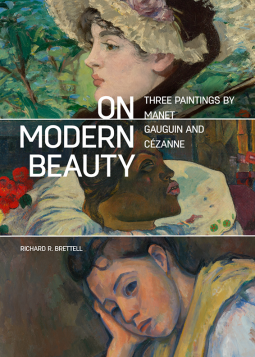
On Modern Beauty
Three Paintings by Manet, Gauguin, and Cézanne
This title was previously available on NetGalley and is now archived.
Send NetGalley books directly to your Kindle or Kindle app
1
To read on a Kindle or Kindle app, please add kindle@netgalley.com as an approved email address to receive files in your Amazon account. Click here for step-by-step instructions.
2
Also find your Kindle email address within your Amazon account, and enter it here.
Pub Date Jun 11 2019 | Archive Date Jul 8 2019
Getty Publications | J. Paul Getty Museum
Talking about this book? Use #OnModernBeauty #NetGalley. More hashtag tips!
Description
A thought-provoking examination of beauty using three works of art by Manet, Gauguin, and Cézanne.
As the discipline of art history has moved away from connoisseurship, the notion of beauty has become increasingly problematic. Both culturally and personally subjective, the term is difficult to define and nearly universally avoided. In this insightful book, Richard R. Brettell, one of the leading authorities on Impressionism and French art of the nineteenth and early twentieth centuries, dares to confront the concept of modern beauty head-on. This is not a study of aesthetic philosophy, but rather a richly contextualized look at the ambitions of specific artists and artworks at a particular time and place.
Brettell shapes his manifesto around three masterworks from the collection of the J. Paul Getty Museum: Édouard Manet’s Jeanne (Spring), Paul Gauguin’s Arii Matamoe (The Royal End), and Paul Cézanne’s Young Italian Woman at a Table. The provocative discussion reveals how each of these exceptional paintings, though depicting very different subjects—a fashionable actress, a preserved head, and a weary working woman—enacts a revolutionary, yet enduring, icon of beauty.
Available Editions
| EDITION | Other Format |
| ISBN | 9781606066065 |
| PRICE | $19.95 (USD) |
| PAGES | 116 |
Links
Average rating from 5 members
Featured Reviews
 Jason M, Reviewer
Richard R. Brettell poses three questions which he seeks to answer in his art history book, "On Modern Beauty": Is beauty transitory? Is beauty immemorial? Is beauty beyond time? His book is a collection of three essays with the aim to answer these questions using modern works of art from Edouard Manet, Paul Gauguin and Paul Cezanne, compared with other works of art from other eras and how they might answer these same questions.
It is a fascinating study on both the time these pieces were created and the essential questions posed to understand the meaning of art and the changes in time as different eras of art communicate new ideas.
I enjoyed the discussion Mr. Brettell engaged his readers in and learned a lot from this book.
I received this eBook free of charge from Getty Publications via NetGalley in exchange for a fair and honest review. I did not receive any fiscal compensation from either company for this review and the opinions expressed herein are entirely my own.
 Mel L, Reviewer
A life affirming upbeat book , not one I would normally read but one i found i enjoyed. Easy to read and follow and one you don’t want to put down .
 Adam D, Librarian
"On Modern Beauty" by Richard Brettell was an interesting book. It wasn't what I was expecting from the blurb, but I'll definitely recommend this to patrons.
 Ivana ., Reviewer
On Modern Beauty: Three Paintings by Manet, Gauguin and Cezanne is a collection of three essays, or better said lectures on beauty in context of those artists.
I didn't enjoy them very much. That is everything I can say about it.
John L, Reviewer
Hmmm… I'm all in favour of a book derived from a set of three lectures, especially when the Getty is concerned. But this, the second book for me this week inspired by their purchase of a single Manet painting, does kind of feel like an attempt at getting as much of their money back as possible. The essay about Jeanne/Spring/whatever is too slight in contrast to the 400pp opus about it available elsewhere. Lecture two would have been about a Gauguin portrait of a disembodied head, but is most bizarre, coming from a lecturer whose pupils spot that he never uses the word "beautiful". The subject is just plain ugly, as is the painting, for all the intent behind it, but here the author makes up for any prior shortcomings, like that Perec book where every vowel was an E because he'd not allowed himself their use for years. And the Cezanne piece shows just how much we don't know, in favour of what little we do. I for one don't think the subject Italian, or young, or even at a table, for if that's a table then so am I. She seems to me to be leaning as a middle-aged, sorrowful woman, on the side of a crib. Her look, deemed to be melancholia, looks more like grief to me. But it ain't beautiful, which is a further negation of the thesis of this book. One last negation of the volume – while it isn't awful, by any means, it isn't what the average man on the average omnibus would get much out of. Perhaps the less-scripted, more pictorial lectures on YouTube are more user-friendly, a la TED Talks, but this is too academic and waffly for the common browser.
Readers who liked this book also liked:



Kerri Rawson
Biographies & Memoirs, Parenting, Families, Relationships, True Crime