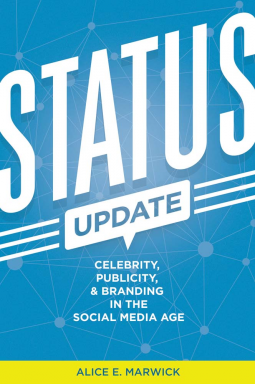
Status Update
Celebrity, Publicity, and Branding in the Social Media Age
This title was previously available on NetGalley and is now archived.
Buy on Amazon
Buy on BN.com
Buy on Bookshop.org
*This page contains affiliate links, so we may earn a small commission when you make a purchase through links on our site at no additional cost to you.
Send NetGalley books directly to your Kindle or Kindle app
1
To read on a Kindle or Kindle app, please add kindle@netgalley.com as an approved email address to receive files in your Amazon account. Click here for step-by-step instructions.
2
Also find your Kindle email address within your Amazon account, and enter it here.
Pub Date Nov 26 2013 | Archive Date Jan 2 2014
Description
Social media, once heralded as revolutionary and democratic, have instead proved exclusionary and elitist
Social media technologies such as YouTube, Twitter, and Facebook promised a new participatory online culture. Yet, technology insider Alice Marwick contends in this insightful book, “Web 2.0” only encouraged a preoccupation with status and attention. Her original research—which includes conversations with entrepreneurs, Internet celebrities, and Silicon Valley journalists—explores the culture and ideology of San Francisco’s tech community in the period between the dot com boom and the App store, when the city was the world’s center of social media development.
Marwick argues that early revolutionary goals have failed to materialize: while many continue to view social media as democratic, these technologies instead turn users into marketers and self-promoters, and leave technology companies poised to violate privacy and to prioritize profits over participation. Marwick analyzes status-building techniques—such as self-branding, micro-celebrity, and life-streaming—to show that Web 2.0 did not provide a cultural revolution, but only furthered inequality and reinforced traditional social stratification, demarcated by race, class, and gender.
Social media technologies such as YouTube, Twitter, and Facebook promised a new participatory online culture. Yet, technology insider Alice Marwick contends in this insightful book, “Web 2.0” only encouraged a preoccupation with status and attention. Her original research—which includes conversations with entrepreneurs, Internet celebrities, and Silicon Valley journalists—explores the culture and ideology of San Francisco’s tech community in the period between the dot com boom and the App store, when the city was the world’s center of social media development.
Marwick argues that early revolutionary goals have failed to materialize: while many continue to view social media as democratic, these technologies instead turn users into marketers and self-promoters, and leave technology companies poised to violate privacy and to prioritize profits over participation. Marwick analyzes status-building techniques—such as self-branding, micro-celebrity, and life-streaming—to show that Web 2.0 did not provide a cultural revolution, but only furthered inequality and reinforced traditional social stratification, demarcated by race, class, and gender.
A Note From the Publisher
Alice E. Marwick is assistant professor, communication and media studies, Fordham University, and an academic affiliate at the Center on Law and Information Policy, Fordham Law School. Previously a postdoctoral researcher at Microsoft Research, she regularly speaks to the press on various social media topics and has written for the New York Times, the Daily Beast, and the Guardian. She lives in New York City.
Available Editions
| EDITION | Hardcover |
| ISBN | 9780300176728 |
| PRICE | $27.50 (USD) |
Available to Buy
Buy on Amazon Buy on BN.com Buy on Bookshop.org*This page contains affiliate links, so we may earn a small commission when you make a purchase through links on our site at no additional cost to you.