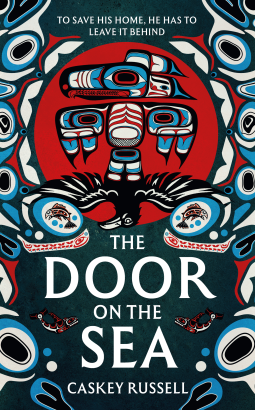
The Door on the Sea
This title was previously available on NetGalley and is now archived.
Send NetGalley books directly to your Kindle or Kindle app
1
To read on a Kindle or Kindle app, please add kindle@netgalley.com as an approved email address to receive files in your Amazon account. Click here for step-by-step instructions.
2
Also find your Kindle email address within your Amazon account, and enter it here.
Pub Date Oct 7 2025 | Archive Date Oct 3 2025
Rebellion | Solaris
Talking about this book? Use #TheDoorontheSea #NetGalley. More hashtag tips!
Description
An epic quest fantasy debut inspired by Tlingit folklore and culture, for fans of The Earthsea Cycle and Black Sun.
To save his home, he'll have to leave it behind.
When Elān trapped a salmon-stealing raven in his cupboard, he never expected it would hold the key to saving his people from the shapeshifting Koosh invaders plaguing their shores. In exchange for its freedom, the raven offers a secret that can save Elān’s home: the Koosh have lost one of their most powerful weapons, and only the raven knows where it is.
Elān is tasked with captaining a canoe crewed by an unlikely team including a human bear-cousin, a massive wolf, and the endlessly vulgar raven. To retrieve the weapon, they will face stormy seas, cannibal giants and a changing world. But Elān is a storyteller, not a warrior.
As their world continues to fall to the Koosh, and alliances are challenged and broken, Elān must choose his role in his own epic story.
Available Editions
| EDITION | Other Format |
| ISBN | 9781837863785 |
| PRICE | CA$35.99 (CAD) |
| PAGES | 450 |
Available on NetGalley
Available to Buy
Buy on Amazon Buy on BN.com Buy on Bookshop.orgAverage rating from 110 members
Featured Reviews
 Rachel D, Reviewer
I absolutely loved this one. From the very first scene, when Elān captures a salmon-stealing raven in his cupboard, I was hooked. What starts as a quirky moment unfolds into an unforgettable adventure steeped in myth, belonging, and transformation.
Elān is a storyteller, not a warrior, and watching him rise to the challenge felt deeply rewarding. The crew he gathers includes a bear-cousin, a massive wolf, and an irreverent raven, and they quickly become more than companions: by the end, they felt like old friends.
The prose captures the mist and salt of storm-torn seas, making every scene vivid and alive. The stakes deepen as alliances shift, giants appear, and shapeshifters haunt the edges of the world. But it's the quieter moments that stay with you: moments where Elān grapples with belonging and identity.
If you're drawn to folklore-rich fantasy with a beating heart, this is a book you won't forget. It's a reminder that stories have the power to save worlds—and ourselves.
 Carling T, Reviewer
** Thank you to Rebellion | Solaris, Netgallery, and Caskey Russel for an e-ARC in exchange for my honest review. **
Elān is made for the sheets (of paper) and not for the streets!
Or that is how the story begins. Elān is more interested in stories, knowledge, and books than he is in becoming a mighty warrior like his grandfather. He's never fit in and is seemingly trying to find his place among his tribe and in the world. But when he catches a foul-mouthed, cantankerous raven stealing his salmon, he traps him in a cupboard. Raven tells Elān where he can find a powerful weapon lost at sea by the Koosh invaders. When elder Ixt catches wind of this, he sends Elān, mouthy Raven, and a group of misfit warriors to retrieve the weapon and save his people.
Elān and his crewmates face a perilous journey against the sea, cannibalistic giants, and the Koosh invaders. Constantly compared to his warrior grandfather and crippled with self-doubt, Elān must figure out who he wants to be and earn the crew's respect. Along the way he learns that all he ever needed to be was exactly himself.
Overall: How do you critique a story that feels like it has always been? This book is unique in that the story feels like one that has been passed down from generation to generation. It was touching to read that this is a story he developed for his kids, as it felt like one of those stories you are told by your parents after you've been tucked in tight for the night. "Please, one more chapter!"
Recommended: for anyone! Literally, everyone should read this book.
Feels like: an Indigenous version of the Odyssey- only way better!
Gripes: None! Well, I could have used a little more Raven, who is now one of my all-time favorite characters!
Rating: 5/5- Perfection, no notes!
Note to the author: This is my advanced PLEA for the second installment of this story!
 Librarian 1816155
A classic adventure story told with an indigenous voice, setting, and characters, giving it a unique and refreshing take! To be added to any library of indigenous reads!
 Amalie F, Reviewer
I can't remember the last time that I read a quest fantasy in which I truly felt like I was reading something new and fresh. It's safe to say that this is the case here. Most of this immersive story takes place while out at sea in a smaller vessel (by choice, mind you, and not by force). I really had no idea how much I needed a story and a setting like that until it fell into my lap. I thought I had read stories like this before, but I definitely hadn’t.
Another thing that stood out to me was the narration. More specifically, the way that it draws on oral storytelling and folkloric traditions, making big stakes feel incredibly intimate and relatable (and funny; you'll know what I mean when you read). To me, this is what folklore does best and I see that type of that storytelling reflected here.
And speaking of tradition, this is a theme that saturates the expansive world that Russell has created. Alongside the themes of worldview and otherness, readers are being treated to familiar themes wrapped in an unfamiliar packaging.
In my opinion, this is what makes TDOTS truly shine; its ability to take the well-known and make it wholly unknown.
 Suzanne K, Reviewer
What a delightful epic fantasy.
Elan, our narrator and unlikely hero is 18 and though he believed himself to be more bookish (a bookeater) but is convinced to go on an adventure with a diverse group of warriors and seamen.
The characters are trying to outrun the Koosh who are spreading evil and destroying villages with their dzanti. They are even stronger than cannibal giants.
Raven, is a raven but also a silly guy with the greatest insults I have read in a while. The raven can speak any language human or animal but often refuses to translate. Which makes communicating with Chetdyl (a wolf) hard.
This book was much more action packed than I had thought. The world building is so clear, it’s like you are in their boat.
I cannot wait for the next installment of this book.
Highly recommend it for anyone who loves fantasy and epic stories.
 Elizabeth L, Reviewer
"An epic quest fantasy debut that is the Tlingit indigenous response to The Lord of the Rings.
When Elān trapped a salmon-stealing raven in his cupboard, he never expected it would hold the key to saving his people from the shapeshifting Koosh invaders plaguing their shores. In exchange for its freedom, the raven offers a secret that can save Elān's home: the Koosh have lost one of their most powerful weapons, and only the raven knows where it is.
Elān is tasked with captaining a canoe crewed by an unlikely team including a human bear-cousin, a massive wolf, and the endlessly vulgar raven. To retrieve the weapon, they will face stormy seas, cannibal giants and a changing world. But Elān is a storyteller, not a warrior.
As their world continues to fall to the Koosh, and alliances are challenged and broken, Elān must choose his role in his own epic story."
Do the human-bear cousin and the massive wolf cub demand second breakfast?
 J R, Reviewer
effective adventure story that feels like it's ancient and yet new. despite the tlingit worldbuilding the plot is relatively standard but it works. 5 stars. tysm for the arc.
Will S, Reviewer
As I read Caskey Russell’s The Door on the Sea, I realized for the first time just how much of the epic fantasy genre is European-coded. The people talk in British accents on the audiobooks and characters are humans, elves, and dwarves. Cities seem to always resemble medieval manorial towns and the social structure is often straight out of European Feudalism with Lords, Knights, and Serfs (perhaps with some different titles and names). Russell’s The Door on the Sea felt…off to me until I reoriented my perspective. I’ve done it before, and you probably have too for Asian-inspired fantasy books, but there have been hundreds of societies that have come and gone…so why not use something else as the basis for a new epic fantasy series?
And that’s precisely what Russell has done with his novel, The Door in the Sea, based on Tlingit folktales and legends.
The Tlingit, if you aren’t familiar with them, are indigenous to the Pacific Northwest (think British Columbia in Canada or southern Alaska). They are one of the tribes most famous for carving totem poles and have a rich tapestry of history and stories to draw from. So when our main character, Elān, travels via canoe to other fishing villages, it felt inauthentic until I had to stop myself to realize we can (and should) mine other cultures for their unique aspects and fascinating villains and characters.
Once I got past the “non-Euro-ness” of the story, I settled in and had a great time with Elān and his found-family fellowship. There was a certain Tolkein-esque vibe to how Russell sets up Elān on his journey. Our main protagonist, Elān, is a storyteller, not a warrior, and that aspect is woven throughout the story, giving other characters places to shine and a chance for Elān to add his own uniqueness to the quest. For a time, the tension between Elān and the female warrior who accompanies him, Kwa, was almost too much, but it finally got to a good place for the characters in the end.
Of course, what would this story be without a foul-mouthed, belligerent raven who may hold the key to defeating the Koosh, but is nearly entirely unwilling to assist the fellowship in the ups and downs of their journey to get it? At times, Raven was both my favorite and least favorite character, and perhaps that’s exactly what Russell was going for.
Ultimately, I enjoyed The Door in the Sea and will absolutely pick up the sequel to see what Elān and crew get up to in the next installment of this very non-European epic fantasy.
Thank you to Solaris for providing this book for review consideration via NetGalley. All opinions are my own.
 Maria G, Media/Journalist
In The Door on the Sea, Caskey Russell crafts an adventure fantasy deeply rooted in Indigenous cosmologies and in an ethic of belonging to the land and the sea. The novel follows Elān, a young man connected to the Aaní people, who becomes entangled in political and spiritual conflicts while transporting the enigmatic weapon known as the dzanti, an object capable of shifting the balance of power between rival peoples.
From its opening pages, the narrative universe stands out for its cultural richness. The Aaní live in northern archipelagos, in houses built from fallen wood and adorned with ancestral symbols, sustaining a relationship of respect with nature. This care for the natural world is not mere backdrop, but the moral foundation of the work. The contrast between this worldview and the militaristic logic surrounding the dzanti establishes the book’s central thematic axis: power as a threat to harmony.
Elān is not an invulnerable hero. He hesitates, makes mistakes, and doubts. His journey is marked by both physical and internal displacement. Alongside characters such as Hoosa, who is connected to black bears and able to speak with them, and under the constant interference of the irreverent Raven, the narrative alternates moments of strategic tension with passages of biting humor. Raven, a trickster figure who speaks all languages and challenges human authority, functions as the protagonist’s unsettling conscience. When he insists that the dzanti’s true destination is not the planned stronghold but the mysterious Door on Saaw Island, he shifts the narrative from a military mission toward a nearly spiritual quest.
Structurally, the novel privileges movement by sea. The voyages aboard Waka, the decisions about winds and routes, and the nocturnal infiltrations into enemy territory lend dynamism to the plot. Even so, the primary conflict is not merely external. The real tension lies in Elān’s choice between obeying collective expectations and listening to a deeper truth about the use of power.
One of the book’s greatest strengths is its refusal to simplify violence. The dzanti represents not only strategic advantage but also the risk of moral destruction. By relocating the climax to the decision of where and how to use the weapon, Russell questions the assumption that possessing strength necessarily requires deploying it. Fantasy thus becomes a space for ethical debate.
As a weakness, the pacing occasionally lingers in nautical descriptions and repetitive dialogue that can dilute dramatic intensity. In addition, certain antagonists lack greater psychological complexity, functioning more as opposing forces than as fully developed characters. Even so, the cultural and symbolic cohesion of the world sustains the novel’s overall power.
Taken as a whole, The Door on the Sea is more than a maritime adventure. It is a narrative about responsibility in the face of power, about listening to ancestral voices, and about recognizing that some doors do not lead to glory, but to transformation. By guiding his protagonist toward the Door at sea, Russell suggests that the true threshold to cross is not geographic, but moral.
 Cacie A, Librarian
An adventure-filled epic fantasy that weaves indigenous myth with wonderful story. It reminds me of the journey in Lord of the Rings but with a refreshing,native twist.
 L D, Reviewer
Raven, a foul-mouthed and constantly disrespectful presence brings a wonderful irreverence, and fairly lowbrow humour, to this compelling quest novel, and first instalment in The Raven and Eagle series.
Author Caskey Russell creates a world that is being slowly invaded by strange beings with powerful weapons. In fact, it’s word brought by Raven of one of these weapons lost by the Koosh that sets off an effort to secure this for the people of the land, in the hope of reversing the coming conquest and enslavement.
An elder of the Aaní people convinces his fellow elders of the urgent need to retrieve the weapon. The council appoint members of different clans, one of he Aaní as leader of the mission, one of the Bear, a Wolf representative, two warriors of the Aaní to provide protection, and a heavily bribed Raven, as very reluctantguide.
Elān has been trying to find his place with the Aaní ; he attempted to be a warrior, but is really a storyteller. But, his stories are not traditional, and have caused some upset with the questions he provokes. So the elder thinks it would be good for Elān to lead the mission, and maybe grow up a little along the way.
The group have to deal with multiple perils and problems, including rival clans, as they traverse dangerous territories over several days, then have to find a way to not only get the weapon, but escape back home with it.
There is much humour, argument, and camaraderie in this fun story. I loved how at loose ends main character Elān is, how much he longs for to find his own meaningful place amongst his people. The trip ends up giving him many challenges, all of which drive his growth: his self-respect, confidence and problem-solving all vastly improve, as well as his leadership ability.
Meanwhile, Raven provides a constant stream of insults directed at everyone, and I found it impossible not to love this argumentative and disruptive individual, and influence in the group.
I really enjoyed this story, and look forward to reading the next book.
Thank you to Netgalley and to Rebellion for this ARC in exchange for my review.
Readers who liked this book also liked:

Nibedita Sen
General Fiction (Adult), Sci Fi & Fantasy
Brigid Kemmerer
General Fiction (Adult), Romance, Sci Fi & Fantasy