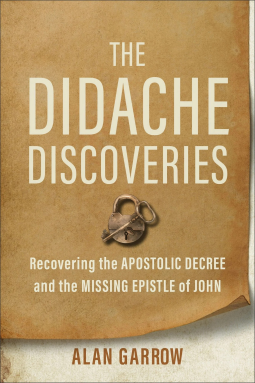
The Didache Discoveries
Recovering the Apostolic Decree and the Missing Epistle of John
This title was previously available on NetGalley and is now archived.
Send NetGalley books directly to your Kindle or Kindle app
1
To read on a Kindle or Kindle app, please add kindle@netgalley.com as an approved email address to receive files in your Amazon account. Click here for step-by-step instructions.
2
Also find your Kindle email address within your Amazon account, and enter it here.
Pub Date Jun 23 2026 | Archive Date Jul 7 2026
Baker Academic & Brazos Press | Baker Academic
Talking about this book? Use #TheDidacheDiscoveries #NetGalley. More hashtag tips!
Description
The first, compiled by James the brother of Jesus and the twelve apostles in 48 CE, is the Apostolic Decree. This document, partially described in Acts 15, was treated as foundational Christian Scripture by the writers of the New Testament. In that role it provides the starting point for interactions that open out across Paul's letters, the synoptic gospels, and the Johannine literature--enabling solutions to previously unanswerable questions about Paul's theology, the infamous synoptic problem, and the origins of Johannine theological creativity. Crucial to the story of the latter is the discovery of the Didache's second hidden document: the Missing Epistle of John. This text, referenced in 3 John 9, reworks the sometimes eccentric instructions of the Apostolic Decree and makes them more generally applicable--a move that provides fascinating insight into the ways the writers of the New Testament handled their own sacred text.
The Didache Discoveries promises to impact every major aspect of the study of the New Testament and early Christianity.
Available Editions
| EDITION | Paperback |
| ISBN | 9781540970138 |
| PRICE | $34.99 (USD) |
Available on NetGalley
Available to Buy
Buy on Amazon Buy on BN.com Buy on Bookshop.orgAverage rating from 3 members
Featured Reviews
 Jeremiah P, Reviewer
In The Didache Discoveries, Alan Garrow argues that the ancient church manual known as the Didache is actually a combination of two highly sought-after, first-century texts: the Apostolic Decree and the Missing Epistle of John.
By stripping away later editorial additions (which he compares to removing "rust"), Garrow separates the document into two distinct layers: an Original Didache and a Revised Didache.
He proposes that the Original Didache is the long-lost Apostolic Decree, an identification that he argues resolves major New Testament puzzles, including the Acts-Galatians conundrum, the background of Paul's letters to the Thessalonians, and the mystery of the "Q" source used by Matthew and Luke.
Also, he identifies the Revised Didache as the Missing Epistle of John, arguing that this text sparked a historical conflict with the church leader Diotrephes and provided the creative, eucharistic foundation for the Book of Revelation
Overall, Garrow reframes the Didache not as a simple instructional manual, but as the 'golden key' that unlocks the earliest chapters of Christian history.
 Pete F, Media/Journalist
The Didache Discoveries appears to compile Alan Garrow’s life’s work on the Didache. His main argument is that the Didache we have is actually a combination of the Apostolic Decree mentioned in Acts 15 and John’s missing epistle mentioned in 3 John 5–9. He then examines numerous other New Testament passages that may have been influenced by the Didache. I have a fondness for the Didache and was curious to learn more. Since I don’t have a horse in the race, I was along for the ride—this could either be a creative discovery or hubris.
Working with a text adjacent to the canon of Scripture, Garrow has more leeway. However, as we’ll discuss later, he draws a lot of conclusions about how the Didache intersects with the New Testament.
I appreciated Garrow’s metaphor of missing keys and missing keyhooks. Sometimes we know of a document that we don’t have a copy of, and sometimes we have a document but don’t know which hook it matches.
However, I found his metaphor of “removing rust” to be less compelling. First, he split the Didache into two hypothetical documents, which he calls the Original Didache and the Revised Didache. He claims that the title “The Teaching of the Lord, by the Twelve Apostles, to the Gentiles” refers to the Apostolic Decree, and “The Teaching of the Twelve Apostles” refers to a revised version. This is all based on the argument that parallels and duplication within the document must have been from two separate sources. He says, “Removing the ‘rust’ reveals a text with two titles, two baptism rites, two eucharistic prayers, and two sets of visitor instructions.”
I do not find this argument compelling, since ancient writers were more likely to use repetition as a rhetorical device than we are today. I agree that “single author” is a myth (in both ancient and modern texts!). But I am suspicious of the freewheeling splicing/combining he does to reconstruct hypothetical texts.
Next, he spends a good bit of time on the Original Didache. Why does the Apostolic Decree we have recorded in Acts 15 not match the Didache? Garrow answers that Acts 15 shows Luke highlighting the parts of the Original Didache/Apostolic Decree that were most friendly to Paul. “[I]t is reasonable to expect that Luke, as a partisan reporter, would have highlighted those parts of the decree most favorable to Paul’s position (while perhaps reinterpreting any unfavorable parts), rather than recording the whole compromise in full.”
The differences between the texts are explained by the human inclination to decide a matter with a compromise that each side can interpret as a win for their side. This assumption of Scripture’s formation from human nature without the Holy Spirit rubs me the wrong way. Certainly, God used humans to write Scripture (and be the Church!), but I believe that God guided the writing of Scripture.
Closely related to Acts 15 is Paul’s recounting of that interaction in Galatians, where Paul reinterprets the text to his purpose. “For example, why did Paul find himself needing to defend himself against the suggestion that he was still preaching circumcision (Gal. 5:11)? This was because of his known endorsement of the Original Didache / Apostolic Decree—a text that may be understood as teaching that circumcision, while not necessary for shared table fellowship, is ultimately necessary for salvation.” Paul clarifies for the Galatians that circumcision is not required for salvation.
Garrow spends some time explaining how Paul’s other audiences were also familiar with the Didache, especially the Thessalonians. 1 Thessalonians clearly references and incorporates pre-Pauline materials. In Paul’s clarification on eschatology in 4:15–17, he specifically refers to a “word of the Lord” (4:15). Garrow’s hypothesis is that the Thessalonians misinterpreted the Didache and were concerned that those who died without being martyred would be left behind. “Read in this way the Didache appears to state that the entire faith of those who fail to achieve martyrdom (and then to join the heavenly holy ones) will be ‘of no account.’” Paul seeks to correct this misunderstanding. In 2 Thessalonians, Paul reiterates much of the content of 1 Thessalonians but changes his tone to clarify its authenticity, specifically referring to his authenticating signature (3:17).
Interestingly, Garrow spends very little time on the Missing Epistle of John, as we have very little explanation of it in Scripture. “The survival of the short and seemingly inconsequential 2 and 3 John suggests that they were initially valued because of their author rather than their content.” Okay, so he takes John to be the author of the Johannine epistles. John mentions traveling missionaries in 3 John 5–8, then says that Diotrephes has been trying to ignore John’s apostolic authority. Garrow’s assumption is that John expanded upon the Original Didache to suit his favorite method of Eucharist and traveling missionaries.
In the second half of the book, Garrow piles on various connections with other Scripture passages throughout the New Testament. By my count, Garrow’s thesis has implications for up to 16 books of the New Testament. (It almost felt like a conspiracy theory—“This solves all the puzzles!”) He often starts sentences with the word “Given” to take his assumptions one step further. However, I wasn’t always clear on the “so what” for how he thinks this should shape how we read Scripture.
Assuming that John reworked the Didache, “Revelation and the Revised Didache have distinctly similar attitudes to eating food sacrificed to idols and the practice of sorcery.” Garrow posits that Revelation is divided into seven cliffhanger sections to be used for Eucharistic meditations for prophets to “give thanks as much as they wish” (Did. 10:7). That’s a cool idea, but I’m not sure what to do with it.
Matthew and Luke each have a few verses overlapping with the Didache, so it may have been part of what we imagine as “Q.” Didache 1:2-5a has some parallels to Luke 6:24–37 and Matthew 5:38–48. He argues that it makes more sense that Luke rephrased the Golden Rule in a positive direction and elided “avoid the fleshly and bodily passions” from the Didache rather than the other way around. However, this leaves the majority of “Q” unaccounted for.
Garrow makes a quick reference to previous teaching about Two Ways in Hebrews 6:1–6. In addition to some verbal connections to 1 Peter 4:12 and 2:11, the Two Ways theme continues through the Church Fathers influenced most by the Petrine tradition. He also mentions a linguistic connection in Mark 13:26.
Paul also refers to earlier teaching in 1 Corinthians about food sacrificed specifically to “idols” (interestingly, not the word for “gods”). In addition, “Given Paul’s knowledge of Didache 16, as evidenced in 1 Thessalonians, and given the high status he attributes to this tradition, there is every reason to suspect that when Paul wrote 1 Corinthians 2:9, the ‘Scripture’ he quoted was the Original Didache’s lost ending.” This feels like a bit of a leap.
James refers to previous teaching as the “implanted Word” (1:21) and the “perfect law” (1:25), drawing parallels to the Didache. Garrow claims that James uses the Didache the most conservatively since he was an author of the original Apostolic Decree.
In general, what Garrow says makes sense. There were certainly early teachings like this: early documents dealing with the questions of how gentiles can be Christians, how to deal with traveling apostles, and how to perform the Eucharist. Garrow highlights many interesting parallels between the Didache and the New Testament canon.
However, Garrow did not succeed in convincing me of his thesis. His explanation of the Apostolic Decree included too many assumptions about the rhetorical use of repetition and the Spirit’s role in the inspiration of Scripture. Showing parallels to a few verses in Matthew and Luke doesn’t go far in proving the Didache is actually Q. Showing that Peter, Paul, and James all quote earlier teaching doesn’t mean that the Didache is this earlier document.
My conclusion is that even if the Didache is one of multiple instructional texts, it is a valuable resource to learn the themes that were important in the Apostolic Era.
Readers who liked this book also liked:
Steven A. McKinion; Benjamin T. Quinn
Christian, Religion & Spirituality