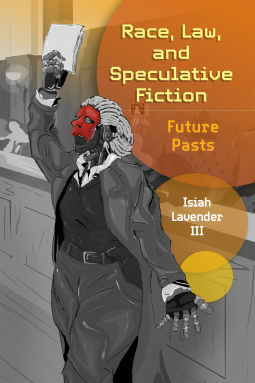
Race, Law, and Speculative Fiction
Future Pasts
This title was previously available on NetGalley and is now archived.
Send NetGalley books directly to your Kindle or Kindle app
1
To read on a Kindle or Kindle app, please add kindle@netgalley.com as an approved email address to receive files in your Amazon account. Click here for step-by-step instructions.
2
Also find your Kindle email address within your Amazon account, and enter it here.
Pub Date May 19 2026 | Archive Date May 19 2026
Talking about this book? Use #RaceLawandSpeculativeFiction #NetGalley. More hashtag tips!
Description
An analysis of US science fiction, through the lens of critical race theory, that illuminates how the genre offers new directions for serious appraisals of race and racism between yesterday, today, and tomorrow
In Race, Law, and Speculative Fiction, Isiah Lavender III takes seriously the theoretical, stylistic, and rhetorical possibilities inherent in the genre of science fiction toward challenging perceptions of race, ethnicity, whiteness, and Blackness in US culture. To do so, he examines works by a wide variety of science fiction writers exploring racial themes—Samuel R. Delany, Octavia Butler, Edgar Allan Poe, Mat Johnson (whose Pym [2011] is a direct challenge to Poe’s The Narrative of Arthur Gordon Pym of Nantucket [1838]), Derrick Bell, and others.
Locating racial contexts, social categorizations, and cultural patterns in US speculative fiction, Lavender employs the tenets of critical race theory to sight the unanticipated things the genre might have to say about race at the intersection between imaginary laws and how we, as readers, partake in this imagining. Recognizable science fiction tropes—such as alien contact, time travel, contagion, generation starships, the near future, alternate history, climate change, among others—constitute science fictional novum. The novum is the new thing, invention, or novelty introduced into the fictional world that deliberately functions as the catalyst for the change made in the fictional world, differing from the reader’s world. Lavender coined the term noirum to represent the legislative innovations prompted within the fictional world to cope with, if not to control, the impact of the novum. Whether it is a make-believe amendment, imaginary federal court ruling, fictitious executive order, or something else entirely, the noirum identifies the ways in which these powerful science fiction motifs are organized around question of race.
Race, Law, and Speculative Fiction analyzes the ways in which science fiction has engaged with institutions and the law, offering narratives or concepts, or both, that uphold the racial status quo or fictional alternatives to existing legal structures. Bringing critical race theory and science fiction together, Lavender highlights stories that not only counter the dominant narrative of white supremacy but also envision a future in which people are united in full colored racial consciousness against dehumanization of any kind.
Advance Praise
"Isaiah Lavender III combines rock-solid scholarship, a sure grasp of the much maligned and misrepresented field of critical race theory, and playful, inviting prose in this innovative, important work of literary criticism."—John Rieder, University of Hawai‘i
"Race, Law, and Speculative Fiction argues that the racial injustices shaping contemporary US life were already written into our imagined futures. Long before mass incarceration, police violence, surveillance, and the myth of colorblind law dominated public debate, science fiction was rehearsing the legal logics of racial control. Introducing the concept of the noirum, Isiah Lavender III shows how speculative narratives make visible the hidden movement of institutions—and reveals Black science fiction writers as some of the most incisive critical race theorists of our time. This book demonstrates that science fiction is not escapism but a critical site for understanding democracy, power, and futurity. By reframing science fiction as a mode of legal and racial theory, this book reshapes how scholars understand the relationship between narrative, power, and the future."—Lisa Yaszek, Georgia Tech
Available Editions
| EDITION | Hardcover |
| ISBN | 9781512829334 |
| PRICE | $54.95 (USD) |
| PAGES | 288 |