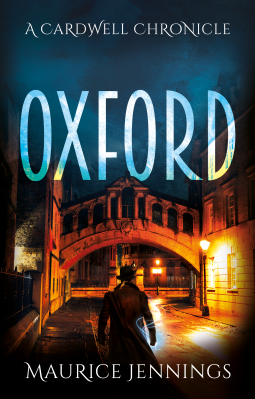
Oxford
A Cardwell Chronicle
This title was previously available on NetGalley and is now archived.
Send NetGalley books directly to your Kindle or Kindle app
1
To read on a Kindle or Kindle app, please add kindle@netgalley.com as an approved email address to receive files in your Amazon account. Click here for step-by-step instructions.
2
Also find your Kindle email address within your Amazon account, and enter it here.
Pub Date Apr 28 2026 | Archive Date May 6 2026
Talking about this book? Use #Oxford #NetGalley. More hashtag tips!
Description
It is 1930, and the world still lingers under a long shadow cast by the Great War, but a new fight is approaching.
Borne from men with dark ambitions, aligned with gods from distant universes, few have the strength to stand against them. For Aidan Cardwell – born in Belfast, raised in Japan, on the cusp of attending Oxford – surviving an assassination attempt and learning that his father was an agent for the King of England was only the beginning.
A Note From the Publisher
Available Editions
| EDITION | Ebook |
| ISBN | 9781806346028 |
| PRICE | £4.99 (GBP) |
| PAGES | 544 |
Available on NetGalley
Available to Buy
Buy on Amazon Buy on BN.com Buy on Bookshop.org Buy on KoboAverage rating from 2 members
Featured Reviews
 Chrysanthi G, Reviewer
What I appreciated most was the reflective tone of the story. It is not rushed or overly dramatic, but instead takes its time to explore the characters and their journeys. There is a sense of growth and self-discovery woven throughout, making it feel more personal than plot-driven.
The writing has a calm, thoughtful rhythm that allows you to settle into the story. It feels like a book you are meant to experience slowly, taking in both the atmosphere and the internal struggles of the characters.
By the end, I felt quietly satisfied. It is a story that focuses on depth rather than intensity, leaving you with a sense of reflection and appreciation for the journey.
 Jeni L, Librarian
Oxford is a reflective, place-centered work that treats the city less as a backdrop and more as an evolving intellectual and architectural organism. Maurice Jennings approaches the subject with an architect’s sensibility, emphasizing structure, continuity, and the layered accumulation of history that defines the city’s character.
The book’s greatest strength is its attention to atmosphere and form. Rather than presenting Oxford as a simple collection of landmarks, it examines how spaces interact—how courtyards, spires, streets, and institutions collectively shape a sense of identity that is both physical and cultural. This creates a reading experience that feels contemplative and observational rather than purely informational.
Jennings’s perspective brings clarity to the built environment, highlighting proportion, materiality, and spatial relationships in a way that will particularly appeal to readers interested in architecture or urban design. The writing often encourages slow looking, treating the city as something to be understood through repetition, variation, and detail.
Because of this focus, the book is more meditative than narrative-driven. Readers expecting a conventional travel guide or historical chronology may find it less structured in that sense, as it privileges impression and analysis over linear storytelling.
Overall, Oxford is a thoughtful, visually attentive exploration of place that succeeds in capturing the layered identity of a historic city through an architectural and observational lens, offering a calm and immersive study of how environments shape meaning over time.