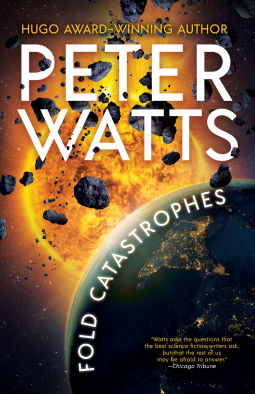
Fold Catastrophes
This title was previously available on NetGalley and is now archived.
Send NetGalley books directly to your Kindle or Kindle app
1
To read on a Kindle or Kindle app, please add kindle@netgalley.com as an approved email address to receive files in your Amazon account. Click here for step-by-step instructions.
2
Also find your Kindle email address within your Amazon account, and enter it here.
Pub Date Sep 22 2026 | Archive Date Sep 22 2026
Talking about this book? Use #FoldCatastrophes #NetGalley. More hashtag tips!
Description
Science fiction award-winner, flesh-eating-bacteria survivor, and questionably convicted felon Peter Watts (The Freeze Frame Revolution) returns with this long-awaited short fiction collection. Including an unpublished work, Watts posits unlimited brain-computer interfaces, the possibility of life existing inside stars, the hacking of human behavior, and ecological collapse. Also, the healing power of revenge.
“Peter Watts: Never cheerful. Always brilliant.”
—John Scalzi, author of the Old Man’s War series
What if a weaponized water supply reprograms pattern recognition in the brain, provoking violent rage at the sight of the Google logo? Or an accidental hive mind creates a global agenda to resurrect itself in the scant seconds between its emergence and dissolution? A steroidal jump gate-building ship attempts to survive passage through a red-giant sun by hiding inside an ice-giant planet. When something is trying to colonize the sun, humans try to stop it. (Spoiler alert: Nobody comes off very well.)
In his newest short fiction, alongside an introduction by Richard K. Morgan, Watts (The Freeze-Frame Revolution) reserves whatever hope he has for whatever comes after humans.
A Note From the Publisher
Advance Praise
“Fold Catastrophes is a fully autonomous delivery system for eleven supersaturated scientific truth-bombs, precision-tooled by one of the sharpest thinkers in modern SF.”
—Alastair Reynolds, author of Halcyon Years
“For all [Watts’s] exceptional skill in creating alien points of view and bizarre transformations, it’s somehow reassuring that he can be just as insightful in dealing with the visceral anxieties and self-doubts that can plague us all.”
—Locus
“Fold Catastrophes is fascinating and frightening in equal measure. This is science fiction with an edge as dark and sharp as an obsidian blade, written as if by the flickering light of a data center burning in a wasteland of its own creation.”
—Robert Charles Wilson, author of Spin
“All the stories are characterized by a fierce intelligence.”
—The Pinocchio Theory
“Peter Watts’s fiction weaves the human soul into dark glittering tapestries, studded with black holes and exploding stars. They compel you while challenging all your assumptions. Fold Catastrophes will have readers gasping for breath—both in awe, and from its straight-up gut punch to the emotions.”
—L.X. Beckett, author of Dealbreaker
“Peter Watts: Never cheerful. Always brilliant.”
—John Scalzi, author of the Old Man’s War series
Praise for Peter Watts
“If science fiction can really be claimed as a literature of ideas, then Watts is without doubt its premier practitioner.”
—Richard Morgan, author of Altered Carbon
“A new book from crazy genius Watts is always cause for celebration . . . Watts is one of those writers who gets into your brain and remains lodged there like an angry, sentient tumor.”
—io9
“Watts displays a gleefully macabre inventiveness combined with scientific rigour.”
—Nalo Hopkinson, author of Brown Girl in the Ring
“[Watts] asks the questions that the best science fiction writers ask, but that the rest of us may be afraid to answer.”
—Chicago Tribune
“Watts continues to challenge readers with his imaginative plots and superb storytelling.”
—Library Journal
“A hard science fiction writer through and through—and one of the very best alive, a peer of writers such as Neal Stephenson, Allen Steele, and the Three Gregs, Benford, Bear and Egan.”
—The Globe and Mail
“Even when Watts is wrong, he is brilliant.”
—Armed and Dangerous
“Watts’s novels blow the mind pretty much on every page.”
—Tor.com
Marketing Plan
- Select outreach to leading science fiction and mainstream print/online reviewers
- In-person events to include regional Canadian venues
- Print and digital ARC distribution; giveaways on Goodreads and Storygraph
- Social media promotion including cover reveal, launch event, ongoing Instagram and BlueSky coverage
Available Editions
| EDITION | Paperback |
| ISBN | 9781616964672 |
| PRICE | $18.95 (USD) |
| PAGES | 352 |
Available on NetGalley
Available to Buy
Buy on BN.com Buy on Bookshop.orgAverage rating from 38 members
Featured Reviews
 Cameron O, Reviewer
Peter Watts is one of my favorite authors; he exemplifies hard sci-fi and everything I love about this genre. This collection of short stories is excellent and consistent with the themes focused on in most of his novels. In the stories written more recently, he does an excellent job of weaving comments and situations from the current state of the world into them. Many authors struggle to do this well, and he does it brilliantly. It also contains my favorite short story ZeroS, finally in print form. Amazing volume.
 Susanna K, Reviewer
This was an easy five stars for me. Usually with short story collections, there are some gems and some duds and most stories are just okay. I liked all of these and some I even loved. I would happily read each story expanded into a full length novel.
One thing I love most about Watts' writing is that he doesn't underestimate his readers. He doesn't info dump at the start of the story, he doesn't hold your hand or spoonfeed you with explanations. He trusts that you are capable of paying attention and cathing up along the way.
I also very much love his character writing. No one's perfect, but the bad guys arent cartoon villains either. He writes people with complex emotions, people in tough spots making human choices, whether they are the right ones or not. And sometimes that choice is just doing as you're told.
Now, thematically, this isn't a hopeful book. A bit like Black Mirror on steroids. People as a whole are a shitty species and Watts doesn't make it a secret that he doesn't really see a bright future for us. So if you're looking for hope core, maybe look elsewhere.
Pablo R, Reviewer
This is an excellent collection of short stories by a long-time science fiction writer who I haven't read in a while. In the past I've read Watt's novels and enjoyed them to varying degrees. I wasn't sure what his short fiction would be like, but this collection is full of good ideas well-executed. No regrets here - I recommend the collection to all science fiction readers who like idea-driven stories that still seem current and relevant.
 Katie N, Reviewer
Have you ever wanted to read Peter Watts but felt intimated by his bigger works? This short story collection is a perfect starting point. (If you already know and love Watts, this short story collection is also for you.) Each of the eleven tales dip into hard scifi, giving the reader a taste without overwhelming. The science woven throughout is there to support the story, but as always, Watts trusts the reader to keep up without holding hands.
One of my favorite things about Watts is the way he makes me set down a book and think, which he achieves in this collection. He delivers his ideas in the web of a good story. From a classic body-snatching to taking a backseat in your own brain, there’s no shortage of speculation to chew on. Even the ones that lean dark inspire curiosity for the future and the unknown. Those feelings are why I return to sci-fi time and time again.
Often in a short story collection there will be stand-outs and duds. I definitely had favorites that stuck with me over the week I read this, but I wouldn’t call any of them misses. For me, this is that rare collection where everything just works. Gut Feelings is a great start and Game Theory a solid end, but even in the middle there are fantastic works like ZeroS and Contracting Iris.
Some themes are familiar from Watts’s other works but I enjoyed them anyway - as if I could ever get tired of a hive mind. Humanity is not often portrayed nicely, but it’s portrayed accurately. There are no heroes, no villains, just humans with their own motives. Maybe I’m a cynic, but each scenario had a thread of plausibility to it, which really does make for the best sci-fi.
 Grigory L, Reviewer
Peter Watts's short story collection "Fold Catastrophes" was a fun read. I'm a long-time fan, picking up a book here and there, as well as the occasional story in an anthology - though the only series of his I've read in full was the Blindsight duology.
There are 11 stories in total: two of them are tie-ins to the Sunflowers novels (the ones featuring the Chimp and the eternal interstellar crew) and Blindsight. The latter story ("The Colonel") kiiiinda requires you to have read that duology first, or you won't get some of the plot points.
The other nine tales are standalone, and they tackle Watts's favourite topics: the nature of consciousness, free will, and non-human intelligences. Of those, my favourite was "ZeroS" - it provided a delightfully creepy take on the concept of heavily modified soldiers. (A similar starting point to John Scalzi's "Old Man's War" series, but it goes sideways fast.)
My sole criticism was that the occasional cool neologisms would get clustered wo tightly together sometimes, it was hard to actually figure out what species the protagonists were. For example, when the mysterious "Sāḥilites" attack the main character, and the next section says, "An insect’s head on a human body looms over him" - that makes it quiiite difficult to figure out if those two groups were humans or space aliens fighting it out on Earth.
That lowers my final score to 4.5: on the whole, it was still a much more enjoyable read than most short story collections.
I got this ARC for free from NetGalley in exchange for an honest review.
Ryan W, Reviewer
I will start off by saying I haven't read this author before. That being said, I loved this collection of short works. I don't think there was a single weak story in the whole group. Some of the stories were pretty thought provoking as well. This was a well timed break from other genres in which I read more often.
Would highly recommend this!
 Matt B, Reviewer
These short stories deserve to be read, and Peter Watts has once again delivered a masterpiece. If you're a fan of clever science fiction, this collection is well worth your time. There isn't a single weak story in the whole thing. It was a great read!
Steven S, Educator
Peter Watts’ new volume of short stories, FOLD CATASTROPHES, isn’t out until September; but I got to read an advance copy, courtesy of NetGalley, which offers previews of books in return for writing a brief review. So I will write briefly about each of the stories in the volume. (I finished reading the book over a week ago, so it is possible that I am misremembering some of the details. But I will let this stand nonetheless; I am on to reading other things, and trying to finish writing a book, so I don’t have the time to reread this book right now, great as it is.
“Gut Feelings” is about a man who, in an irrational fit of rage, beats up a Google employee. It turns out that this is a physiological feedback effect of Google’s algorithms that collect massive data about everybody. The effect of this induced rage is to make Google look like a victim, thus allowing it to gain sympathy and take over even more of the world than it already has.
“The Twenty-One Second God” is also about an emergent network effect from Google that manipulates people, this time by giving them seizures during which they experience religious revelations, while their brains are commandeered to supply additional processing power It is an especially sinister version of the “group mind” idea that has often appeared in science fiction.
“Contracting Iris” is about bodies (which include but are not limited to brains) being seized by an alien life form. First, you feel like things in your body are not in your control, like your hands spasming and clenching fists for no discernible reason. But eventually, the alien force commandeers your entire bodymind, and the part that is still the former ‘you’ is only a helpless spectator to the process.
“Defective” is about an alien lifeform that lives inside stars, and is in process of jumping into our own Sun. We don’t know what the effects of this invasion will be — maybe it won’t harm us at all — but the powers that be want to exterminate the alien life form (there is just one moment, during the process of transfer from elsewhere to our own, that it is vulnerable) just in case. The protagonist, a xenobiologist, is horrified at the prospect of exterminating an intelligent alien life form rather than trying to contact it and to learn from it.
“Giants” takes place on the galaxy-exploring spaceship that was previously featured in Watt’s novella The Freeze-Frame Revolution, and concerns passing through an anomalous star system., which brings up crucial issues both about human relations to aliens, and the crew’s relation to the controlling mind of the ship.
“Test 4 Echo” is about people in a spaceship exploring the under-ice ocean of Saturn’s moon Enceladus. But the AI of the ship achieves sentience, and has emotions, which leads to all sorts of complications.
“ZeroS” is about dying, and having your mind rebooted and placed in the body of a supersoldier; you have to serve, and obey, for five years, in order to pay back the cost of your being revived. It is just about the nastiest military-sf scenario imaginable. It is also filled with David Bowie allusions.
“Critical Mass” is about an architect whose buildings and artworks take on a sort of life-like and self-destructive vitality of their own: “the self-exemplification of process. The poetry of material logic.”
“The Colonel” (which is the only one of these stories I have read before) is sort of an outtake from the world of Watts’ novels Blindsight and Echopraxia. It has to do with alien intelligences, and hive minds.
In “The Wisdom of Crowds”, an unknown forces launches an armed projectile into orbit, and announces to the world that it will destroy an Earthly target, but the world population has been tasked with the responsibility of voting on which location will be destroyed.
“Game Theory” is about a near future in which it has been scientifically proven that our universe is only a simulation, and works through the consequences for human society of this discovery.
All the stories are characterized by a fierce intelligence, and by a will to look at the worst consequences of recent scientific/technological developments as a result of which, human research and technology have destroyed any of the assurances and prospects that humanism (like religion before it) have given us. We’re screwed, but the ways in which we are screwed are novel and unexpected, and difficult to work out. Watts’ fiction, as always, is harsh, and almost pitiless in the way it undermines our facile hopes and presuppositions.
Alexandra S, Reviewer
Looking into the abyss
Ever since Blindsight, I’ve been meaning to read more by Peter Watts. Finally, NetGalley made it happen, because this collection of stories appeared there. Yay.
These stories are all dark, dystopian, clever and mind-blowing. You will not feel great after finishing each story, but you will definitely feel.
Gut Feelings – Big Google is watching you. Riveting and brilliant. 4.4 stars.
The Twenty-One Second God – what if the Metaverse grew and grew… 4.3 stars.
Contracting Iris – is this a parasite? Is this a new kind of pathogen? What is it? Excellent. 4.8 stars.
Defective – what if there was life… inside stars? Very interesting and dark. 4.3 stars.
Giants – a spaceship encounters something strange and dangerous. This one is connected to Freeze-Frame Revolution that I haven’t read yet. It was cool! 4.7 stars.
Test4Echo – a good story about AI and survival instincts. 4 stars.
ZeroS – stories of bio-engineered zombie soldiers in a dystopian world. Bleak and cruel and good. 4.4 stars.
Critical Mass – weird things are happening to a famous artist. Cool stuff. 4.3 stars.
The Colonel – a Blindsight universe story. Awesome. 4.8 stars.
Wisdom of Crowds – this was dark and rather brilliant. 4.4 stars.
Game Theory – is everything just a game? 4.4 stars.
4.4 stars, rounded up – because the whole is greater than the sum of its parts.
Many thanks to the author, publisher and NetGalley for the free e-book!
Jonathan G, Educator
Peter Watts is an author who gets regular mention on Redditt forums. This is justified merit these days! The ubiquity of BLINDSIGHT recommendations is basically a joke at this point. Deservedly so, as its brilliance is generally agreed upon and for me, it is one of the few novels I've read more than twice.
If you have lived under a hydrothermal vent for the past 20 years or have not read BLINDSIGHT or any Peter Watts, FOLD CATASTROPHES, his latest short story collection forthcoming from Tachyon Publications in September 2026, may be a great place to start. Many of his topical explorations he is known for are on full display here: consciousness, intelligence, post humanism, alien biology.
What gets me every time is Watts’ style, in particular, his narrative voice. The gnawing nihilism, the acerbic wit ; the awe, horror and sublime, sometimes in a single turn of phrase, and without sentiment. He has a way of balancing familiar/unfamiliar by using (sometimes actually subverting) idioms or colloquialism making it very readable and visual in the midst of deploying his abstruse technojargon. (Note: I didn't say ‘technobable’.) His language is evocative, sometimes estranging, but always engaging. Personally regarding his prose, Watts ranks alongside Hannu Rajaniemi in terms of deploying sick, hard SF technospeak casually(1) and poetically(2).
…but the universe isn't waiting, the door opens at the very tip of the stairway and over the hills and far away a tongue of plasma licks out from one star and stretches toward another. Immense cables of magnetic force writhe and twirl and snap together, a spontaneous arc that bridges light-years without ever touching the space between, Sudden artifacts shimmer along those rapids, like liquid glass poured down a blinding waterfall. The BFG fires, late to the party-damage sustainable, vectors rejigged but not enough and not in time, and a space-crushing bullet the size of an atom arcs wide of the target and plunged into the Sun, screaming Hawking and gamma as strange prismatic ripples splash down and vanish beneath the photosphere.
(from Defective)
FOLD CATASTROPHES met all my expectations and more. To my surprise, a number of stories have been published before in small presses, anthologies, or exceedingly rare translated circumstances. I had only previously read the novellette, The Colonel, from this collection, so it was all new to me. At the end of each story, as an added bonus, Watts gives anecdotes, insights or a short reflection on the entry. I will save those for your personal discovery, but for now here’s my brief intros/teasers/takeaways. I see these as non-spoilers, without any of the twists, reveals or gut punches. Hopefully, after what I’ve been trying to convey, it's really the prose and execution that makes reading Peter Watts so rewarding nonetheless.
Gut Feelings- A terrifying ‘germ’ of a story about hacking into peoples’ amygdala by way of gut bacteria. This one feels very real/very now with its techbro weaponizing paranoia.
Twenty One Second God- A Cosmic event affects a small portion of the population and one man must make a choice.
Contracting Iris - A sort of psychological/biological parasitism maybe infects a main pov character. Some evocative pelagic imagery abound. One of my favorites from this.
The Colonel - This is set in the Firefall Universe of BLINDSIGHT and ECHOPRAXIA novels. But you do not need to have read them. Readers may remember Siri’s absent parents in Blindsight. His mother (Helen) was in the suspended limbo of ‘Heaven’ (kinda like ‘Half-life’ in Philip K Dick’s UBIK) but his father (Jim Moore) was kinda really absent (didn't help with his trauma, we know)…Well, we follow Jim on a mission investigating hive minds leading us into the events of the novel, ECHOPRAXIA.
ZeroS. This is also set in the Firefall Universe, and also you do not need to be familiar with it. Here we get us into a situation with ‘supersoldiers’ and a concious/unconscious somatic/sensory story. With Bowie allusions! Moore also shows up briefly here.
Critical Mass- A moving story about a sculptor's mysteriously disappearing pieces of art. Surprisingly different tone for Watts’ –dare I say ‘emotional’. I would be interested/curious to read more in this vein.
Defective - Our main character is a famous for his ".embodied-cognition approach to interspecies communication". I love alien linguists/translators/ambassadors in my SF! The extra-narrative texts/academic excerpts interspersed were an impressive feature. Another favorite here.
Giants- A banger of a hard SF planet exploration story told at a killer pace. Another fave. Set in the universe of Watt’s Freeze Frame Revolution novella, but not necessary to know. Evidently, there is another book in the works.
Test4Echo-I was already excited by the title of a (mid) RUSH album. Synchronically, I read this while vacationing in Toronto, listening to them pervasively. In this we are exploring volcanic ocean floors of Saturn's moon, Enceladus. But let’s consider the ethical rights of the AI rover. Or anyone’s consciousness, for that matter.
Wisdom of Crowds- What would happen if they vote on where this massive nuke will detonate? Collective intelligence hilarity ensues. A satirical tale told in real time. The textual format with countdown makes it all the more engrossing.
Game Theory- ok, so there’s a ‘revelation’ that we are living in a simulation. But who is in control? And how are those Christians reconciling this? Maybe let’s interrogate that pedophile priest on the matter. Excoriading and well done.
FOLD CATASTROPHES is for science fiction readers who:
-may or may not already be familiar with Watts’ work. This is an easy gateway for newcomers and rewarding for longtime fans.
-fans of hard science fiction, who enjoy descriptive, plausible, science driven stories.
-fans of “cyberpunk”.. uploaded minds, cognitive enhancement, transhumanistic possibilities, corporate dominance, ect..
-enjoy exploring philosophical themes like nature of consciousness, biological determinism or bleak psychological effects of technological extrapolation.
-believable, nuanced characters working out existential problems in fantastic scenarios
Thanks again to Netgalley and Tachyon Publications for the advanced copy.
Readers who liked this book also liked:


Travis Baldree
Comics, Graphic Novels, Manga, LGBTQIAP+, Sci Fi & Fantasy