Please wait... This may take a moment.
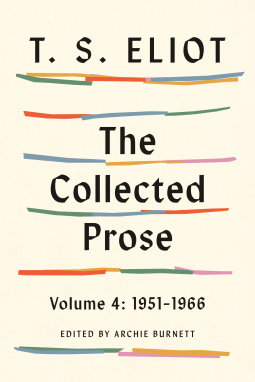
The Collected Prose, Volume 4: 1951–1966
Pub Date
Dec 08 2026
| Archive Date
Jan 08 2027
Description
The definitive edition of the published prose of the Nobel laureate, the most important poet-critic of modern times.
The Collected Prose presents those works that T. S. Eliot allowed to reach print in the order of their final revision or printing. Publishing across four volumes, the series aims to provide an authoritative and clean-text record of Eliot’s approved texts and their revisions, beginning with his formative observations, written while he was at high school, and concluding in his final major opus, To Criticize the Critic, published in the months after his death.
This fourth and final volume covers 1951 to 1966, a period of concluding productivity in Eliot’s writing. Although his poetry was all but complete, his theatrical and critical work flourished through a decade that included such books as Poetry and Drama, The Frontiers of Criticism, and On Poetry and Poets.
The definitive edition of the published prose of the Nobel laureate, the most important poet-critic of modern times.
The Collected Prose presents those works that T. S. Eliot allowed to reach print in...
Description
The definitive edition of the published prose of the Nobel laureate, the most important poet-critic of modern times.
The Collected Prose presents those works that T. S. Eliot allowed to reach print in the order of their final revision or printing. Publishing across four volumes, the series aims to provide an authoritative and clean-text record of Eliot’s approved texts and their revisions, beginning with his formative observations, written while he was at high school, and concluding in his final major opus, To Criticize the Critic, published in the months after his death.
This fourth and final volume covers 1951 to 1966, a period of concluding productivity in Eliot’s writing. Although his poetry was all but complete, his theatrical and critical work flourished through a decade that included such books as Poetry and Drama, The Frontiers of Criticism, and On Poetry and Poets.
A Note From the Publisher
Thomas Stearns Eliot, a poet, critic, and publisher, was born in St. Louis, Missouri, in 1888. He settled in England in 1915, where for a few years he worked in the foreign section of Lloyds Bank. His first book of poems, Prufrock and Other Observations, was published in 1917. In 1922, he became editor of the literary journal The Criterion, publishing The Waste Land in its first outing. In 1925 Eliot was recruited by Geoffrey Faber to be the literary editor and a director of a new publishing house, Faber and Gwyer (later Faber and Faber). It was a role in which he excelled, going on to establish Faber as a leading publisher of poetry with a list that embraced the outstanding English-language poets of the twentieth century. Eliot received the Nobel Prize in Literature in 1948. He continued to work at Faber until his death in 1965.
Thomas Stearns Eliot, a poet, critic, and publisher, was born in St. Louis, Missouri, in 1888. He settled in England in 1915, where for a few years he worked in the foreign section of Lloyds Bank...
A Note From the Publisher
Thomas Stearns Eliot, a poet, critic, and publisher, was born in St. Louis, Missouri, in 1888. He settled in England in 1915, where for a few years he worked in the foreign section of Lloyds Bank. His first book of poems, Prufrock and Other Observations, was published in 1917. In 1922, he became editor of the literary journal The Criterion, publishing The Waste Land in its first outing. In 1925 Eliot was recruited by Geoffrey Faber to be the literary editor and a director of a new publishing house, Faber and Gwyer (later Faber and Faber). It was a role in which he excelled, going on to establish Faber as a leading publisher of poetry with a list that embraced the outstanding English-language poets of the twentieth century. Eliot received the Nobel Prize in Literature in 1948. He continued to work at Faber until his death in 1965.
Available Editions
| EDITION |
Hardcover |
| ISBN |
9780374617035 |
| PRICE |
$50.00 (USD)
|
| PAGES |
864
|
Available on NetGalley
NetGalley Reader
(EPUB)
NetGalley Shelf App
(EPUB)
Send to Kindle (EPUB)
Send to Kobo (EPUB)
Download (EPUB)
Additional Information
Available Editions
| EDITION |
Hardcover |
| ISBN |
9780374617035 |
| PRICE |
$50.00 (USD)
|
| PAGES |
864
|
Available on NetGalley
NetGalley Reader
(EPUB)
NetGalley Shelf App
(EPUB)
Send to Kindle (EPUB)
Send to Kobo (EPUB)
Download (EPUB)
Average rating from 1 member
Featured Reviews
Stetson T, Reviewer
5 stars
5 stars
5 stars
5 stars
5 stars
The fourth volume of Archie Burnett's Collected Prose covers Eliot's emeritus period. All his major accomplishments now lay behind him. Nevertheless, his sharp wit remains. The collection includes essays that repeatedly turn to questions that pre-occupied Eliot throughout his career: literary standards, historical continuity, the formation of taste, and the relation between literature and culture.
The prose work demonstrates a mastery, confidence, and ease that is not as notable in his earlier works. Eliot's characteristic discipline and economy are still there even when he adopts a more conversational tone.
Burnett's editorial approach serves these writings especially well. Presented chronologically, they reveal a remarkable consistency of purpose. Decades after "Tradition and the Individual Talent," Eliot remains preoccupied with tradition. Decades after his earliest reviews, he remains concerned with standards. The continuity is instructive. Intellectual fashions changed around him; his central commitments endured. He still held sway on the syllabi of literary courses in universities in America but a decade or so after his death, this hold would slip. I wish Eliot had managed to find a successor, which, of course, would have been no small feat itself.
Volume 4 lacks the excitement of discovery found in the earliest prose and the wartime urgency of the middle years. Its pleasures are subtler.
Burnett's edition ultimately offers a rare opportunity to watch a major critic at work after the great battles have ended, an Eliotian epilogue. The portrait is distinguished, humane, and deeply learned. Few have expressed thoughts on literature with greater authority.
5 stars
5 stars
5 stars
5 stars
5 stars
Featured Reviews
Stetson T, Reviewer
5 stars
5 stars
5 stars
5 stars
5 stars
The fourth volume of Archie Burnett's Collected Prose covers Eliot's emeritus period. All his major accomplishments now lay behind him. Nevertheless, his sharp wit remains. The collection includes essays that repeatedly turn to questions that pre-occupied Eliot throughout his career: literary standards, historical continuity, the formation of taste, and the relation between literature and culture.
The prose work demonstrates a mastery, confidence, and ease that is not as notable in his earlier works. Eliot's characteristic discipline and economy are still there even when he adopts a more conversational tone.
Burnett's editorial approach serves these writings especially well. Presented chronologically, they reveal a remarkable consistency of purpose. Decades after "Tradition and the Individual Talent," Eliot remains preoccupied with tradition. Decades after his earliest reviews, he remains concerned with standards. The continuity is instructive. Intellectual fashions changed around him; his central commitments endured. He still held sway on the syllabi of literary courses in universities in America but a decade or so after his death, this hold would slip. I wish Eliot had managed to find a successor, which, of course, would have been no small feat itself.
Volume 4 lacks the excitement of discovery found in the earliest prose and the wartime urgency of the middle years. Its pleasures are subtler.
Burnett's edition ultimately offers a rare opportunity to watch a major critic at work after the great battles have ended, an Eliotian epilogue. The portrait is distinguished, humane, and deeply learned. Few have expressed thoughts on literature with greater authority.
5 stars
5 stars
5 stars
5 stars
5 stars