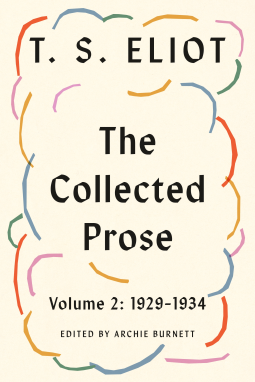
The Collected Prose, Volume 2: 1929–1934
with Archie Burnett (Editor)
Sign In or Register Now to see if this title is available for request.
Buy on BN.com Buy on Bookshop.orgSend NetGalley books directly to your Kindle or Kindle app
1
To read on a Kindle or Kindle app, please add kindle@netgalley.com as an approved email address to receive files in your Amazon account. Click here for step-by-step instructions.
2
Also find your Kindle email address within your Amazon account, and enter it here.
Pub Date Dec 8 2026 | Archive Date Dec 9 2026
Description
The definitive edition of the published prose of the Nobel laureate, the most important poet-critic of modern times.
The Collected Prose presents those works that T. S. Eliot allowed to reach print in the order of their final revision or printing. Publishing across four volumes, the series aims to provide an authoritative and clean-text record of Eliot’s approved texts and their revisions, beginning with his formative observations, written while he was at high school, and concluding in his final major opus, To Criticize the Critic, published in the months after his death.
This second volume spans 1929 to 1934, a period in which Eliot’s poetry was maturing into the reflective verse of Animula, Ash Wednesday, and Marina. It was also a moment that confirmed his critical reputation with the publication of Selected Essays, reprinting and revising his most important essays on tradition and the individual talent, Hamlet, Marvell, and Dante, and culminating in the Harvard lectures that became The Use of Poetry and the Use of Criticism.
A Note From the Publisher
Available Editions
| EDITION | Other Format |
| ISBN | 9780374616953 |
| PRICE | $60.00 (USD) |
| PAGES | 912 |
Available on NetGalley
Available to Buy
Buy on BN.com Buy on Bookshop.orgAverage rating from 1 member
Featured Reviews
 Stetson T, Reviewer
Archie Burnett's The Collected Prose, Volume 2: 1929–1935 captures T. S. Eliot at a watershed moment in his intellectual development. If the first volume chronicled the emergence of the poet-critic who transformed literary modernism, the second records the maturation of a thinker increasingly concerned with the relationship between literature, religion, and civilization. The years covered here include the aftermath of Eliot's conversion to Anglo-Catholicism and the period in which he became one of the most influential cultural critics in the English-speaking world.
What is striking is the continuity between Eliot's literary criticism and his broader social reflections. Some readers sometimes imagine that the later Eliot abandoned criticism for religious and cultural commentary. Burnett's collection demonstrates otherwise. Eliot's essays on poets, dramatists, and critics remain exercises in close judgment, but they increasingly proceed from the conviction that literature cannot be separated from the moral and spiritual assumptions of a society. Questions of literary value become questions of cultural health.
The volume includes some of Eliot's most important criticism, particularly his essays on the metaphysical tradition, the Elizabethans, and the nature of poetic drama. Throughout, Eliot remains a critic of remarkable discrimination. His prose combines historical learning with his deep capacity for evaluative judgment, continually asking both what a work means but why it matters.
At the same time, the collection reveals a more reflective and less polemical Eliot than the youthful critic of The Sacred Wood. The iconoclast of the 1910s and 1920s gives way to a writer concerned with continuity, inheritance, and order. The great theme of the volume is culture itself: how traditions are preserved, how civilizations transmit values, and how literature participates in that transmission.
Burnett's editorial work once again serves the material admirably. By presenting Eliot's prose in a coherent chronological sequence, he allows readers to trace the evolution of ideas that would culminate in Eliot's major cultural and religious writings of the late 1930s and 1940s. The collection thus functions not merely as a repository of essays but as a record of a mind responding to the intellectual and political crises of the interwar years.
The chief value of The Collected Prose, Volume 2 lies in its demonstration that Eliot's literary criticism and cultural criticism were never separate enterprises. For Eliot, literature was one of the principal ways a civilization understood itself. Burnett's edition makes that conviction visible on nearly every page. The result is an important volume for understanding the later development of one of the twentieth century's most influential critical minds.