*This page contains affiliate links, so we may earn a small commission when you make a purchase through links on our site at no additional cost to you.
Send NetGalley books directly to your Kindle or Kindle app
To read on a Kindle or Kindle app, please add kindle@netgalley.com as an approved email address to receive files in your Amazon account. Click here for step-by-step instructions.
2
Also find your Kindle email address within your Amazon account, and enter it here.
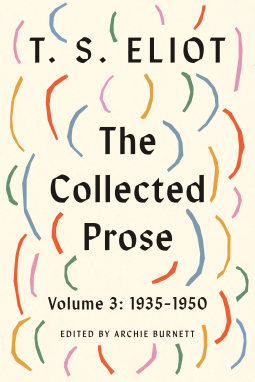
The definitive edition of the published prose of the Nobel laureate, the most important poet-critic of modern times.
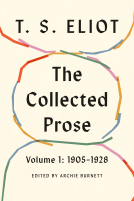
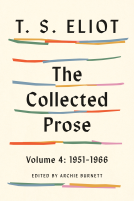
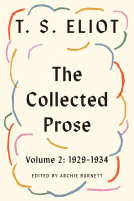
The Collected Prose presents those works that T. S. Eliot allowed to reach print in the order of their final revision or printing. Publishing across four volumes, the series aims to provide an authoritative and clean-text record of Eliot’s approved texts and their revisions, beginning with his formative observations, written while he was at high school, and concluding in his final major opus, To Criticize the Critic, published in the months after his death.
This third volume collects Eliot’s prose from 1935 to 1950, when his works The Idea of a Christian Society and The Music of Poetry would engage the seminal grounds of his Four Quartets, while his Notes Towards the Definition of Culture would appear at the moment he was awarded the Nobel Prize in Literature. It was a period of experimentation in form and genre, in which writings for the theater were taking center stage and he was composing, for the first time for children, Old Possum’s Book of Practical Cats.
The definitive edition of the published prose of the Nobel laureate, the most important poet-critic of modern times.
The Collected Prose presents those works that T. S. Eliot allowed to reach print in...
The definitive edition of the published prose of the Nobel laureate, the most important poet-critic of modern times.
The Collected Prose presents those works that T. S. Eliot allowed to reach print in the order of their final revision or printing. Publishing across four volumes, the series aims to provide an authoritative and clean-text record of Eliot’s approved texts and their revisions, beginning with his formative observations, written while he was at high school, and concluding in his final major opus, To Criticize the Critic, published in the months after his death.
This third volume collects Eliot’s prose from 1935 to 1950, when his works The Idea of a Christian Society and The Music of Poetry would engage the seminal grounds of his Four Quartets, while his Notes Towards the Definition of Culture would appear at the moment he was awarded the Nobel Prize in Literature. It was a period of experimentation in form and genre, in which writings for the theater were taking center stage and he was composing, for the first time for children, Old Possum’s Book of Practical Cats.
A Note From the Publisher
Thomas Stearns Eliot, a poet, critic, and publisher, was born in St. Louis, Missouri, in 1888. He settled in England in 1915, where for a few years he worked in the foreign section of Lloyds Bank. His first book of poems, Prufrock and Other Observations, was published in 1917. In 1922, he became editor of the literary journal The Criterion, publishing The Waste Land in its first outing. In 1925 Eliot was recruited by Geoffrey Faber to be the literary editor and a director of a new publishing house, Faber and Gwyer (later Faber and Faber). It was a role in which he excelled, going on to establish Faber as a leading publisher of poetry with a list that embraced the outstanding English-language poets of the twentieth century. Eliot received the Nobel Prize in Literature in 1948. He continued to work at Faber until his death in 1965.
Thomas Stearns Eliot, a poet, critic, and publisher, was born in St. Louis, Missouri, in 1888. He settled in England in 1915, where for a few years he worked in the foreign section of Lloyds Bank...
Thomas Stearns Eliot, a poet, critic, and publisher, was born in St. Louis, Missouri, in 1888. He settled in England in 1915, where for a few years he worked in the foreign section of Lloyds Bank. His first book of poems, Prufrock and Other Observations, was published in 1917. In 1922, he became editor of the literary journal The Criterion, publishing The Waste Land in its first outing. In 1925 Eliot was recruited by Geoffrey Faber to be the literary editor and a director of a new publishing house, Faber and Gwyer (later Faber and Faber). It was a role in which he excelled, going on to establish Faber as a leading publisher of poetry with a list that embraced the outstanding English-language poets of the twentieth century. Eliot received the Nobel Prize in Literature in 1948. He continued to work at Faber until his death in 1965.
*This page contains affiliate links, so we may earn a small commission when you make a purchase through links on our site at no additional cost to you.
*This page contains affiliate links, so we may earn a small commission when you make a purchase through links on our site at no additional cost to you.
Average rating from 3 members
Featured Reviews
Stetson T, Reviewer
5 stars
5 stars
5 stars
5 stars
5 stars
The third volume of Archie Burnett's Collected Prose series presents T. S. Eliot's prose during the a turbulent decade. Covering the years 1936–1950, the collection spans the approach of the Second World War, the war itself, and its immediate aftermath. Eliot served as a London fire-warden during the Blitz and advocated a middle way between opposing totalitarianism, specifically one of Anglo-Catholicism. It is also the period in which Eliot produced some of his greatest achievements, namely Four Quartets, while maintaining his status as one of the leading cultural and religious voices in Britain, including winning the Nobel prize in literature in 1948.
What distinguishes this volume is the extent to which Eliot's criticism becomes inseparable from the larger question of civilization under pressure. Yet Eliot never abandons the practice of criticism itself. Some of the finest pieces in the volume are his studies of major figures from the English tradition, particularly his essays on poets and dramatists whose work he believed embodied a living continuity of culture. I've always found it edifying to witness how one great writer appraises another. Eliot remains an extraordinarily perceptive reader as he age.
The wartime context gives many of the essays a particular urgency. Eliot writes as a defender of cultural memory at a moment when Europe's intellectual inheritance appeared endangered. His recurring themes (tradition, authority, continuity, and belief) take on greater significance.
Burnett's editorial arrangement, which is chronological, allows readers to follow this development with unusual clarity. The volume demonstrates that Eliot's mature criticism was never just literary. It formed part of a larger effort to understand how culture survives periods of crisis and how great works of literature help preserve a society's moral and spiritual resources. This volume captures Eliot at the height of his authority: poet, critic, editor, religious thinker, and public intellectual.
5 stars
5 stars
5 stars
5 stars
5 stars
Was this review helpful?
Featured Reviews
Stetson T, Reviewer
5 stars
5 stars
5 stars
5 stars
5 stars
The third volume of Archie Burnett's Collected Prose series presents T. S. Eliot's prose during the a turbulent decade. Covering the years 1936–1950, the collection spans the approach of the Second World War, the war itself, and its immediate aftermath. Eliot served as a London fire-warden during the Blitz and advocated a middle way between opposing totalitarianism, specifically one of Anglo-Catholicism. It is also the period in which Eliot produced some of his greatest achievements, namely Four Quartets, while maintaining his status as one of the leading cultural and religious voices in Britain, including winning the Nobel prize in literature in 1948.
What distinguishes this volume is the extent to which Eliot's criticism becomes inseparable from the larger question of civilization under pressure. Yet Eliot never abandons the practice of criticism itself. Some of the finest pieces in the volume are his studies of major figures from the English tradition, particularly his essays on poets and dramatists whose work he believed embodied a living continuity of culture. I've always found it edifying to witness how one great writer appraises another. Eliot remains an extraordinarily perceptive reader as he age.
The wartime context gives many of the essays a particular urgency. Eliot writes as a defender of cultural memory at a moment when Europe's intellectual inheritance appeared endangered. His recurring themes (tradition, authority, continuity, and belief) take on greater significance.
Burnett's editorial arrangement, which is chronological, allows readers to follow this development with unusual clarity. The volume demonstrates that Eliot's mature criticism was never just literary. It formed part of a larger effort to understand how culture survives periods of crisis and how great works of literature help preserve a society's moral and spiritual resources. This volume captures Eliot at the height of his authority: poet, critic, editor, religious thinker, and public intellectual.
This site uses cookies. By continuing to use the site, you are agreeing to our cookie policy. You'll also find information about how we protect your personal data in our privacy policy.
 Stetson T, Reviewer