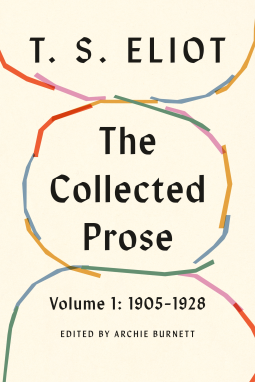
The Collected Prose, Volume 1: 1905–1928
with Archie Burnett (Editor)
Sign In or Register Now to see if this title is available for request.
Buy on BN.com Buy on Bookshop.orgSend NetGalley books directly to your Kindle or Kindle app
1
To read on a Kindle or Kindle app, please add kindle@netgalley.com as an approved email address to receive files in your Amazon account. Click here for step-by-step instructions.
2
Also find your Kindle email address within your Amazon account, and enter it here.
Pub Date Dec 8 2026 | Archive Date Dec 9 2026
Description
The definitive edition of the published prose of the Nobel laureate, the most important poet-critic of modern times.
T. S. Eliot is regarded as the most important poet-critic of modern times, the twentieth century’s man of letters whose reputation was forged not only on the strength of his verse but on the enduring influence of his critical writings.
The Collected Prose presents those works that Eliot allowed to reach print in the order of their final revision or printing. Publishing across four volumes, the series aims to provide an authoritative and clean-text record of Eliot’s approved texts and their revisions, beginning with his formative observations, written while he was at high school, and concluding in his final major opus, To Criticize the Critic, published in the months after his death.
This first volume covers the years 1905 to 1928, a time of dramatic development for Eliot, as both a poet and a critic, that saw the publication of Prufrock and Other Observations, The Waste Land, and Journey of the Magi, and a gathering of his seminal early essays under the title The Sacred Wood. In his penetrating surveys of poetic form and the literary milieu of the day, he assesses the era’s aging giants (Yeats, Swinburne, Henry James) and hails the arrival of its new generation (Ezra Pound, James Joyce, Wyndham Lewis). The volume also traces Eliot’s deepening search for a meaningful response to the trauma of the Great War, and an exploration of religion that led to his confirmation in the Church of England in 1927.
A Note From the Publisher
Available Editions
| EDITION | Other Format |
| ISBN | 9780374616922 |
| PRICE | $60.00 (USD) |
| PAGES | 896 |
Available on NetGalley
Available to Buy
Buy on BN.com Buy on Bookshop.orgAverage rating from 1 member
Featured Reviews
 Stetson T, Reviewer
Few twentieth-century writers have exercised a greater influence on literary criticism than T. S. Eliot. Despite this enormous critical gravity, Eliot's critical reputation has often rested on a relatively small cluster of canonical essays, such as "Tradition and the Individual Talent," "Hamlet and His Problems," "The Metaphysical Poets," and a handful of others repeatedly anthologized and taught. Archie Burnett's The Collected Prose, Volume 1: 1905–1928 performs a valuable corrective. By gathering nearly a quarter-century of Eliot's "published" prose into a single authoritative volume, Burnett enables readers to see both the literary titan and the evolving intelligence behind modern criticism. For the tenacious reader, the collection functions as an intellectual biography in prose.
The volume covers Eliot's development from precocious schoolboy writer to the commanding literary authority of the late 1920s, encompassing the years in which he published Prufrock and Other Observations, The Waste Land, and The Sacred Wood. It presents the texts in the form Eliot himself allowed into print, arranged according to their final authorized versions. Burnett's editorial principle is deliberately conservative: rather than overwhelming readers with textual apparatus, he offers a clean and reliable reading text that foregrounds Eliot's own words and revisions. The effect is to restore a sense of continuity across writings that have too often been encountered as isolated essays.
What emerges most strikingly is the extent to which Eliot's criticism was always an activity of judgment and less a product of theory than some may have assumed. Modern literary studies frequently remembers him as the architect of concepts like tradition, impersonality, the objective correlative, but the prose collected here reveals that Eliot was far more interested in discriminations of value than in systematic doctrine. Eliot's essays are filled with rankings, comparisons, exclusions, and reassessments. He continually asks why one writer matters more than another, why one literary age achieved greatness while another declined, and how standards of judgment might be maintained amid cultural change. What Bill Simmons is to basketball and pop culture, Eliot was for high literature and thought for his age.
This emphasis becomes especially clear in his writings on the nineteenth century. Eliot's reassessments of figures such as Henry James and Algernon Charles Swinburne are meaningful acts of critical revaluation. He approaches literary history as a living order in which reputations remain provisional, which contrasts distinctly with critical debate today. At the same time, he champions contemporaries whose importance was not yet universally recognized, including Ezra Pound, James Joyce, and Wyndham Lewis. The volume thus documents Eliot's role not merely as an observer of modernism but as one of its principal canon-makers.
Perhaps the most rewarding aspect of the collection is the opportunity it provides to trace the gradual formation of Eliot's mature critical positions. Read individually, famous essays can seem like pronouncements delivered from on high. Read chronologically, they appear instead as moments within an ongoing conversation. One sees Eliot testing formulations, revisiting assumptions, and refining distinctions. The celebrated doctrine of tradition, for example, emerges not as a single breakthrough but as part of a sustained effort to understand the relation between individual achievement and historical continuity. The same is true of his insistence on impersonality in poetry, functioning downstream of a demand that emotion be transformed into artistic form.
Burnett's edition also highlights an aspect of Eliot's criticism that admirers and detractors alike sometimes overlook: its extraordinary responsiveness to the immediate literary environment. Eliot's criticism was rarely abstract. It was written amid reviews, controversies, editorial work, and arguments with contemporaries. The collected prose restores the original context of a writer engaged in constant dialogue with the literature of his moment. The reader encounters not only the monumental theorist but also the working journalist and reviewer, responding week by week to new books and emerging reputations.
At the same time, the collection reveals some of the limitations that have complicated Eliot's legacy. His judgments can be narrow, his exclusions severe, and his confidence in cultural hierarchy occasionally excessive. Certain evaluations now appear idiosyncratic or historically contingent. Yet these limitations are inseparable from the strengths of his criticism. Eliot remains compelling because he was willing to make strong judgments and to ground them in explicit standards. Even when one disagrees with him, one is forced to confront the criteria by which literature is valued.
The later portions of the volume acquire additional interest because they document the intersection of literary criticism with Eliot's religious and cultural concerns. By the late 1920s, criticism increasingly becomes a vehicle for broader reflections on civilization, belief, and social order. The movement culminates in the spiritual commitments surrounding his 1927 reception into the Church of England. Readers familiar only with the literary essays may be surprised by how naturally these concerns emerge from the critical project itself. For Eliot, questions of literary form were never entirely separable from questions of culture and moral order.
Burnett deserves considerable praise for making this evolution visible. The edition complements rather than replaces the larger scholarly enterprise represented by The Complete Prose of T. S. Eliot. Whereas the massive critical edition seeks comprehensiveness, Burnett's collection offers something equally valuable: a coherent record of the prose Eliot himself chose to publish and preserve. The result is especially attractive for readers interested in Eliot as a critic rather than as a textual archive.
The greatest achievement of The Collected Prose, Volume 1 is that it restores a sense of movement to Eliot's intellectual life. One finishes the volume with a renewed appreciation of how the most influential critic of literary modernism actually became that figure. It was not through a handful of famous essays, but through years of continuous reading, reviewing, arguing, and revising. Burnett's edition allows us to witness the formation of the poet-critic in real time.
For scholars of modernism it will be indispensable; for general readers, it offers perhaps the best single opportunity to understand why Eliot's criticism shaped the literary culture of the twentieth century so profoundly.