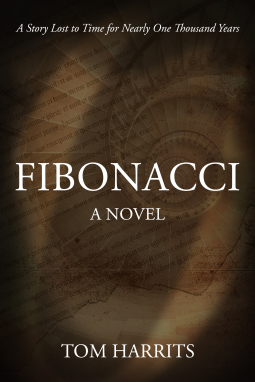
Fibonacci: A Novel
Sign In or Register Now to see if this title is available for request.
Send NetGalley books directly to your Kindle or Kindle app
1
To read on a Kindle or Kindle app, please add kindle@netgalley.com as an approved email address to receive files in your Amazon account. Click here for step-by-step instructions.
2
Also find your Kindle email address within your Amazon account, and enter it here.
Pub Date Oct 13 2026 | Archive Date Nov 30 2026
Talking about this book? Use #FibonacciNovel #NetGalley. More hashtag tips!
Description
Would you change the world forever if no one would remember?
Elegant, thoughtful, and profound. For readers who enjoy vividly researched and deeply reflective historical fiction about the cost of changing the world for all time.
Leonardo Bonacci–Leo–struggles under the weight of his questions and has no idea what to choose. Should he go? Leave his childhood home of Pisa and join his father to live and work on the other side of the world, split from the rest of his family? What if it wouldn’t be safe? Should he stay? When everything at home has come to feel so empty? Yet these are his options, splintering before him. How cruel to leave it to him to decide. What if he chooses wrong?
FIBONACCI tells the groundbreaking story of how this young merchant’s son journeys across continents to find his life’s purpose—and irreversibly changes the world in the process. As he learns the new reality before him, he comes upon a discovery, learned from the very people he was told were his “enemy,” that will lay the foundation for modern math, science, technology, and business as we know it. A new language that will unite humanity through the centuries that follow: the figures 9, 8, 7, 6, 5, 4, 3, 2, 1, and most confounding of all, a new mark his world had never known before, the 0.
Few people today know the story of Leonardo Bonacci, the namesake behind the famed Fibonacci sequence, even though none of our lives would function as they do without him. For he brought the Hindu-Arabic numeral system to the West, a system that has revolutionized the world. This novel breaks nearly one thousand years of silence to reintroduce the man who, before he was lost to time, altered everything.
About the Author
Tom Harrits is a novelist and storyteller who graduated summa cum laude and Phi Beta Kappa from Princeton University with a degree in English literature. His award-winning senior thesis on John Milton's poetic iconoclasm in Paradise Lost was hailed by faculty, with one reviewer proclaiming it "the best undergraduate work" she had ever read. After graduating, Tom moved to Los Angeles to pursue his passion for storytelling in Hollywood, which led him to positions at UTA and Mandalay Pictures, among others. Tom now spends his days writing, performing, and exploring new ways to bring stories to life for global audiences. He is happily married to his wife, Emily, an accomplished entertainment and media Business Affairs executive, who has worked at Disney, Condé Nast, and CAA. They reside in Southern California with their family.
A Note From the Publisher
Paperback and E-Book available October 13th, 2026
Advance Praise
"The author vividly reconstructs medieval life in Pisa, Bugia, and Akka through the concrete details of sensory experience . . . [an] imaginative debut novel with biopic potential."
-Kirkus Reviews
"Tom Harrits breathes pure life into the medieval mystery that is Fibonacci. His sure hand delivers an adventure this misunderstood youth must have experienced on his way to discovering the divine secret that forever changed our Western world."
-Doug Richardson, Screenwriter and Author
"A deep dive into a mind like no other, Fibonacci whisks us into an unimaginable time before numbers as we now know them in the West came to be. I loved exploring a world I knew so little about, thanks to the novel's impeccable research. Who knew the discovery of zero could be so fascinating?"
-Janet Scott Batchler, Screenwriter and Professor of Cinematic Arts at USC
"I was blown away by Tom Harrits' novel. When I tried to describe it to friends, I first compared it to The Odyssey, then finally moved over to Siddhartha. But Leo—Leonardo when he gets older—does something neither of those heroes does: he returns with a boon that changes the world and echoes all the way to us. Stop reading this and start reading the book."
-Flint Dille, Screenwriter and Author
“Leonardo Fibonacci was a man whose mathematical achievements have completely overshadowed his life. We have a few words of autobiography in his Book of the Abacus and very little else to go on. Even his surname was only bestowed on him long after he had died. Tom Harrits has given him a story, fictional but informed by deep research and hence plausible . . . This book is a laudable achievement."
-Dr. James Hannam, Author of God's Philosophers: How the Medieval World Laid the Foundations of Modern Science (shortlisted for the Royal Society Prize for Science Books)
Marketing Plan
Overall Strategy: A comprehensive digital and grassroots campaign focused heavily on historical fiction communities; academic and educational communities, including high schools, colleges, and universities; influential voices in math, science, and technology; independent bookstores; libraries; and media outreach leading up to the October 2026 launch.
Available Editions
| EDITION | Paperback |
| ISBN | 9798996208203 |
| PRICE | $17.99 (USD) |
| PAGES | 303 |
Links
Available on NetGalley
Average rating from 23 members
Featured Reviews
 Amy F, Reviewer
Fibonacci is a beautifully written novel that imagines the life of an incredibly influential yet forgotten figure. Because so little is known about Leonardo "Fibonacci" Bonacci, the author deserves tremendous credit for writing a believable, deeply human portrait of the man who introduced the Hindu-Arabic numeral system to the Western world. The author created Bonacci to be relentlessly curious, constantly searching for meaning in patterns, abhorring black/white thought, and questioning all of reality as he perceives it- all of which seem to paint a pretty realistic picture of how someone with Fibonacci's innate mathematical genius would probably have thought and behaved.
The book follows Fibonacci from his home in Pisa to Algeria, Syria, and Egypt, where he encounters the numeral system we now take completely for granted. Prior to Fibonacci, Western merchants relied on Roman numerals, finger counting, and the abacus to conduct trade, making trade and business incredibly cumbersome and time-consuming. He faces new, revolutionary ideas (like the concept of zero!) and meets them with resistance, but still makes his way home to Pisa, changing business, commerce, and likely the world as we know it.
I also really liked how the author incorporated the origins of the Fibonacci Sequence where it fit into the book. The Fibonacci Sequence is an enigmatic mathematical pattern that appears throughout nature and continues to hold extreme influence in fields ranging from science to finance and even spiritualism. As a day trader who uses Fibonacci retracements and extensions every day, I loved reading how Fibonacci himself would have probably observed the sequences in nature, architecture, and quite possibly even in his own behavior.
Ultimately this book is a very fitting tribute to Leonardo Bonacci, and a reminder that some of history's greatest innovators are also completely forgotten or overlooked.
Thank you to NetGalley, Wandering Steps Media and the author for the advance copy of this book.
 Kyle F, Reviewer
Fibonacci played a significant role in the adoption of the decimal system, which revolutionized business and science in Europe by enabling arithmetic to be performed with incomparably greater efficiency. Yet today we have largely forgotten this major contribution.
Fibonacci is a thought-provoking and thematically deep exploration of the risk inherent in cutting-edge work, the inner turmoil and self-doubt that must be managed to see it through, and the almost spiritual experience of finding the cracks in problems that lead to paradigm shifts. Fibonacci may have died and been forgotten, but he brought forth much fruit. It is high time that we recognize him properly, and Harrits' novel does this with reverence and respect.
 Reviewer 2143542
An unconventional and mysterious window into one of the most influential minds in human history. The narrative resists easy answers, pulling you deeper into its puzzle with every page. It lingers long after the final chapter, begging to be meditated over in the reader's mind for weeks afterwards.
This story trusts the reader to sit with ambiguity rather than spelling everything out, which I am sure will challenge some audiences (in a positive manner). Anyone drawn to stories that reward patience and reflection will find themselves richly rewarded. It is the rare book that feels less like something you finish and more like something you carry with you.
Reviewer 1736917
It's fascinating how much our numerical system and how we conduct business changed over time. In school, Fibonacci has been a fleeting term, heard once, buried deep in unused knowledge after. This book has done a phenomenal job, giving it more substance. To see the journey of Leonardo and numbers had me appreciate the foundation they have provided us nowadays much more.
Aside from the educational aspect, the story did an amazing job at portraying coming of age as well. It was beautiful to watch Leonardo grow up, though I did struggle to connect with the character at some parts of his life.
Overall, I think it's a beautiful historical fiction that does its job well, aside from the limited knowledge there is about the man himself. I learned much while being entertained! 4 stars from me.
Educator 253159
This would make a great family-time read aloud for a homeschooling family...or at least one that loves history, like we did! Set in the 1100s, we learn about numerals, dark ages' commerce, Pisa (including the early days as the tower began to lean), and the musings of a young boy during this time period. It's nothing flamboyant, but it's a wonderful story woven with intricate historic details that children will remember thanks to the story element.
 RHIANNON D, Reviewer
When I first read the synopsis on NetGalley, I was immediately intrigued by the subject matter being that I'm aware of Fibonacci's importance, but I hardly know anything about him. Even though this work is largely fictionalized, which one would have to expect being that these events are all in the 1100s, I was still very curious to gain any understanding of this individual. Tom Harrits's largely succeeds in doing so by his strong characterization of the character Leonardo Fibonacci. The novel reads as a introspective, coming of age journey during a crucial period of Fibonacci's life as he moves away from his childhood home to live abroad with his father to learn the ropes of his business. Leaving his bubble of Pisa exposes Leo to many different kinds of people, particularly Arabs who he comes to witness the discrimination they face from his own kind. Of course, we know from history Fibonacci recognized the brilliance of their numerology system and this would evolve into the Fibonacci sequence we know today. Harrits's choice to tell the story of a figure who bridged conflicting worlds together through the universal language of math is a truly beautiful concept, however, this math is largely not very present in the book which may confuse readers who are expecting Fibonacci's Sequence to play a larger part. The novel is largely character driven and slow paced as it focuses more on the tensions in the world around Leo and his internal struggle with them, rather than the math he is known for. Readers should not expect a particular riveting read plot-wise, but a well-written, character-driven story using Fibonacci's discovery as a metaphor for connecting with those around us despite our differences.
Thank you to NetGalley and publishers for supplying the galley for this book.
 Jan M, Reviewer
This is a well-written literary account of the early life of Fibonacci and how he brought mathematics to the West. The son of a businessman, he reluctantly becomes part of the family concern in the East, forcing him to leave his beloved Pisa. His adventures are cultural, learning to get along in this strange new country, making friends, but there was always something missing in his life, and here he finds it.
Well told, lovely descriptions of a bygone place and time, though I found it slow at times.
Highly recommended historical fiction.
Robin M, Librarian
This is a fascinating historical fiction book about Fibonacci, a mathematician about whom little is known. I have heard about the Fibonacci Sequence, so I was interested in learning more about the man. There is not a lot of factual information about him, so the author has created much from his imagination, hence historical fiction rather than factual nonfiction. Fibonacci was living with his father in Bugia, Algeria, where he encountered other cultures, including Arabs, his enemies. The Arabs are the people who taught him about modern mathematics, concepts he shared with others. He also wrote LIBER ABACI, the BOOK OF CALCULATION. Thanks to NetGalley and Wandering Steps Media for providing an ARC.
David L, Reviewer
Fibonacci
By Tom Harrits
Armed with relatively limited surviving information about Leonardo Pisano—known to history as Fibonacci—author Tom Harrits has crafted a fictional story that plausibly showcases how a single person can change the course of the river of history simply by standing in its flow with a paradigm-shifting idea.
We are given a chair at the table of Leonardo’s heart and mind as, following his father’s footsteps into business, he ends up blazing a trail that will ultimately change the way Western civilization does its collective business.
Emerging from an antiquated commercial system saddled with the cumbersome methods of Roman numerals and calculation, Leonardo encounters in his travels among his nation’s enemies a revolutionary new way of doing the business of business.
The story within the story is an intimate and compelling tale of a boy coming of age, battling doubts while living in the shadow of a good but demanding father. Following that father means leaving his boyhood home of Pisa, Italy, to carve out a place in a foreign “gateway city” to the mysterious East, during an age when crusading armies fought over possession of disputed Holy Lands.
Yet amid those divisions, one language held the city, the region, and much of the civilized world together: the mathematics of business.
As Leonardo sets up shop under his father’s auspices, he ventures into sectors of the divided city where merchants seem to be speaking a mathematical “dialect” he does not recognize. As he forges relationships with “the enemy” in the Arabic quarters, he witnesses the speed and accuracy of their methods. His interest piqued, yet straining against his cultural reservations, Leonardo steps out of his father’s shadow and into the light of opportunity.
But before his discoveries can change the business of the Western world, his own inner world must learn a new language—one of self-confidence and personal differentiation.
The wide-eyed boy who fearfully sailed away from home under the flag of the city-state of Pisa eventually returns, years later, to stand before an emperor with ideas that will help transform medieval Europe and contribute to a mathematical language that would one day take humanity to the moon and human technology to the stars.
It is a story of providence, self-discovery, and unrecognized sea change.
Tom Harrits does yeoman’s work in combining the scant surviving information surrounding a profound—yet largely unappreciated—shift in history with richly imaginative, well-informed storytelling. In doing so, he makes both the man and the history behind the discovery accessible and compelling.
Reading the narrative, I came away feeling, seeing, sensing, tasting, and experiencing the medieval world across distant lands in a way I had never appreciated before. I was equally entertained and educated as I traveled alongside Fibonacci on his life’s journey.
I’m grateful I had the opportunity to make that journey with him through Tom Harrits’ book, and I look forward to reading more from Harrits in the future.
Fran E, Reviewer
“Liber Abaci is one of the most important books on mathematics of the Middle Ages. Its effect was enormous in disseminating the Hindu number system and the methods of algebra throughout Europe…Liber Abaci, or the Book of Calculation, appeared first in 1202…and in a second version in 1228…It was Leonardo’s purpose to replace Roman numerals with the Hindu numerals not only among scientists, but in commerce and among the common people”."The ten numerals of the Hindu number system are presented, including zero, that is called zephir from the Arabic…numbers of any size can be represented with only the ten numerals.”
-Introduction of Fibonacci’s Liber Abaci
Leonardo Pisano’s Book of Calculation
[translated by Laurence Sigler]
“While based on fragments of truth, this novel is fiction…recreated through reading, research, and the error of imagination”
-Tom Harrits, author
Leonardo, the elder son of the Bonacci family was born in Pisa, Italy in 1170. At that time in history, the Pisans had established key shipping ports through the Arno River, securing “direct lifelines into the flow of goods and money from East to West [and back]; shipping lanes, The Silk Road, the intertwining of every tribe and tongue, the wealth of the world.” Guilielmo, Leo's father, was a giant among men, a jovial wordsmith who was instrumental in expanding the “great game of trade and profit” in Pisa. Leo was expected to inherit Guilielmo’s booming business and to this end, he had been instructed in reading, writing and arithmetic. Guilielmo’s fondaco was a trading post where men came to barter and trade, often haggling over prices. Even as the sea receded over time and Pisa became landlocked, Guilielmo’s profit margin had not diminished.
How could goods and services be quantified, priced and converted from one foreign currency to another? Finger counting was used to add and subtract while an abacus was always available. Calculations were prone to error especially when computing large monetary sums.
Advancement opportunities were offered to Guilielmo, a diplomatic post to represent the merchants of Pisa in the Mediterranean port of Bugia, in northeastern Algeria. Risk would be involved in dealing with people from an unfamiliar culture. Leaving for his new post, Guilielmo encouraged Leo to consider joining him in one year's time. Thirteen year old Leo was determined to “glean every last gem of insight from the greatest minds of his trade.”
The novel then morphs into Leo’s coming of age phase with all the indecision a teenager might experience…should he stay at home with his mother and younger brother or travel to his father by sailing vessel with an escort, a trip that included entry into the waters of the Barbary Coast. Friendship had already been a challenge in Pisa. With a lack of certainty and a heavy heart, Leo left his family behind to join his father in Bugia. This life changing decision would place him on a path to puzzle out and embrace a new method of calculation.
Guilielmo was determined to hire a tutor to teach Leo Arabic. Ever curious, Leo wandered down the weaving interconnected streets of the Arab quarter stopping at the window of an Arab customhouse. No finger counting…no abacus…computations were done differently…symbols written out neatly in grids. The customhouse owner eventually agreed to teach Leo the numerology used. “With the nine numbers, carved upon a tablet, any number could be written, any number calculated…one last symbol…untouched by any explanation…a funny, round little symbol, the zephir [the zero]...take it out and none of it seemed to work. Let it fill the spaces between, however, and suddenly it all came to life.” A puzzle…a method to replace the antiquated finger counting in Pisa. Could he convince others of the merits of this computational technique?
The Fibonacci Sequence began with the puzzle of rabbits as per the Liber Abaci.
“A certain man put a pair of rabbits in a place surrounded on all sides by a wall. How many pairs of rabbits can be produced from that pair in a year if it is supposed that every month each pair begets a new pair which from the second month on becomes productive?”
The resulting sequence is 0,1,1,2,3,5,8,13,21,34,55… Each number is the sum of the two preceding numbers. Fibonacci numbers help us see the order, beauty and wonder of our world; the pattern of seeds in flowering plants, the spirals on snail shells.
Fibonacci by Tom Harrits is a wonderful debut novel. Harrits captured the uncertainty, the angst, and the distractibility of Leo’s teenage years. In view of the times in Bugia where the government was often in flux and mistrust was rampant, Leo refused to heed his father’s warnings about personal safety and ventured out to pursue the knowledge imparted by a kind, albeit suspicious customhouse owner, an association that would change business dealings and commerce in early Pisa.
Highly recommended.
Thank you Wandering Steps Media and Net Galley for the ARC in exchange for an honest review.
Readers who liked this book also liked:
Matt Mikalatos; Aaron Burns
Arts & Photography, Biographies & Memoirs, Religion & Spirituality


Radio City Entertainment
Arts & Photography, Cooking, Food & Wine, Professional & Technical