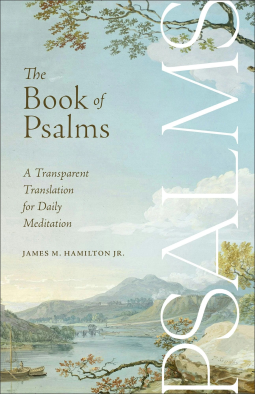
The Book of Psalms
A Transparent Translation for Daily Meditation
This title was previously available on NetGalley and is now archived.
Send NetGalley books directly to your Kindle or Kindle app
1
To read on a Kindle or Kindle app, please add kindle@netgalley.com as an approved email address to receive files in your Amazon account. Click here for step-by-step instructions.
2
Also find your Kindle email address within your Amazon account, and enter it here.
Pub Date Sep 1 2026 | Archive Date Oct 2 2026
Talking about this book? Use #TheBookofPsalms #NetGalley. More hashtag tips!
Description
The psalms are the inspired prayers and praises of God's people. When we study and pray them, they change us--we are shaped by Scripture to think about God the way the psalmists did, and their words become the overflow of our hearts. But much of what makes the psalms so powerful is embedded in the structure and artistry of the original Hebrew--features that most English translations, by rendering the psalms according to the conventions of English poetry, inevitably obscure.
This translation takes a different approach. Intentionally literal and transparent to the underlying Hebrew, James M. Hamilton Jr.'s rendering lets the structure of the original show through--allowing readers to encounter the psalms' language and form in ways most English translations don't permit. Rather than smoothing the Hebrew into fluent English verse, Hamilton holds back and lets the poetry speak on its own terms, preserving and displaying the features that define it:
● Repetition--the deliberate recurrence of words and phrases that creates emphasis and rhythm in Hebrew verse
● Parallelism--the matching or contrasting of lines that is the defining feature of Hebrew poetry
● Symmetry and contrast--the balanced structures that give individual psalms their shape and coherence
● Amplification--the movement from statement to expansion that deepens meaning across a psalm's arc
The result is a translation designed for pastors, students, and serious lay readers who want to peer into the actual words of the psalms and understand how they work.
This new and distinctive translation is ideal for those who, like the blessed man of Psalm 1, aspire to meditate on God's Word day and night--and want to do so with greater fidelity to the words the psalmists actually wrote.
Available Editions
| EDITION | Other Format |
| ISBN | 9781540905994 |
| PRICE | $19.99 (USD) |
| PAGES | 224 |
Available on NetGalley
Available to Buy
Buy on BN.com Buy on Bookshop.orgAverage rating from 4 members
Featured Reviews
 Ian A, Reviewer
I've been praying the Psalms everyday now for the last few years, too many to count. I love just stepping into them everyday. Sometimes, I use some sort of devotional like Brian Simmons one (which is very good) or simply grab a relevant psalm for the mood I'm in for that particular day.
I grabbed this Book of Psalms from NetGalley not quite sure what I'd be getting but it's simply that: a book of Psalms. All 150 of them. Hamilton believes he's rendered the closest interpretation of the Hebrew translation. I'm enjoying them as I simply read/pray a few each day. I'm now at Psalm 30.
I appreciate the use of 'Yahweh' instead of 'Lord' even though I often revert back to Lord when I pray a psalm because that's what I'm used to. I like the more layman language used so, for example, 'guts' used instead of whatever more formal word might be used in other versions.
Even though I'll always be a big fan of Peterson's Message version, I'm appreciating Hamilton's translation in drawing me closer to the Lord as I pray each one.
I received an early ebook copy from the publisher via NetGalley, however, this has had no bearing on my review.
 Mila R, Reviewer
I don't think I've ever read a book quite like this because, obviously, the Psalms are something so many of us have encountered before, but reading them in this particular translation gave me a slightly different perspective.
What I really appreciated about James M. Hamilton Jr.'s approach is that he tries to stay close to the original Hebrew poetry, keeping things like repetition, parallelism and the structure of the Psalms rather than simply turning them into polished English poetry. It made me slow down and actually pay attention to the wording and patterns instead of just reading through them.
The Psalms themselves cover so many different emotions, praise, fear, grief, anger, hope, trust and gratitude, and I think that's one of the things that makes them so comforting. You can be having a completely different kind of day and somehow find words in the Psalms that meet you exactly where you are.
This isn't necessarily something I'd pick up to read quickly from cover to cover. For me, it's much more of a book to take slowly, read a Psalm at a time, reflect on it and perhaps come back to certain passages again and again.
Overall, I think this is a really interesting translation for anyone who wants to spend more time with the Psalms and understand not just what they say, but how their original poetry works. A beautiful one to have on the shelf and return to whenever you need it.
 joyce l, Reviewer
Those who are unfamiliar with the Psalms or those who are interested in a new, often literal, translation of them, may want to give this title a look. Those who study the Bible, will decide if they think this translation does them justice. However, in my opinion, you don't have to be religious to want to see what these ancient texts say. They are often quoted and some familiarity with them is part of a broad education.
Many thanks to NetGalley and Baker Books for this title. All thoughts are my own.
 Jon E, Reviewer
The author translated the Psalms into English in as literal and readable as he can as an aid to see the connection within the Psalms better. Two key point to highlight: 1. his verse number follows the Hebrew text, and 2. he uses Yahweh in his translation which I strongly agree with. If God gave us his name and wants us to use it, I believe it is not wrong to speak it. However, the author included a note that if this is jarring for you, you can read it as Lord instead of Yahweh.
Readers who liked this book also liked:


Richard S. Lytle
Business, Leadership, Finance, Christian, Nonfiction (Adult)
Martin Reeves; Christian Stadler; Julia Hautz; Hamad Buamim
Business, Leadership, Finance, Nonfiction (Adult)

Robert Fisher
Business, Leadership, Finance, Health, Mind & Body, Self-Help


We Are Bookish
General Fiction (Adult), Romance, Women's Fiction