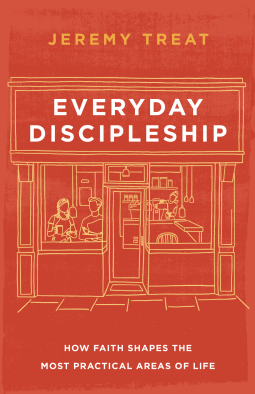
Everyday Discipleship
How Faith Shapes the Most Practical Areas of Life
Sign In or Register Now to see if this title is available for request.
Buy on Amazon Buy on BN.com Buy on Bookshop.orgSend NetGalley books directly to your Kindle or Kindle app
1
To read on a Kindle or Kindle app, please add kindle@netgalley.com as an approved email address to receive files in your Amazon account. Click here for step-by-step instructions.
2
Also find your Kindle email address within your Amazon account, and enter it here.
Pub Date Oct 20 2026 | Archive Date Nov 19 2026
InterVarsity Press | IVP
Talking about this book? Use #EverydayDiscipleship #NetGalley. More hashtag tips!
Description
The gospel is not meant to make us hyperspiritual. It's meant to make us fully human.
Do you love Jesus but struggle to connect your faith to your daily work, hobbies, relationships, and everyday decisions? Many of us havebeen shaped by an understanding of discipleship that's focused primarily on "spiritual things" like reading Scripture, praying, and going to church. We might view the "secular" parts of our lives as neutral at best, or dangerous distractions from what's truly important at worst.
You might have questions:
- Does God care about my work?
- Are hobbies a waste of time?
- Does it matter what I eat?
- Does my body matter as much as my soul?
- Is it okay for Christians to experience anxiety or depression?
Pastor Jeremy Treat understands this disconnect. In Everyday Discipleship, he dismantles the harmful sacred-secular divide that leaves many Christians feeling spiritually compartmentalized, uncertain about how faith applies to ordinary life, and unable to fully enjoy Christ in the entirety of our lives.
This practical, transformative book reveals how following Jesus encompasses every sphere of our existence, from the meals we eat to the work we do, from our engagement with technology to our approach to relationships. The included discussion guide helps groups dig deeper and put these ideas into practice.
Explore how faith in Jesus shapes the most practical areas of your life:
- Daily activities like meals, work, rest, and play
- Engagement with society through technology, art, science, and politics
- Personal matters like the body, mental health, sexuality, and relationships
Trade a compartmentalized mindset for a holistic understanding of discipleship that is rooted in the good news of Jesus. The mundane, often-overlooked parts of life can become infused with meaning and purpose as you learn to follow Jesus even in those areas. With Everyday Discipleship, begin to fully embrace your ordinary life to the glory of an extraordinary God.
Available Editions
| EDITION | Other Format |
| ISBN | 9781514014349 |
| PRICE | $19.99 (USD) |
| PAGES | 192 |
Links
Available on NetGalley
Available to Buy
Buy on Amazon Buy on BN.com Buy on Bookshop.orgAverage rating from 8 members
Featured Reviews
 Bianca O, Reviewer
Jeremy Treat's Everyday Discipleship is one of those books that continually pushes the reader to ask whether they have unintentionally divided their life into "spiritual" and "non-spiritual" categories. The central message of the book is that discipleship is not something Christians do during church services, Bible studies, or quiet times alone; it is the way we live every aspect of our lives under the lordship of Christ. Work, rest, relationships, sexuality, hobbies, finances, suffering, beauty, and community all fall under Jesus' authority.
One of the earliest quotes that stood out to me was: "The all-encompassing dominion of Christ must extend to our work, play, rest, hobbies, sexuality, finances, and every other aspect of our lives." This theme runs through the entire book. Treat continually reminds readers that the question is not whether Jesus is Lord, but whether we are actually living as though He is. I appreciated that the book was practical without becoming shallow. Rather than simply offering life advice, it consistently rooted its applications in theological truths.
A particularly helpful section was Treat's discussion of vocation and work. His statement that "work is not a break from discipleship; it is discipleship" challenges the common tendency to see ministry and ordinary employment as separate categories. Likewise, his observation that vocational discipleship asks not, "Am I doing Christian work?" but rather, "Am I working as a Christian?" was both simple and profound. It shifts the focus away from job titles and toward faithfulness.
Another aspect of the book that I appreciated was its emphasis on delight. Treat notes that people often focus on God's prohibition of one tree in Eden while overlooking His invitation to enjoy all the others. That observation struck me because it highlights God's generosity rather than reducing Christianity to a list of restrictions. A similar theme appeared in his reflections on beauty. One of my favourite quotes from the book was: "Beauty has a way of slowing us down, opening us up, and reminding us that the world is more than utility and efficiency." As someone who deeply appreciates beauty, this resonated with me. In a culture obsessed with productivity and usefulness, it was refreshing to be reminded that beauty itself points us toward God.
The strongest sections of the book, however, were those dealing with community and relationships. Treat repeatedly argues that discipleship is fundamentally communal rather than individualistic. His claim that "the local church is the primary context for discipleship" appears throughout the book in different forms. Again and again, he returns to the truth that following Jesus was never intended to be a solitary journey.
Many of the quotes I highlighted came from these chapters. For example:
"You were not made to navigate desire, loneliness, faithfulness, or suffering on your own. Following Jesus has always been a communal way of life."
"We cannot grow in Christ apart from relationships. Discipleship is not merely an individual journey with Jesus; it's a shared life with God's people."
"To belong to Christ is to belong to His people."
I especially appreciated his discussion of emotional and mental health. His point that isolation often intensifies suffering while healthy relationships contribute to healing felt both biblically grounded and pastorally wise. One of the most memorable passages in the book was his argument that we are wounded in relationships and therefore often experience healing through relationships as well. Importantly, he clarifies that this does not necessarily mean reconciling with the same people who caused harm, but rather entering into healthy, grace-filled relationships where restoration can occur. That nuance was important.
His comments on vulnerability were also insightful. The line, "You can be impressive, or you can be known, but you can't be both," is one that stayed with me long after reading. There is a great deal of truth in the idea that the desire to maintain an image often prevents genuine intimacy. Vulnerability is risky, but genuine Christian community requires it.
One small detail that I appreciated was that Treat briefly but clearly connected emotional affairs, pornography, and romance novels within the same discussion. Many Christian books speak extensively about obvious forms of sexual temptation while ignoring more socially acceptable ways people can cultivate unhealthy fantasies or emotional attachments. He did not spend a long time on the subject, but I appreciated that he acknowledged it.
The final definition of discipleship that Treat offers serves as an excellent summary of the entire book: "To be a disciple of Jesus means to be with Jesus, learn from Jesus, and become like Jesus." After finishing the book, I found myself reflecting on which of those three aspects comes most naturally to me and which one needs greater intentionality. Any book that leaves the reader examining their own walk with Christ rather than merely evaluating the author's arguments has accomplished something worthwhile.
Overall, Everyday Discipleship is practical, biblically rich, and deeply relevant to ordinary life. Even where I disagreed with some conclusions (Sabbath day being one of them), I found the book consistently pointed readers back to Christ, the local church, and the reality that discipleship encompasses every area of life. Its strongest contributions are its emphasis on community, identity in Christ, vocation, vulnerability, and the integration of faith into everyday living. I would gladly recommend it to Christians who want to think more deeply about what it actually means to follow Jesus in the ordinary rhythms of life.
Brie M, Reviewer
Everyday Discipleship by Jeremy Treat is a much-needed read for our world. So many modern-day Christians (myself included) have a tendency to divide the secular and the sacred. To bridge this gap, we don't have to reinvent the wheel. Treat says, "It is a good reminder that discipleship is not just about adding things to your life; it is also learning to think differently about what you're already doing." I feel like that sentence frames the rest of the book! This book is very practical and a good read for all Christians in any season of life.
Readers who liked this book also liked:

Jen Murphy Parker
Biographies & Memoirs, Nonfiction (Adult), Parenting, Families, Relationships





Dave Ramsey
Business, Leadership, Finance, Christian, Nonfiction (Adult)