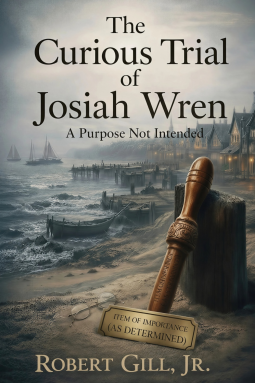
The Curious Trial of Josiah Wren
An Honest Deception from Carroway Island
This title was previously available on NetGalley and is now archived.
Send NetGalley books directly to your Kindle or Kindle app
1
To read on a Kindle or Kindle app, please add kindle@netgalley.com as an approved email address to receive files in your Amazon account. Click here for step-by-step instructions.
2
Also find your Kindle email address within your Amazon account, and enter it here.
Pub Date Jun 15 2026 | Archive Date Jul 1 2026
Talking about this book? Use #TheCuriousTrialofJosiahWren #NetGalley. More hashtag tips!
Description
On the isolated marsh island of Carroway, people notice things.
A curtain drawn too early.
A visitor arriving at the wrong hour.
A rhythm heard faintly through a neighboring wall.
And once noticed, such things are rarely left alone.
Josiah Wren is a quiet craftsman who spends his days turning smooth wooden belaying pins in the shed behind his house. His wife, Beulah, believes in order, restraint, and the proper arrangement of all things. But when a small hidden sack of Josiah’s handcrafted pins is discovered in a cupboard behind a stack of church circulars, a chain of misunderstandings begins to spread across the island with astonishing speed.
What begins as private curiosity soon becomes public correction.
As rumors travel through church pews, women’s auxiliaries, ferry docks, and front porches, Carroway Island slowly reorganizes itself around an increasingly absurd belief no one fully explains — yet everyone somehow understands.
Deadpan, atmospheric, and sharply observant, The Curious Trial of Josiah Wren blends literary satire, coastal folklore, and small-town suspicion into a uniquely American novel about gossip, morality, secrecy, and the dangerous efficiency of collective interpretation.
Perfect for readers who enjoy:
• literary fiction with dark humor
• eccentric island communities
• Southern Gothic atmosphere
• layered social satire
• slow-burning absurdity in the spirit of Shirley Jackson, Charles Portis, and Fredrik Backman
Welcome to Carroway Island.
Where nothing stays private for long.
Available Editions
| ISBN | 9798996041978 |
| PRICE | |
Available on NetGalley
Available to Buy
Buy on AmazonAverage rating from 4 members
Featured Reviews
 Fran E, Reviewer
During the 19th Century on Chesapeake Bay’s Carroway Island, Josiah Wren was known “for producing objects that held as they were meant to hold and released when properly asked.” In his workshop behind his dwelling, he shaped belaying pins out of seasoned wood. He was a master craftsman whose beautifully carved pins, marked with his initials, J.W., were prized aboard working vessels…that is until they were not.
As a confirmed landlubber, before taking an armchair visit, I needed to immerse myself in the seafaring life. Consulting the Carroway Island Visitor’s Guide and decked out in island gear, I was ready to proceed.
Caraway Island boasts a close knit community that harvests oysters, crabs and fish. It is generational and traditional, with residents sharing their knowledge of the rhythm of the tides and ways to address geographic changes wrought by coastal storms and erosion. The Carroway Island Motto is: No Cars. No Hurry. Just the Tide.” Now that the stage has been set, this reader will time travel back to the 19th Century with documentation confirming an Honorary Residency on Carroway Island. As a fly on the wall, I will try to examine the cause for the hoopla surrounding the trial of Josiah Wren.
To Beulah Wren, her husband’s trade was stable, modest and useful. Neighbors often entered each other’s households without knocking. That’s how Mrs. Crowley noticed the muslin sack, a sack that contained three small belaying pins. These pins in Beulah’s kitchen cabinet were in a location “that suggested either forgetfulness or intention…A hidden object suggested with secrecy or purpose…” Beulah needed clarity, but all she could hear was “the faint regular tread of Josiah at the lathe, working pine into usefulness with no idea at all that usefulness had already begun to revise itself under his roof.”
The island seemed to be adjusting to a peculiarity, a demand for smaller belaying pins; beyond the sole use to secure ropes on vessels. Josiah, “a man who works by hand and by season does not question demand. He had always believed usefulness would explain itself. He simply fulfilled.” Orders had exceeded expectations. The smaller pins were smoother and more refined. A thing well made would find its purpose. Reverend Caldwell noticed the increased attention span of his women congregants at Sunday’s Sermon. “There was a sense of…release…of unnecessary tension.” Josiah’s lathe continued to fill orders. “Definition of the small pins…introduced distinction…distinction required resolution…this was not always desirable.”
Caraway Island was controlled by the ebb and flow of the tides. The pier did not change but “the shoreline had acquired a new character. Not unpleasant. But altered…not to its previous condition. But to a condition that could be accepted…”. That is until a terrible storm. Small pins had been prioritized and perhaps some had mistakenly been used aboard vessels. These smaller pins did not sit properly and lines slipped. Along with the storms came structural changes to island dwellings. “Boards that had once aligned now suggested independence. (A) porch, while still attached, no longer appeared committed.” The tide breaching the sea wall pushed into dwellings “without hesitation.” Small belaying pins started to appear afloat in the rising waters. Emergency changed the narrative denoting the purpose and use of small belaying pins and their inadvertent use in vessels.
Author Robert Gill, Jr, a fantastic weaver of words, presents both the ebb and incoming flow of the tides at Carroway Island along with the issue of responsibility for the belaying pins. Can a jury trial lead to criminalization resulting from a simple belaying pin? Is the pin a defendant thereby responsible for its own behavior? The satirical writing style of Gill is unique, the humor is unbeatable.
A highly recommended read.
Thank you Teaching Press and Net Galley for the ARC in exchange for an honest review.
Readers who liked this book also liked:

Ashton Creed
Nonfiction (Adult), Parenting, Families, Relationships, Self-Help
Kevin Hayes
Children's Fiction, Parenting, Families, Relationships




Jelina Bertow
Historical Fiction, Literary Fiction, Women's Fiction