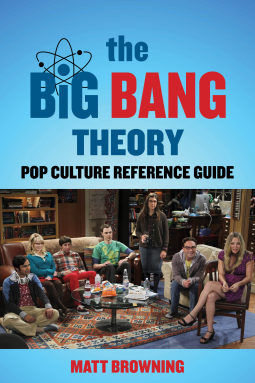
The Big Bang Theory Pop Culture Reference Guide
This title was previously available on NetGalley and is now archived.
Send NetGalley books directly to your Kindle or Kindle app
1
To read on a Kindle or Kindle app, please add kindle@netgalley.com as an approved email address to receive files in your Amazon account. Click here for step-by-step instructions.
2
Also find your Kindle email address within your Amazon account, and enter it here.
Pub Date Jan 19 2027 | Archive Date Aug 10 2026
Globe Pequot | Lyons Press
Talking about this book? Use #TheBigBangTheoryPopularCultureReferenceGuide #NetGalley. More hashtag tips!
Description
The Big Bang Theory Pop Culture Reference Guide is an in-depth look at the thousands of topical references to people, places, movies, music, science, and events which make up many of the funniest lines on the enduringly popular television series The Big Bang Theory, bringing new and long-time fans alike in on the joke.
It was 2007. The era of Must-See TV had ended. There was no Friends, no Will and Grace, no Seinfeld. The broadcast airwaves were being ruled by reality television series like American Idol and Big Brother, coupled with the expanded offerings of cable networks. Only CBS was seeing some success with the traditional multi-camera sitcom structure through shows like How I Met Your Mother and Two and a Half Men. Into that very lineup, sandwiched between the two hit series, came a fresh take on the sitcom setup: What would happen if two brainy nerds found themselves living next door to a beautiful woman? And television history was made, while educating readers about pop culture and world events.
The relatively simple premise didn’t stop there. The Big Bang Theory was not only funny—–it was smart. Very smart. Centering the action around a group of researchers at a prestigious university elevated the dialogue above standard sitcom fare. Just like setting had been considered a character on earlier shows like Northern Exposure, for The Big Bang Theory, science was one of the stars of the show. And so was pop culture. Because not only were our beloved nerds—Sheldon, Leonard, Howard, and Rajesh—brilliant in the laboratory, they were peerless in the comic book store too. Each episode is peppered with pop culture references drawn from science fiction: comics, books, television, film, music, board games, video games, and more. While Sheldon might be brilliant in string theory, he was equally brilliant in Star Trek lore. And the humor didn’t only revolve around nerd culture. For every obscure reference pulled from Klingon and Dungeons & Dragons, neighbor Penny could match wits when it came to the Kardashians and Juicy Couture.
Over the course of 12 seasons and 279 episodes from 2007 to 2019, The Big Bang Theory became a cultural touchstone with an extraordinarily devoted fan base. In every episode, its fast-paced style of dialogue offered biting observations and timeless humor about issues ranging from comic books to scientific discoveries. Meticulously researched episode by episode, The Big Bang Theory Pop Culture Reference Guide is an eye-opening, illuminating encyclopedia of thousands of topical jokes that will help both new and longtime fans experience their favorite show in a whole new light.
Marketing Plan
Market
Market Opportunity & Audience
Streaming dominance: According to Nielsen, The Big Bang Theory was the single most-binged title in all of streaming in 2024, accumulating 29.1 billion total minutes viewed—more than any other show on any platform. It ranked No. 7 overall on the Nielsen Top 10 across all platforms, competing against prestige dramas, reality hits, and new releases alike, and remains top-tier entertainment.
Massive built-in fan base: The Big Bang Theory aired 279 episodes across 12 seasons (2007–2019), attracting over 20 million viewers per episode at its peak. The series finale in 2019 drew 23 million viewers, the most-watched entertainment telecast of the year. That fan base has only grown more devoted in the streaming era.
Nostalgia and legacy TV boom: Streamers are leaning hard into legacy content. HBO/Max, Peacock, and Netflix have all reported that library titles—particularly multi-season sitcoms—drive more hours of engagement per title than new originals. The Big Bang Theory is a cornerstone of HBO/Max's content library.
STEM culture mainstream: The Big Bang Theory helped normalize and celebrate science and nerd culture, emerging just as STEM careers were expanding. The U.S. STEM workforce grew by 79% between 2000 and 2020 (Pew Research). Readers who feel personally seen by the show are a passionate, book-buying demographic.
Comic book and genre fandom crossover: Marvel Cinematic Universe films have grossed over $33 billion worldwide. San Diego Comic-Con annually draws 130,000+ attendees. The fan overlap between BBT and comic/sci-fi fandom is extensive and commercially active.
Gift and coffee-table market: Encyclopedic TV companion books are proven holiday, birthday, and fan-gift titles. The format—organized by episode, rich in trivia and reference—naturally positions this as a gift book for the holidays and beyond.
Comparable titles: The Office: The Untold Story of the Greatest Sitcom of the 2000s (sold over 100,000 copies); Seinfeldia: How a Show About Nothing Changed Everything; and the broader encyclopedia/companion genre anchored by titles like The Simpsons Archive demonstrate the commercial viability of deep-dive TV reference books.
Author Credentials
Matt Browning is the author of The Definitive Golden Girls Cultural Reference Guide (Lyons Press) and the Gilmore Girls Pop Culture Reference Guide (Lyons Press)—establishing him as the leading voice in the TV pop culture encyclopedia subgenre.
Owner of Plot Twist Books, an independent bookstore in Charleston, West Virginia, named Best Bookstore in West Virginia in both 2023 and 2024—giving him deep roots and credibility in the bookselling community.
Host of the “Bookstore Explorer” podcast, which has surpassed 25,000 downloads and features interviews with booksellers and literary personalities, providing a ready-made promotional platform and industry relationships.
A lifelong television devotee with obsessive, firsthand knowledge of The Big Bang Theory across all 12 seasons and 279 episodes—the researcher behind every entry in this book.
Strong bookseller relationships from his retail background give this title an organic indie bookstore advocacy advantage that most authors cannot offer.
Publicity
Print, Broadcast & Major Media
Major trade reviewers: Publishers Weekly, Kirkus Reviews, Library Journal, and Booklist among others
Entertainment & pop culture: Entertainment Weekly, Variety, The Hollywood Reporter, TV Guide, Vulture, AV Club, Decider, Rolling Stone website (music/pop culture references angle)
National newspapers: The New York Times (Arts/TV section), The Washington Post, USA Today, Los Angeles Times, Chicago Tribune, The Guardian (US edition)
Science & tech publications: Wired, Popular Science, Scientific American, Science News, Physics Today (the show's treatment of science is a unique hook)
Geek/fandom media: io9/Gizmodo, Screen Rant, CBR, Den of Geek, Nerdist, IGN (comic/video game reference angle)
NPR shows: Fresh Air, Weekend Edition, All Things Considered, Morning Edition, Pop Culture Happy Hour (ideal fit), Wait Wait... Don't Tell Me!
Broadcast/streaming media: CBS News Sunday Morning (natural home network angle—BBT was a CBS flagship), The Today Show, Good Morning America, CBS Mornings
Op-ed/essay strategy: Pitch bylined pieces on the cultural legacy of The Big Bang Theory, the mainstreaming of nerd culture, or the science communication power of sitcoms to The Atlantic, Slate, Vox, and The New York Times Magazine.
Podcasts
TV & Pop Culture: Couch Surfing (Peacock), The Watch (The Ringer), TV's Top 5 (Hollywood Reporter), Las Culturistas, Extra Hot Great, TV Guidance Counselor, Better Call Saul Insider (for craft-of-TV angle), Still Watching Netflix
Geek/Fandom Culture: Nerdist Podcast, Star Trek: The Pod Directive, The Incomparable, Giant Bombcast (video game references), My Marvelous Year, House to Astonish (comics), All Systems Podcast
Science & Academia: Science Vs, Radiolab, StarTalk with Neil deGrasse Tyson (strong fit—Tyson appeared on BBT), The Joy of Why (Steven Strogatz/Quanta Magazine), Sean Carroll's Mindscape
Books & Trivia: Books on the Nightstand, Reading Glasses, The Stacks, Literary Disco, No Such Thing as a Fish (QI podcast—trivia/reference angle is a natural fit), Omnibus with Ken Jennings and John Roderick
Bookstore & Indie Community: Bookstore Explorer (author's own podcast—25,000+ downloads), Book Riot, What Should I Read Next?, Shelf Love, From the Front Lines (ABA podcast)
Comedy & Entertainment: Good One: A Podcast About Jokes (Vulture), Conan O'Brien Needs a Friend, SmartLess, Fly on the Wall with Dana Carvey and David Spade, Comedy Bang Bang
Trade & Consumer Marketing
Bookseller & Library Outreach
Author's ownership of Plot Twist Books (named Best Bookstore in West Virginia 2023 & 2024) makes him a credible, trusted voice in the independent bookselling community—pitch an author Q&A for IndieBound/ABA newsletters and Shelf Awareness.
Pre-Order & Launch Incentives
Pre-order campaign with exclusive downloadable "Ultimate BBT Pop Culture Quiz" (10–15 questions drawn from the book) distributed via author newsletter and social channels.
First-week launch push: Coordinate author social content, podcast appearances, and bookseller outreach to concentrate publicity in publication week and capture bestseller list eligibility windows.
Signed bookplate program via Plot Twist Books for pre-orders placed through independent booksellers.
Social Media & Digital Marketing
Author Platform & Built-In Demand
“Bookstore Explorer” podcast (25,000+ downloads) provides a built-in, book-buying audience and a direct channel for launch promotion, author interviews, and listener giveaways.
Plot Twist Books social channels and physical storefront provide real-world activation opportunities: in-store events, window displays, and regional media coverage in West Virginia.
Author newsletter/subscriber list: Leverage existing customer and podcast listener database for pre-order announcements, exclusive content, and signed copy offers.
Platform Strategy
BookTok (TikTok): The Big Bang Theory has a robust and highly active TikTok presence. Clips and fan edits from the show regularly accumulate millions of views. Target BookTok creators who are also BBT fans with ARCs and a "Can you stump me?" challenge format using trivia from the book. The show's meme-friendly content (Soft Kitty, Bazinga, the Roommate Agreement) makes this format natural.
Bookstagram (Instagram): Target bookstagram accounts with 10,000–500,000 followers who cover pop culture, TV, and gift books. Flat-lay photography featuring the book alongside BBT-themed props (comic books, action figures, physics textbooks) will perform well. The show's visual aesthetic is highly recognizable and click-worthy.
YouTube: Pitch to YouTube channels dedicated to BBT analysis, sitcom retrospectives, and pop culture explainers. BBT-focused channels and "Every reference in Season X" video essays already have substantial viewership—this book is the definitive resource those creators need.
Reddit: r/bigbangtheory has 285,000+ members; r/books has 23 million members. Coordinate an author AMA (Ask Me Anything) on r/bigbangtheory timed to publication. Organic seeding of trivia questions and reference deep-dives in relevant subreddits (r/television, r/scifi, r/comicbooks).
Facebook Groups: Multiple active Big Bang Theory fan groups on Facebook with tens of thousands of members represent a direct-access audience. Publisher and author posts in these communities, timed to launch week, can drive significant organic reach.
X/Twitter: Daily trivia threads, "reference of the day" posts from the book, and engagement with the BBT fan community on X can build momentum. The show's official accounts and alumni (cast and writers) are accessible on the platform.
Available Editions
| EDITION | Other Format |
| ISBN | 9781493097050 |
| PRICE | $24.95 (USD) |
| PAGES | 360 |
Links
Available on NetGalley
Available to Buy
Buy on BN.com Buy on Bookshop.orgAverage rating from 10 members
Readers who liked this book also liked:
Lexi Davis
General Fiction (Adult), New Adult, Romance
Molly Beth Griffin
Children's Fiction, Health, Mind & Body, Parenting, Families, Relationships