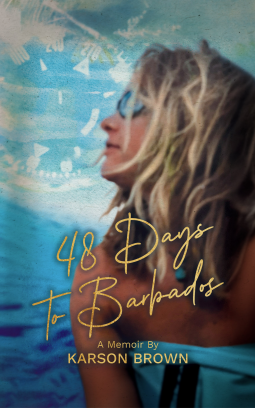
48 Days to Barbados
with Steph West (Editor); Jessica Keaveny (Photographer); Jaime North (Illustrator)
Sign In or Register Now to see if this title is available for request.
Buy on BN.com Buy on Bookshop.orgSend NetGalley books directly to your Kindle or Kindle app
1
To read on a Kindle or Kindle app, please add kindle@netgalley.com as an approved email address to receive files in your Amazon account. Click here for step-by-step instructions.
2
Also find your Kindle email address within your Amazon account, and enter it here.
Pub Date Oct 20 2026 | Archive Date Jan 31 2027
Talking about this book? Use #48DaysToBarbados #NetGalley. More hashtag tips!
Description
“48 DAYS TO BARBADOS IS VISCERAL: THE SMELL OF ONIONS PERMEATING A SLEEPING BAG, THE TASTE OF SULFUROUS WATER, THE SOUND OF WATER AGAINST THE HULL…IT’S A COURAGEOUS TALE ABOUT HOW WE FIND OURSELVES BY LOSING OUR BEARINGS.”
— KIMBERLY KING PARSONS, Bestselling Author Of We Were The Universe
In 1999, experienced sailor Karson Brown was in her late twenties, married, and searching for something she couldn’t quite name when she got the call she’d been dreaming of her whole life — a chance to sail across the Atlantic Ocean. The plan seemed straightforward: Brown and her best friend would join Captain Pam, whom they’d never met, in Portugal and help her sail her thirty-four-foot boat Voyager to Florida as part of an all-female crew.
What happened next drove Brown to the edge of her physical, mental, and emotional limits as the Atlantic began dismantling, piece by piece, every certainty she had brought aboard.
In 48 Days to Barbados, a seemingly routine sailboat delivery becomes five weeks of shifting itineraries, a failed engine, contaminated water, dwindling provisions, and no clear way home as Hurricane Lenny threatens from afar. Yet the greatest uncertainty lived within Brown herself. Far from her Seattle home and confined with two women she was only beginning to understand, Brown was forced to confront the fractures in her marriage, the complicated legacy of her mother, and the deep longing she finally allowed herself to recognize.
Told with candor, humor, and reverence for the sea, 48 Days to Barbados is a memoir of a lifelong Pacific Northwest sailor confronted by extreme nautical circumstances who survives by learning to trust her inner voice and the ocean she has profoundly loved since childhood.
Learn more at redfernpress.com.
Advance Praise
“48 DAYS TO BARBADOS IS VISCERAL: THE SMELL OF ONIONS PERMEATING A SLEEPING BAG, THE TASTE OF SULFUROUS WATER, THE SOUND OF WATER AGAINST THE HULL…IT’S A COURAGEOUS TALE ABOUT HOW WE FIND OURSELVES BY LOSING OUR BEARINGS.”
— KIMBERLY KING PARSONS, Bestselling Author Of We Were The Universe
Available Editions
| EDITION | Paperback |
| ISBN | 9781967038343 |
| PRICE | 18.99 |
| PAGES | 358 |
Available on NetGalley
Available to Buy
Buy on BN.com Buy on Bookshop.orgBISAC Codes
Average rating from 1 member
Featured Reviews
 Ruthie W, Reviewer
*"My tolerance had stretched wider every day, as if my ancestors had trained me for this."* That line is the spine of Karson Brown's debut memoir, *48 Days to Barbados* (Red Fern Press, out October 20, 2026), and it's the one I keep returning to after I closed the book. It isn't about heroics. It's about capacity — discovering, mid-crisis, that you can hold more than you thought, and that some of that holding was never entirely yours to begin with.
In 1999, 28-year-old Karson and her best friend Erin signed on as unpaid deckhands to help a woman they barely knew, Captain Pam, sail a 34-foot boat from Portugal to Florida. On paper it was a three-week delivery. For someone who grew up on sailboats, it read like a gift. It became a 48-day fight for survival. The red flags were there before they left the dock — a boat that wasn't ready, a captain who wouldn't take input on food or supplies, a timeline that didn't hold up against basic math, a departure squarely inside hurricane season. Brown doesn't hide that she saw these signs and went anyway, and that honesty is part of what makes the book work. This isn't a story about bad luck ambushing good planning. It's a story about what happens after you've already said yes.
Much of the tension on board comes not from the ocean but from Pam herself — curt, immovable, allergic to deviation. No extra water. No beans. No avocados. No changes. When the boat's water tank turns sour, sulfurous, tasting of old egg salad, and the desalinator can only wring a half-cup of drinkable water out of forty-five minutes of effort, Pam's refusal to acknowledge the severity becomes more frightening than the shortage itself. Dehydration teaches Brown something rigidity never could: to trust her own read of a situation over someone else's insistence that everything is fine.
Brown is a visual artist as much as a writer, and it shows. She reaches for Helen Frankenthaler's paintings to describe the sea under a hurricane sky, color bleeding into color, except here the water is doing the exploding. It's an unexpected comparison that works, because the ocean during Hurricane Lenny isn't rendered as an enemy so much as an enormous, indifferent canvas the crew is trapped inside of. She credits her parents with the two skills that arguably keep the crew alive, attention and momentum, and threads that inheritance through the whole book. When she finally has to navigate by the stars because the instruments have failed her, it reads less like a survival skill and more like a language she'd been fluent in without knowing it.
The book opens with the question that drives the next 48 days — how am I going to make it through this — and it arrives within the first hour of the crossing, long before anyone is ready for it. What makes the memoir more than a survival narrative is what Brown finds underneath that question as the trip wears on: a growing, almost involuntary pull toward wanting to be a mother. At the height of Hurricane Lenny, she isn't bargaining with the storm for her own sake so much as for a future self she hasn't met yet. There's a kinship here with Tori Amos's "Me and a Gun," the stark a cappella song built around a survivor holding onto a place she hasn't yet seen as her reason to keep going. Brown's crisis is different in nature, but the logic is the same: sometimes what gets you through isn't strength in the moment, it's a refusal to let an unlived future go unlived. For Brown, that future had a face. For the crew, it also had a name — Barbados, the landfall they were sailing toward the entire time, even when it seemed impossibly far away.
If you loved *Wild*, this belongs on the same shelf, not because the terrain matches but because the internal work does. Cheryl Strayed walked toward herself; Karson Brown sailed toward herself, one dwindling cup of water at a time. *48 Days to Barbados* is a book about a boat, a hurricane, and a captain who wouldn't budge — but underneath it, it's about the moment you realize your tolerance has been quietly widening the whole time, and that you come from people who somehow knew you'd need it. "I was sailing into a new life but I simultaneously missed my old one profoundly." That's the whole crossing, really — not just the ocean part.