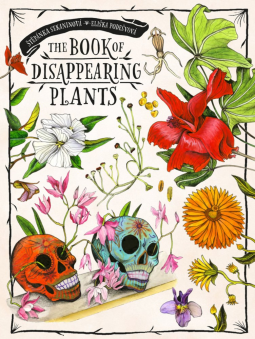
The Book of Disappearing Plants
with Eliska Podesvova (Illustrator)
This title was previously available on NetGalley and is now archived.
Send NetGalley books directly to your Kindle or Kindle app
1
To read on a Kindle or Kindle app, please add kindle@netgalley.com as an approved email address to receive files in your Amazon account. Click here for step-by-step instructions.
2
Also find your Kindle email address within your Amazon account, and enter it here.
Pub Date Jun 30 2026 | Archive Date Oct 28 2026
Talking about this book? Use #TheBookofDisappearingPlants #NetGalley. More hashtag tips!
Description
A Love Letter to Nature—and a Wake-Up Call for the Future
Step into a world of wonder and warning with The Book of Disappearing Plants, a breathtaking journey through the vanishing green corners of our planet. This beautifully illustrated and powerfully written book invites young readers to discover the incredible stories of 30 plants that once thrived—and the urgent reasons they’re fading away.
This book reveals the silent disappearance of plant species due to climate change, deforestation, and urban expansion. But it’s not just a story of loss—it’s a call to action. With every page, kids will learn how they can become protectors of the planet and champions of conservation.
- A Powerful Environmental Message: Sparks curiosity and compassion for the natural world while teaching kids about real-world ecological issues.
- Eye-Opening and Empowering: Helps children see plants not just as background, but as vital, beautiful, and endangered life forms.
- Presents 30 Unique Plants: Arranged chronologically by the date they disappeared, this book describes 30 plants that have become extinct in the wild.
- STEM-Infused Learning: Introduces young readers to botany, ecosystems, and environmental science through engaging facts and real-world connections.
- Encourages Independent Learning: Includes web resources and suggested reading materials for continued education about endangered plant species and the natural world.
- Career Exploration: Lists 10 disciplines that focus specifically on plants, including agronomy, ecology, ethnobotany, phycology, phytopathology, phytology, mycology, forestry, horticulture, and paleobotany.
- Perfect for Classrooms and Eco-Conscious Families: A must-have for Earth Day, science classes, or any young nature lover’s bookshelf.
For over 75 years, Albatros Media has been crafting original and innovative children's books that are both playful and educational, fostering curiosity and a thirst for knowledge in young minds. We deliver the highest quality children’s books from novelty, picture, pop-up, and how-to books to nonfiction and fairy tales.
A Note From the Publisher
Eye-Opening and Empowering: Helps children see plants not just as background, but as vital, beautiful, and endangered life forms.
Presents 30 Unique Plants: Arranged chronologically by the date they disappeared, this book describes 30 plants that have become extinct in the wild.
STEM-Infused Learning: Introduces young readers to botany, ecosystems, and environmental science through engaging facts and real-world connections.
Encourages Independent Learning: Includes web resources and suggested reading materials for continued education about endangered plant species and the natural world.
Career Exploration: Lists 10 disciplines that focus specifically on plants, including agronomy, ecology, ethnobotany, phycology, phytopathology, phytology, mycology, forestry, horticulture, and paleobotany.
Perfect for Classrooms and Eco-Conscious Families: A must-have for Earth Day, science classes, or any young nature lover’s bookshelf.
Advance Praise
"A first purchase in elementary and middle grade collections where books on botany are popular or needed." —Kasey Swords, School Library Journal
"Quietly hopeful and illuminating." —Kirkus Reviews
"A first purchase in elementary and middle grade collections where books on botany are popular or needed." —Kasey Swords, School Library Journal
"Quietly hopeful and illuminating." —...
Marketing Plan
- Outreach to major trade publications for review consideration
- Edelweiss DRC
- Outreach to bloggers and other relevant websites
- Submission to relevant lists and review centers for inclusion and review consideration
- E-newsletter marketing
- Social media campaign across all of Albatros’ accounts
- Submission to relevant awards
- Lexile Leveling, Graded Reading and AR leveling
- Trade advertising
- Presentation to collection development specialists at educational and library accounts
- Showcase at major trade shows
- NetGalley promotions and listing
- Book video available: https://www.youtube.com/watch?v=j7lPBOX8JL0&t=2s
Available Editions
| EDITION | Hardcover |
| ISBN | 9788000078410 |
| PRICE | $19.95 (USD) |
| PAGES | 72 |
Links
Available on NetGalley
Available to Buy
Buy on BN.com Buy on Bookshop.orgBISAC Codes
Average rating from 36 members

Featured Reviews
 Alison M, Reviewer
this was beautiful and i learned a lot and i really enjoyed myself.
the illustrations are gorgeous, especially since we don’t have photos of most of these lost plants. i loved the detail and the multiple angles of different parts, i found that really fascinating. honestly, all of it was factually interesting and not something i’d read much on before, but mostly it was just wild to flip through and realize how much we’ve lost. and how much work people are doing to try to stop it, which was heartening too.
my nephew (5) is a little young to appreciate all the historical info, but his mind was blown that there were plants that don’t exist anymore. he loved looking at the pictures of the “dinosaur plants” (ie. plants that are extinct like the dinosaurs) and talking about how big or small they were compared to him mostly lol. so both of us had fun.
and on a personal note, i appreciated seeing palestine listed in equal position beside israel and jordan when it was relevant to a plant’s origin.
thanks to NetGalley and Albatros Media for this fascinating little learning experience.
 Educator 840648
Very educational book, lovely illustrations.
As a former horticulture professor, I really enjoyed this book! I had no idea that there were close relatives of some common plants that are extinct or nearly so. I also didn't know that some plants that are said to be extinct actually exist in private collections.
It was interesting to read about efforts to bring back nearly extinct plants, such as Theaceae's Franklinia, and that some plants long thought to be extinct were later found growing in other places.
I'm glad that the book noted that not all plant extinction is due to man--that sometimes it's due to wild animals or natural climate change.
 Helen B, Reviewer
I just finished reading THE BOOK OF DISAPPEARING PLANTS by Štěpánka Sekaninová, illustrated by Eliška Podešvová and found it completely fascinating and a little sad. But more about that later. Because it features beautifully detailed illustrations and a highly engaging STEM scrapbook format, I think it is a book for both young and old readers. It appeals to adult plant lovers, like myself, with its interesting historical context and chronological timelines, while remaining thoroughly captivating, educational, and empowering for young readers.
The book tracks 30 different plants arranged chronologically by when they were last seen in the wild or declared extinct. It explores reasons for the plants disappearing, everything from historical theories and human activity to isolated islands where introduced goats and sheep changed the ecosystem forever.
It is sad, but what I especially appreciated is that despite the serious subject, the author infuses the pages with genuine hope!
I received a complimentary eARC from Albatross Media via NetGalley. All opinions are my own. I like THE BOOK OF DISAPPEARING PLANTS so much I’m buying myself a copy for my shelves!
⭐️ ⭐️ ⭐️ ⭐️ ⭐️
 Jade L, Reviewer
Rating 5/5 stars.
There is so much to learn about plants, and this little book packs in an incredible amount of information. We tend to take plant life for granted since they don't move or make noise, it's easy to forget that they are literally the foundation of our survival, providing oxygen, energy, and the basis for global ecosystems.
The Book of Disappearing Plants takes readers through a chronological journey of thirty species that have vanished from the wild, ranging from prehistoric species like Lepidodendron (scale trees) to flora lost in recent centuries like the Franklin tree (Franklinia alatamaha) and the Madagascan grass (Sartidia perrieri). For each featured plant, author Štěpánka Sekaninová provides a concise yet fascinating breakdown: its evolutionary backstory, where it once grew, key historical dates, and the exact reasons behind its disappearance; whether through natural climate shifts or human interference like agriculture and deforestation.
Eliška Podešvová’s hand-drawn illustrations and thoughtful layout make every single spread look like a piece of art. The mix of vintage-style botanical drawings, maps, quick facts, and historical context makes reading through it feel like exploring a beautifully curated field guide or herbarium.
It’s an educational, eye-opening, and deeply necessary reminder of how fragile our planet's botanical history really is, and why plant conservation matters now more than ever.
 Allie C, Reviewer
This is an amazing book. I will definitely be buying it to use for homeschool. I showed a few pages to my 8 year old daughter and she asked me to buy thr book. She thought it was cool.
Reviewer 2029139
The Book of Disappearing Plants is a fascinating, informative, colorful illustrated book that explores the world of plants, particularly the ones have have gone extinct or are endangered.
The illustrations are eye catching and interesting to look at and the lay out gives the information in an accessible way. Mini maps share where the plant originally grew, and the text gives further info about the place and conditions as well as what happened to the plant to make it go extinct.
This would be great in a science classroom or any late elementary/ middle school library. There are some bigger words but there are enough context clues that readers can figure it out from that or ask a adult to help them learn a new word.
Overall a very intriguing and informative book that would make a great addition to any children's library.
Reviewer 2018751
I am so happy with whatever life decisions led me to reading this book. I don’t know where to start my praise, but I’ll try my best.
Art:
Stunning. Gorgeous. Eliška Podešvová is a talented artist and tattooist, and those skills shine through in this book. The plant drawings are absolutely beautiful and remind me of plant studies from the 17th/18th century. Even simple elements like arrows look intentional on the pages. Before learning that Eliška was a tattooist, I remember thinking I would absolutely love to have art from the book tattooed on myself.
Accessibility of Information:
*The Book of Disappearing Plants* is marketed as a children’s nonfiction book, so while reading, I asked myself whether a middle school student could read along and what they would take away by the end. I would say any child, whether they read the book themselves or have it read to them, will leave with an appreciation for plants. Štěpánka Sekaninová does a fantastic job of communicating information about extinct plants to readers. I can 100% see this book in a middle school library, and even in a grade 3/4 homeroom classroom. Sure, there are some bigger words, but I don't think nonfiction for kids should hide from difficult topics/concepts just because the primary reading demographic is children. Sentences about climate change or how the plant went extinct are communicated without jargon, and a bonus: the sentences aren't condescending. I think connections to climate change and habitat loss are clearly explained, while leaving room for readers to ask more questions. I know I'd look up what else goats eat. :P
Information Depth:
The depth at which each plant is covered strikes a good balance between sharing the whole story while letting readers make connections between each species. For example, if a child started flipping through the pages, I could see them pick up on a pattern in the extinction reasons (e.g., agriculture repeatedly appears in bubble text boxes). Part of that is how the information is displayed on the page. A simple map illustration shows where the species was found, along with text stating when it was last seen. Each species has a bubble text box where Štěpánka shares the known or likely reason the plant went extinct, even if that information was stated somewhere in the paragraphs. Text for each species expands on interesting and relevant facts, such as the origin of its name or how naturalists tried to save the vulnerable plant before it went extinct in the wild.
How I can see this being used in classrooms:
This book would work really well in climate change or conservation-related units. Whether it’s one of the books students can pick for quiet reading time, or a more guided reading with the class. Additionally, I think it would pair really well with an interactive outdoor lesson (though I understand a lot of schools with predominantly black and brown students in Canada may not have access to lots of urban nature - not sure if this extends to other areas) where students get to observe patterns of plant species distribution and abundance. It can also tie back to habitat and food web units, as some species highlighted in this book include text stating which animals interacted with the extinct plant. I know this book is going in my community science project box!
Further Reading:
Štěpánka shares additional resources for younger and older readers, including websites and definitions, at the end of the book. They also share a QR code to their research so readers can find more information since it was limited. I am so incredibly excited to go through their research one day!
Final Note:
If you have access to this book through your library or bookshops, I encourage everyone to read it and share it with any young readers in your life!
Thank you NetGalley for this ARC!
 Jasmine S, Reviewer
What a beautiful book! Wow. Every single page is a work of art, in my opinion.
The Book of Disappearing Plants by Stepanka Sekaninova is a short but powerful book that takes the reader through our planet's history to meet thirty plants that have officially become extinct in the wild. For each plant, you get a brief history of it, where it used to exist and when it was last spotted as well as what led to its extinction.
Each plant also receives hand-drawn gorgeous illustrations by Eliska Podesvova that bring to mind those detailed 19th century illustrations. I kept pausing to take them in. Even if it truly hurt to read about how we lost many of these plants, it's heartwarming that we at least get to capture a glimpse of these plants forever.
Technically this is marketed as a children's nonfiction but, even as an adult, I would like to order a physical copy for my library. I think it would make for a great conversation starter and to bring more awareness to the impact of climate change and urban expansion on plants around us.
 Cora C, Reviewer
Thank you to Albatros Media and NetGalley for the advanced digital copy. All opinions are my own.
This was such an interesting, thought-provoking book. It's a great blend of science and art. I loved the illustrations and learning about all these endangered and extinct plants. I also appreciated that it ends on a positive note, with a plant that has been "resurrected."
This is a great book for kids (and adults) who enjoy learning about the natural world. It would make a wonderful addition to classrooms, libraries, and personal collections.
 Molly H, Reviewer
I received an advanced reader’s copy of The Book of Disappearing Plants, and these opinions are my own.
This is an incredibly beautiful book, and yes, I mean the illustrations, which are absolutely gorgeous, but I also mean the way the story of each of these plants is told.
The book introduces us to several different plant species that have disappeared from the wild, with the exception of one. Fortunately, many of them still survive in botanical gardens, so they have not vanished completely. But they no longer exist where they once grew naturally, and there is something incredibly sad about that.
What struck me most was how often their disappearance was connected to changes in their environments caused by humans.
I have always been much more concerned about endangered animals than endangered plants. Of course I understand how important plants are, but emotionally, an endangered animal has always affected me more. This author changed that.
The way she writes about these plants makes them feel almost like communities of people that once existed in a particular place and time and are now gone. I found myself feeling genuinely invested in what happened to them. Suddenly these weren't just plants with scientific names. They had histories. They belonged somewhere.
And I cared.
There is hopefulness in this book, particularly because people have managed to preserve some of these species. But I also found parts of it deeply discouraging. The book covers thousands of years, with large jumps through time, and you repeatedly see humans making the same kinds of choices.
We want that mineral. We want that metal. We want whatever is underneath the ground, so we dig it up and take it without enough concern for what else depends upon that environment.
And we're still doing it.
Even if your reaction to the disappearance of a particular grass is, "Well, who cares if that grass doesn't exist anymore?" there may be an animal that ate that grass. There may be an entire ecosystem that depended upon it. Nothing exists entirely by itself.
I expected The Book of Disappearing Plants to be beautiful. I expected to admire the illustrations and learn some fascinating things about extinct and endangered plants.
I did not expect it to fire up the environmental activist in me.
But here we are.
This is a beautiful, moving, thought-provoking book, and I recommend it to anyone, especially those of us who may not have realized until now just how much we could care about a disappearing plant.
 Melissa B, Reviewer
Very beautiful book with gorgeous illustrations and excellent information on plants.
Thank you to NetGalley for the opportunity
Caroline V, Educator
Thank you to Albatros Media and NetGalley for the advanced digital copy.
Despite the inherent sadness in reading about extinct and extinct-in-the-wild plants, this was a charming, informational, and ultimately hopeful book. The author, Štěpánka Sekaninová, focuses on not just the plants themselves, but on what led to their disappearance and, in some cases, what conservation efforts are underway to save them. She managed to be honest about the environmental toll caused by human actions in a way that feels appropriate for younger readers.
The illustrations by Eliska Podesvova were lovely and detailed enough to bring the plants to life. Together, the text and illustrations demonstrate how special and beautiful the natural world is and encourage us to help preserve our world and its biodiversity. The author’s note about the Judean date palm ends the book on a hopeful note and the additional information sources at the end are a valuable and important resource.
 Mimi R, Reviewer
i'll admit, i'm definitely the kind of person sekaninova mentioned in the opening of the book: looks at plants sometimes and quickly moves on.
but BOY, did this book change me!! i learned so much. obviously, i could vaguely talk about plants disappearing, but it's so crucial to pinpoint exactly which ones are gone and HOW that happened!
i appreciate so much about this book. the illustrations are stunning. the layout is really effective: a combination of art, maps, text, important dates, fast facts. i also thought the writing itself for each plant was stellar. it's well-researched! the narrative was informative, engaging, and came from a place of empathy, not disillusion.
that's another thing; this book is filled with so much love for our planet, and it ends on a hopeful not too. because disappearing really isn't the same thing as EXTINCT. i think that message is important. it's easy to feel like it's too late to change anything, but it's not. not by a long shot!
i'm so, so glad i could read this! i'll reread this often!
 The Sassy B, Reviewer
Book Review: The Book of Disappearing Plants by Stepanka Sekaninova, Illustrated by Eliska Podesvova
Rating: 5-Stars
I absolutely loved The Book of Disappearing Plants! From the moment I saw its beautiful cover, I knew this was a special book. It's one of those rare finds that manages to be both incredibly fun and deeply educational. The vibrant, colorful illustrations by Eliska Podesvova make flipping through the pages an absolute joy, capturing the beauty of each plant with such care and detail.
This book takes readers on a fascinating journey through the stories of 30 plants that have vanished from the wild. Organized chronologically by their disappearance, it’s a powerful reminder of how climate change, deforestation, and urban growth are quietly erasing parts of our natural world. But instead of just being a sad recount, it’s really a love letter to nature and a call to action—encouraging kids to become champions for conservation.
What I particularly appreciated was how the text is clear and easy to understand without ever feeling dumbed down. Each plant entry offers just enough intriguing facts to spark curiosity and inspire independent learning, making it perfect for young readers just starting to explore botany and environmental science. Plus, the inclusion of web resources and further reading suggestions at the end is a fantastic touch.
I also found it really cool that the book highlights various plant-related careers like ecology, horticulture, and ethnobotany. It’s a subtle way to show kids there’s a whole world of scientific exploration just waiting for them.
All in all, this is a must-have for classrooms, eco-conscious families, or any young nature lovers bookshelf. It’s a quick but impactful introduction to the importance of plants in our ecosystems and why we need to protect them. Highly recommended!
⚠️This review was written based on personal opinions and experiences with the book. Individual preferences may vary⚠️
Reviewer 1979230
I loved this book as an adult plant lover and I could definitely see my students enjoying it too! The illustrations are eye catching, maybe not the most beautifully done but they're unique and eye catching while also being perfectly suited for the plant it illustrates. The content is entertaining while also being educational so if your child loves to learn about the natural world, they'll really love this one.
 Haley C, Librarian
As someone who house and yard are full of plants, I was excited to read this book!
So many unique plants that I had no idea about!
and omg! The illustrations! If the pictures in a book like this are poorly done, it makes the book useless in my opinion.
I can't wait to order this for my library. I bet it would make a great research project for someone.
Reviewer 1554120
Book of Disappearing Plants is a beautifully illustrated and thought-provoking children’s book that shines a light on endangered plant species and the importance of conservation. Combining engaging facts with a powerful environmental message, it inspires curiosity, empathy, and a deeper appreciation for the natural world. An educational and meaningful read for young nature lovers.
 N L, Reviewer
The Book of Disappearing Plants is a compilation of extinct flora that at one point existed on this planet but due to various reasons, now no longer. Many of these we learn about only through fossils. The plants are in chronological order on disappearance date, and I do think it is quite cool that the last one seems to be revived, which is somewhat coincidental given its name includes "phoenix". Very educational, and the illustrations are wonderful. This should make a great addition to any classroom or library.
My only gripe with it is if asomeone is trying to learn more about these plants, all the sources appear to be websites, and I think book sources should also be here.
Reviewer 2035891
Beautifully illustrated and engaging book about the fragility of our flora.
I read this will my 11yr old who was sad to reach the last page and requested more information about our plant world, so thank you for opening us up to the world of plants
 Irina Elena S, Reviewer
Wow, I enjoyed this so much!! My only gripe is that it should've been longer.
The art style immediately intrigued me from the cover, but I wasn't expecting the entire book to have the same level of polish. The illustrations are crispyyyy. Knowing the illustrator is a tattoo artist makes so much sense, because I would wear many of those on my own skin.
I really love the concept of this book! It just grounds you and brings you back to appreciating what you already have. Makes you think "Could I be the saviour for one of these plants or would I just walk past them because I'm always busy?".
I think it has a lot of potential being marketed towards adults, not only children.
I really wish for this to become a series... and maybe an edition that uses the metric system?
Alicia B, Reviewer
The book was very well thought out and I appreciated that it covered a variety of plants and plant species. The illustrations gave a perfect visual while highlighting that for some it is only what the plants are predicted to have looked like. I also appreciated the nod at both human impact on extinction and just natural evolution. Secondly, I think this book is perfect for all ages to read aloud, and maybe second grade or higher for personal reading. There was a great mix of common words and scientific words that were also well explained in the book.
 Lauren K, Librarian
This beautiful browseable picture book is exactly what every child needs to help them understand our need for biodiversity on our planet and how we need to protect what we already have. Written in an approachable way for elementary students, this text includes features like maps and a timeline to help students gain a better understanding of these plants and their place in our history. Featuring gorgeous illustrations, I cannot wait to share this book with my students.
I have already ordered a copy of this book for my elementary school library, out of my own pocket. I just think it is that good.
Thank you to Net Galley and Albatros Media for the ARC. All opinions are my own.
 Jennifer W, Reviewer
As someone who is just getting into their botany era, and someone who has always had a love of learning. The cover of this book grabbed me. I started reading through it to my 2 year old, and he was trying to describe the pictures he was seeing. This is definitely a book that will be coming home with us. The artwork is wonderful and the information is so insightful.
Readers who liked this book also liked:

noho
Children's Fiction, Comics, Graphic Novels, Manga

We Are Bookish
LGBTQIAP+, Romance, Sci Fi & Fantasy



Yuzuru Kuki
Biographies & Memoirs, Children's Nonfiction, Comics, Graphic Novels, Manga

Sir Arthur Conan Doyle
Comics, Graphic Novels, Manga, Mystery & Thrillers, Teens & YA
Fumiyo Kouno
Arts & Photography, Comics, Graphic Novels, Manga, Reference

Wendy Martin
Comics, Graphic Novels, Manga, LGBTQIAP+, Sci Fi & Fantasy
