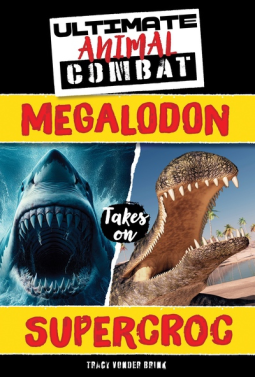
Megalodon Takes On SuperCroc
Sign In or Register Now to see if this title is available for request.
Buy on BN.com Buy on Bookshop.orgSend NetGalley books directly to your Kindle or Kindle app
1
To read on a Kindle or Kindle app, please add kindle@netgalley.com as an approved email address to receive files in your Amazon account. Click here for step-by-step instructions.
2
Also find your Kindle email address within your Amazon account, and enter it here.
Pub Date Aug 1 2026 | Archive Date Oct 5 2026
Rosen Publishing Group | PowerKids Press
Talking about this book? Use #MegalodonTakesOnSuperCroc #NetGalley. More hashtag tips!
Description
Nonfiction for grades 2-5+, part of a 6-title series.
It’s an epic battle for all time! Megalodon, the largest shark to ever live, had teeth the size of a person’s hand. Sarcosuchus, AKA “SuperCroc,” was as heavy as a school bus and hunted dinosaurs. This exciting volume is packed with facts about these prehistoric powerhouses and asks the question: Who would win this face-to-face fight?
Available Editions
| EDITION | Hardcover |
| ISBN | 9781538296394 |
| PRICE | $27.93 (USD) |
| PAGES | 32 |
Available on NetGalley
Available to Buy
Buy on BN.com Buy on Bookshop.orgAverage rating from 5 members
Featured Reviews
 bookmom 0, Reviewer
I read this book with my five year old son and he really liked it! He thought the illustrations were cool (and engaging) and the text was informative but easy to understand. He was disappointed that the book ended without some sort of actual battle or winner. But he did say he thought the SuperCroc would win, I think this would be a great pick for kids interested in sharks or extinct animals!
Thank you to NetGalley and Rosen Publishing Group for the ARC!
 Samantha S, Reviewer
Thank you to NetGalley and Rosen Publishing Group for providing an advance reading copy.
⭐ 3/5
🎨 Visuals: 3/5
I came to Megalodon Takes On Supercroc for one very important reason:
I CAME HERE FOR YOU TO TELL ME WHO WINS. 😂
Okay, maybe not literally—because Megalodon and SuperCroc didn’t live at the same time, in the same place, or even in the same type of water, something the book responsibly explains. But after spending nearly an entire book teaching me about their bodies, speed, power, adaptations, habitats, and potential combat abilities, I expected all of that information to eventually become an evidence-based matchup.
Instead, the book essentially asks the reader: Who do you think would win?
Sir. I came to YOU. 😂
And that’s frustrating because so much about this children’s nonfiction book works.
The premise is an excellent hook for kids who love sharks, prehistoric animals, and “who would win?” questions. The short sections make the information approachable, and the visuals do a particularly good job communicating things like scale. Seeing Megalodon stretched across two pages accomplishes something that simply giving a measurement couldn’t.
I also appreciated the Killer Fact boxes and the inclusion of maps, a glossary, fact checking, further reading, and an index. There’s real nonfiction substance underneath the dramatic presentation. A child can come for GIANT PREHISTORIC PREDATOR BATTLE and accidentally learn about anatomy, fossils, habitat, adaptations, bite force, and scientific vocabulary. I love that.
Where I wanted considerably more care was in distinguishing evidence from scientific inference and speculation. Sometimes the text appropriately uses language such as “scientists think,” “may have,” or “probably.” Other statements about extinct animals’ behavior, physiology, speed, parenting, senses, and abilities are presented much more definitively. Young readers would benefit from consistently understanding the difference between what fossils directly tell us and what scientists reconstruct from that evidence.
And that’s exactly why the ending was such a missed opportunity.
I didn’t need the book to manufacture a definitive winner. I wanted it to model scientific reasoning: perhaps Megalodon would have these advantages in open water; perhaps SuperCroc would have these advantages in a shallow ambush environment; here’s what could matter if one attacked first; and ultimately, we cannot know.
Then ask the reader who they think would win.
That would turn a fun hypothetical into an opportunity to teach children how scientists reason from incomplete evidence.
Some of the highly stylized text was also harder to read than necessary for a book aimed at developing readers. The visuals are certainly attention-grabbing, but I didn’t always love the execution.
Who Should Read?
Kids obsessed with sharks, prehistoric predators, animal matchups, or bite-force statistics will probably have a blast with this—and it could be especially appealing to kids who aren’t naturally drawn to traditional nonfiction.
I recommend it to those kids, but if they get to the end and yell, “BUT WHO WOULD WIN?!” please don’t be mad at me. I tried to warn you. 😂