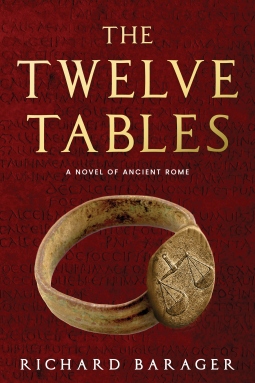
The Twelve Tables
A Novel of Ancient Rome
Sign In or Register Now to see if this title is available for request.
Buy on BN.com Buy on Bookshop.orgSend NetGalley books directly to your Kindle or Kindle app
1
To read on a Kindle or Kindle app, please add kindle@netgalley.com as an approved email address to receive files in your Amazon account. Click here for step-by-step instructions.
2
Also find your Kindle email address within your Amazon account, and enter it here.
Pub Date Nov 17 2026 | Archive Date Nov 17 2026
Talking about this book? Use #TheTwelveTables #NetGalley. More hashtag tips!
Description
The blood of the bulls on Jupiter's hill gave them liberty-the words graven unto these Twelve Tables made them equal.
ROME, 462 BC. To save his family's failing farm, sixteen-year-old Marcus Atilius is sold into debt servitude by his own father. Plunged into the city's underbelly, Marcus must endure a world of cutthroat trading stalls and gritty warehouses, all while navigating a forbidden entanglement with a woman far above his station. Survival demands sharp guile and moral compromise.
As a bitter class struggle pushes Rome toward the brink of civil war, Marcus vows to beat the elites at their own ruthless game to win his freedom and a fortune worthy of the woman he loves.
Yet his rise brings a fateful choice. A historic demand sweeps the city for the Twelve Tables-a revolutionary legal code to protect plebeians from patrician tyranny. With a corrupt aristocrat holding the tether to his trading empire, will Marcus protect his hard-won power, or risk everything for the soul of Rome?
A Note From the Publisher
RichardBarager.com
Advance Praise
"Meticulous tale of Roman ambition, romance, and political evolution."—BookLife Editor’s Pick by Publishers Weekly
"Meticulous tale of Roman ambition, romance, and political evolution."—BookLife Editor’s Pick by Publishers Weekly
Available Editions
| EDITION | Paperback |
| ISBN | 9798897475230 |
| PRICE | $19.95 (USD) |
| PAGES | 280 |
Available on NetGalley
Available to Buy
Buy on BN.com Buy on Bookshop.orgBISAC Codes
Average rating from 7 members
Featured Reviews
 Cesar M, Reviewer
The Twelve Tables is a gripping and well-researched piece of historical fiction. Richard Barager does a fantastic job bringing ancient Rome to life through the eyes of Marcus, a young man fighting to save his family farm.The story balances intense political scheming, high-stakes trade, and a forbidden romance beautifully. I loved learning about the origin of the actual Twelve Tables legal code through such a personal, character-driven story. It moves at a great pace and keeps you hooked until the very end. Highly recommended for fans of ancient history and deep world-building!
 Stephanie @, Reviewer
Set in 5th-century BCE Rome, Marcus is forced into debt servitude at the age of sixteen after being sold by his father and must navigate Rome’s gritty world of trade to win his freedom and build a future with the woman he loves, all while Rome teeters on the brink of civil war.
I really enjoyed this book. It brought 5th-century BCE Rome to life in such a vivid way and it has made me even more excited to delve deeper into this fascinating period of ancient Roman history. I knew next to nothing about this early but very important part of Rome as most book I read about ancient Rome are set later but it has made me want to dig deeper into it.
As the story follows Marcus on his personal journey, the growing political tensions in Rome form an important backdrop to the story as they start unfolding more. The title of the book refers to the Twelve Tables, ancient Rome’s first written set of laws. This may be the history nerd in me, but I loved learning how these laws came into being. It was really fascinating!
I really enjoyed following Marcus’s story and watching him navigate his difficult circumstances, slowly finding his place in Rome. The secondary characters were also a big highlight, each bringing something different to the story. I especially appreciated how the female characters were portrayed as very clever and capable rather than simply being there to run the household. Just more bonus points going to the author!
Overall, I absolutely loved The Twelve Tables by Richard Barager. I loved the combination of Marcus’s personal journey and the fascinating political backdrop. It definitely left me wanting to dive even deeper into this fascinating part of Roman history!
 Alan A, Reviewer
The Twelve Tables is a work of historical fiction that takes place roughly in the period around 450 B.C. The protagonist in this novel is Marcus Atilius , who at the age of 16 is sold into servitude for three years to erase a debt on the family farm. Young Marcus is at first resistant to his new role, but gradually adapts and becomes trusted by his master, Gaius. Marcus also is very attracted to Gaius' daughter, Gavia.
Marcus trades in the sale of salt and olive oil, and later other goods as he learns the craft of salesmanship while meeting unscrupulous characters along the way, many of who are not trustworthy. Marcus works hard to make a name for himself, in hopes of marrying Gaius, daughter. But a marriage has already been arranged, leaving Marcus shattered and hurt.
This is a book that contains a bit of everything--romance, politics, wars, class systems and their impact on people, coming of age, and so forth. Marcus eventually finds a new love, Fabia, only to lose her and his unborn child to a plague that kills many Romans.
The Twelve Tables were real, although they do not survive. These were 12 tables created from bronze to detail Roman regulations, and were considered the basis for Western law that is with us today, influencing documents like the Magna Carta and the US Constitution..
As typical with many societies, power corrupts, and the early leaders who created the Twelve Tables are caught up in their own narcissistic actions and placing their own interests above the people. This leads to the final conflict in the book where Marcus takes a leading role with other citizens against the Decemvirs (the ten leaders behind the Tables) .
I want to thank the author for providing a free digital copy of the book in exchange for a review. I learned a lot about a time period of Ancient Roman History that I was not at all familiar with. For history lovers of this era, this is a book to add to your TBR list.
I give the book 5/5 stars and recommend it to others..
 Nicole L, Reviewer
⚖️The Twelve Tables by Richard Barager⚖️
The story follows a young Marcus Atilius, who at sixteen was sold into debt servitude by his Father to try to save the failing family farm. Marcus ends up in Rome, at the bottom of the ladder. We follow his journey from a young boy, learning about the gruesome Rome and the risks it takes to become a someone in the world of trading goods. There is romance in here, politics, and a lot of the unexpected. This story had me hooked throughout, constantly wondering what was next for Marcus. I felt immersed in 462 BCE, during the Roman Republic. I enjoyed Barager’s writing and the character growth was so believable and just brilliant! I’m not the most clued up with Roman history but I did manage to keep up with most of the politics, without getting too lost. This story has definitely sparked my interest in Roman history! A great read, and I hope we see more books set in the ancient world from Barager!
 Educator 2062337
The book tracks the ups and downs of a Roman peasant as he is forced into the life of Rome. Just as the government is in turmoil, you get to see his inner and outer successes and losses. The book provides a different view of Roman life by allowing the reader to see hardships abd struggles of rural life as well as that of urban merchants.
 Steven H, Librarian
This was a thoroughly enjoyable historical novel that transported me to a time and place I admittedly don't know a tremendous amount about. I've always appreciated historical fiction that not only tells a compelling story but also teaches me something along the way, and this novel managed to do both exceptionally well.
One of the things that impressed me most was the amount of historical research that clearly went into writing this book. Barager does a wonderful job of bringing ancient Rome to life, creating a world that feels authentic and lived in rather than simply serving as a backdrop for the story. The political, social, and cultural details are woven naturally into the narrative, giving the reader a real sense of what life might have been like during this period. I never felt as though I was being given a history lesson, yet I came away feeling that I had learned quite a bit.
Since I'm not particularly familiar with the history of ancient Rome, I found this aspect of the novel especially rewarding. There were customs, ideas, and historical circumstances that were new to me, and I enjoyed discovering them through the experiences of the characters. That's one of my favorite things about well-written historical fiction. It can introduce you to an unfamiliar period of history and make you curious enough to want to learn more about it afterward. The Twelve Tables certainly accomplished that for me.
The characters were another major strength. Barager creates individuals who feel believable within the historical setting, with motivations, values, and concerns that reflect the world they inhabit. I particularly appreciated that they didn't feel like modern people who had simply been dropped into ancient Rome. Their attitudes and decisions seemed appropriate to the time period, which added considerably to the authenticity of the story.
At the same time, the characters were relatable enough that I could become invested in their lives and the challenges they faced. That's not always an easy balance to achieve in historical fiction. An author needs to remain faithful to the period while still creating characters that modern readers can understand and care about. I thought Barager handled that balance very well. Even when the characters' beliefs or circumstances were far removed from my own experiences, their struggles and motivations still felt recognizably human.
I also really enjoyed Barager's writing style. Historical novels that are heavily researched can sometimes become bogged down in descriptions or explanations, sacrificing the momentum of the story in favor of historical accuracy. Thankfully, that wasn't my experience here. The writing was engaging and accessible, and the historical details complemented the narrative rather than overwhelming it. I consistently found myself wanting to read just a little more to see what would happen next.
What I appreciated most was how effectively the novel combined its historical setting with a compelling human story. The history provides the foundation, but it's the characters and their experiences that make the book work. I wasn't simply reading about ancient Rome. I felt as though I was experiencing a small part of that world through the people who lived in it. That sense of immersion is exactly what I look for in historical fiction.
There's also something particularly fascinating about reading a novel set so far back in history. While the customs, political structures, and everyday realities may be vastly different from our own, the underlying human experiences often feel surprisingly familiar. Questions of power, justice, loyalty, ambition, and the relationships between individuals and society are hardly unique to the modern world. Seeing those ideas explored within the context of ancient Rome made the story all the more interesting.
 Jen P, Reviewer
Sold into servitude for the sake of his family, a young man’s circumstances are greatly changed, redirecting his life and prospects in The Twelve Tables: A Novel of Ancient Rome by Richard Barager.
To cover his father’s debt and save his family’s farm, sixteen-year-old Marcus is sold into servitude to Gaius, a prosperous merchant in Rome. While working for Gaius, Marcus gains an education, not only in letters, but in the negotiation skills and political connections that drive the success of their trading business. During his tenure, Marcus also navigates the complexities of a secret romance with Gavia, Gaius’s daughter and someone above his station. After gaining his freedom from servitude, Marcus decides to take up work as a merchant himself, aiming to improve his status to be able to obtain the opportunity to openly pursue Gavia. As years pass and sentiments in Rome between classes erupt into open struggles, Marcus will face a choice of protecting the life he’s managed to build or helping the people gain back the liberties and freedoms that tyrannical actions have taken from them.
In a slowly building narrative that spans over thirteen years of events, changes within Roman society, with struggles between classes and the relative power they wield and the rules, soon to be laws, that govern their functioning, are depicted while given a sympathetic focal point by following the life-changing events that Marcus endures. Marcus is depicted with a relatively steady demeanor, which, as he grows older and has more at stake, aids in his character’s development and ability to become a respected mouthpiece, leading them as a symbol of hope as the people fight back against the tyrannical actions of the few that pollute their lives. There are informative details provided throughout that give context to and broadly outline the major points of action that occur to place them within history, as well as the more detailed minutiae that drive daily life forward. Depicting an origin for Rome’s first written laws, the political tensions and the rebellious atmosphere that cultivated their completion provided a quicker-paced portion of the plot with an overarching sense of things within Marcus’s life coming full circle.
Overall, I’d give it a 4 out of 5 stars.
*I received a copy of this book from the author via NetGalley in exchange for an honest review.
Readers who liked this book also liked: