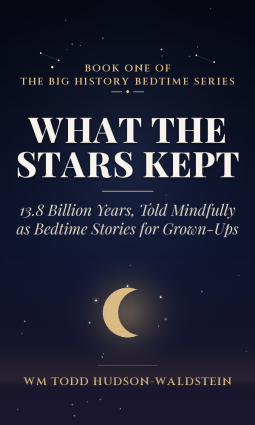
What the Stars Kept
13.8 Billion Years. Told Mindfully as Bedtime Stories for Grown-Ups / Big History Bedtime Stories Series / 1
This title was previously available on NetGalley and is now archived.
Send NetGalley books directly to your Kindle or Kindle app
1
To read on a Kindle or Kindle app, please add kindle@netgalley.com as an approved email address to receive files in your Amazon account. Click here for step-by-step instructions.
2
Also find your Kindle email address within your Amazon account, and enter it here.
Pub Date Aug 16 2026 | Archive Date Oct 7 2026
Talking about this book? Use #WhattheStarsKept #NetGalley. More hashtag tips!
Description
Thirteen point eight billion years, told slowly, at the end of the day.
Most of us learned the story of the universe as a list of facts. Numbers too large to feel. Dates that meant nothing at bedtime. This book tells it differently — as a sequence of quiet stories, written to be read the way you'd read to a child you love, except the child is you.
From the first bursting of light through the shaping of the Earth, the first living cell, the opening of eyes, the flower and the feather, and finally the small upright creature who learned to carry fire and give it a name — each era ends where the day should end. In rest. In something kept.
The science is accurate and sourced. The voice is not a lecture. Written in a spare, line-broken style meant to be read aloud or read slowly, What the Stars Kept is for readers who want the real story of everything and want it to land somewhere gentler than awe — somewhere closer to belonging.
Book One of the Big History Bedtime Series. Includes a full science glossary, per-era sources for further reading, and a note for parents and teachers.
For readers of Carl Sagan, Robin Wall Kimmerer, and anyone who has lain awake wanting the universe to feel like home rather than a void.
A note for reviewers: This book is laid out in a poetic, phrase-by-phrase line style rather than standard prose paragraphs — this is deliberate and intended for read-aloud pacing. Footnotes throughout link to a glossary at the back. No content warnings apply; extinction events and deep-time loss are handled contemplatively. Written for adults, but early readers have read it aloud to children with no trouble; a separate Young Readers' Edition (ages 10–14) is also planned for 2027.
Advance Praise
"An almost incantatory rhythm to the language... it deserves to be recorded and listened to on successive nights before sleep." — Terence Young, author, educator and poet
"If the intent is to produce calm, wonder, and meaningful sleep, the book succeeds completely." — Dr. Colin Nelson, MD
"I definitely had the sense of being held and a part of something beautiful." — Margaret Corrigan, author
Marketing Plan
Early reader response
"You can hear the author's heart is embedded in the telling, and by the time I finished, I felt more hope for our broken world. Extremely timely in this season of climate anxiety." — Rev. David Ohori, MDiv, MACP
About the series
What the Stars Kept is Book One of the Big History Bedtime Series, a four-volume contemplative history running from the origin of the universe to the near future. Books Two, Three, and Four are drafted and in production, with Young Readers' Editions (ages 10–14) planned for 2027.
Marketing and promotion
An audiobook edition of Book One is currently in production.
Targeted outreach to homeschool and classroom educators. The book includes a note for parents and teachers and per-era sources for further reading.
Positioned for readers in contemplative science, meditation, and bedtime reading.
Reviews posted to Amazon and Goodreads at publication are especially appreciated.
Available Editions
| EDITION | Ebook |
| ISBN | 9798171988494 |
| PRICE | $2.99 (USD) |
| PAGES | 210 |
Available on NetGalley
Available to Buy
Buy on Amazon Buy on BN.com Buy on Bookshop.org Buy on KoboAverage rating from 2 members
Featured Reviews
 Madison C, Educator
This book is a scientific devotional of short poems dedicated to universal and philosophical ideas. Each set of poems are meticulously separated by topic and then cross-referenced to other poems in the collection. The organization and structure of the collection puts the reader in mind of a scientist, which compliments the content of the poems. Poems are interrupted with direct commentary to the reader, separated from the other verse in bold, which provides a philosophical and reassuring thought to ponder. This is why I was put in mind of a religious devotional—one could easily sit each night with one of these verses and relax. For a view of the creation of the universe without religious undertones or judgment, these bedtime meditations are bite-sized gifts.
I would give this volume a higher rating, but my one criticism is that the nature of the structure—the categorizing, the footnotes, the AI editing—seems to sanitize these very human and emotional concepts.
 Stephen G, Reviewer
There was a lot I liked about the book. Wm Todd Hudson-Waldstein takes a poetic look at big history and through a glossary tied to footnotes in the text explains what the poetic sequences are about. The poetic looks are interesting and I was frequently able to figure out what part of big history was being referred to before checking the glossary. Sometimes I couldn’t or was incorrect but that was fine and was part of the fun of the book. The explanations in the glossary are quite clear and well-written. I also liked how Hudson-Waldstein discussed the strength of the evidence for the information in the glossary. And the book was a pleasant way to close out the day. Thank you to NetGalley and Victory Editing NetGalley Co-op for the advance reader copy.