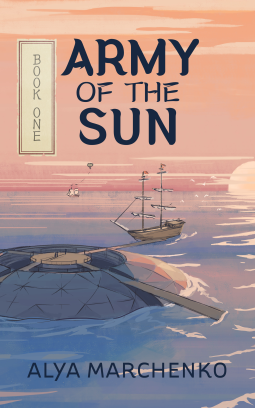
Army of the Sun: Book One
Sign In or Register Now to see if this title is available for request.
Buy on AmazonSend NetGalley books directly to your Kindle or Kindle app
1
To read on a Kindle or Kindle app, please add kindle@netgalley.com as an approved email address to receive files in your Amazon account. Click here for step-by-step instructions.
2
Also find your Kindle email address within your Amazon account, and enter it here.
Pub Date Nov 15 2026 | Archive Date Nov 16 2026
Talking about this book? Use #ArmyOfTheSunBookOne #NetGalley. More hashtag tips!
Description
For centuries, the scattered islands of the Archipelagos have been bound together by oohnica—a force as natural as wind, tide, or gravity, yet harnessed only by aghitas: groups of four people trained to think, act, and feel as one.
Around this strange discipline, universities have risen, realms have prospered, and an uneasy peace has lasted long enough for war to become a subject of history lessons.
Jiro arrives at the University of Eine pursuing a dream: to join an aghita, master oohnica, and become a navigator like his ancestors. But the group that chooses him is anything but ordinary. Led by a brilliant student with more ambition than patience, it includes strangers, rivals, and someone whose innate talent for oohnica should not exist.
At first, their troubles seem like the ordinary struggles of any young aghita learning to work as one. But soon the signs are impossible to dismiss: oohnica is changing—or perhaps revealing that it was never what the scholars believed it to be.
As Jiro’s dream and the old peace both come under threat, he and his companions must leave the safety of the university walls and follow the mystery across the sea.
What they discover could remake their understanding of the world and of one another—and expose the powerful factions already moving to reshape the future of the Archipelagos.
A Note From the Publisher
The novel is approximately 115,000 words and is the first volume of a completed duology.
It may appeal to readers who enjoy the intellectually curious, scientifically minded characters and big ideas of Neal Stephenson, the immersive secondary-world quality of Austin Tappan Wright’s "Islandia," and the restrained, thoughtful use of magic found in Ursula K. Le Guin’s "Earthsea."
The Kindle edition and paperback releases November 15, 2026. Honest reviews on NetGalley, Goodreads, Amazon, personal blogs, and other review platforms are appreciated, but never required.
Advance Praise
“Overall, Marchenko’s series-starter is an ambitious, slow-burning fantasy that trades familiar dragons-and-swords tropes for something rarer: a lived-in academic magic system, a genuinely strange central mystery, and a cast of young adults whose friendships, rivalries, and half-formed romances feel as consequential as the looming geopolitical crisis that surrounds them... This novel is recommended for readers who have patience for slow-burn worldbuilding and are hungry for a narrative that treats found-family drama and speculative anthropology as seriously as plot exposition.” — Kirkus Reviews
Available Editions
| EDITION | Ebook |
| ISBN | 9798996119417 |
| PRICE | |
| PAGES | 446 |
Links
Available on NetGalley
Available to Buy
Buy on AmazonAverage rating from 2 members
Featured Reviews
 Reviewer 1105794
Posted now on Goodreads and again on various platforms when the book releases
The Archipelagos contain four archipelagos, estimated by scholars to be about a quarter of the world, enclosed by the Gale Ring which allows nothing to pass through. Each season has a Gale Month that produces extreme weather throughout The Archipelagos. It is hypothesized that millennia ago the Calamity wiped out civilization and nearly all life. For centuries the Dark Ages reigned, though in the fullness of time civilization remerged from the darkness. As governing powers of The Archipelago began to stabilize they sought to rediscover their world. On the Distant Isles, the Oonanghan practiced oohnica, a form of collective meditation with mystical properties. Over the centuries that followed it was developed as a science and became more widespread. This led to the Great Break between those who could become oohnie and those who could not. Centuries again passed, bringing events to the current day. Oohnica has become integral to the infrastructure and daily life of their societies. The two branches studied at universities are anghi, the theoretical aspect that deals with information, and uglu, the practical aspect which allows for the physical creation of objects.
Jiro is a student at Eine University, and his dream is to be in an aghita, a four person group of oohnie, of navigators. He wants to travel across The Archipelagos, perhaps even find a way beyond, and to discover all that yet remains unknown. This is the personal account of his daily life. It begins as a mundane tale, then events conspire for it to be otherwise. The circumstances are conducive for focusing on romance, but at least for this book, it doesn't.
There's an initial learning curve with the Japanese and fictional words, though it didn't take long for me to be comfortable, and a glossary has been provided. The four part narrative structure of this duology, known as kishotenketsu, has the first book present the questions and the second provides the answers. Another typical trait is that conflict has far less prominence.
This book caters to my preferences, so my only complaint is that doesn't do more with what it has. There's a version of this that I could've given the highest rating. Oftentimes there's too much that drags the rating down for me to do so, though that isn't the case here. The limitation here is that there isn't anything that elevates it to greatness. This book is a solid read with an interesting world and intriguing integration of the preternatural. The central mysteries provide a sense of wonder, such as what's seen on the cover.
Army of the Sun is Marchenko's self-published debut. It was originally written in Russian, but Russia's invasion made being an Ukrainian writing and publishing in Russian nonviable. Marchenko now resides in the United States and together with his wife has translated Army of the Sun into English. To their credit I didn't feel like I was reading a translation at all.
Rating: 3.5/5
----
I saw this while looking at the recently added SFF books on Netgalley. I hadn't thought I'd request a self-published book again with how it's gone before, so I had to consider for a while whether I wanted to be involved. At the time of this writing the only other review is from the editor. Aside from the problem of discovery, there's the problem of prior approval which provides the social proof that it's worthwhile.
Even if someone comes across a book that doesn't mean there will be any interaction. Unfortunately, this is reasonabe due to the limits of time, interest, and money. Why try anything that hasn't been endorsed by so many others, from peers to publishers? That's a problem that the Self-Published Fantasy Blog-Off (SPFBO), The Self-Published Science Fiction Competition (SPSFC) have sought to address. It's true that all books are a leap of faith, and that's especially so for anything self-published.
For me it was worthwhile. A 3.5 rounded up to 4 may not seem like much of a score for a lot of people, but it's the highest rating I've ever given a self-published debut. I'd be astounded and distressed if I had given it any higher, because I'd know that it would be unlikely to ever have the readership that I feel it'd deserve. That gets into what social responsibility anyone with a significant audience has.
As always when writing about anything there's tension between saying too much or too little. Is it better to leave something to surprise, or use it to draw in readers at the expense of that surprise? An example of this is the cover itself. In other cases simply saying that there's something primes the reader to expect and speculate about it. Specific concepts can appeal to, repel, or have readers be indifferent.
Contemporary books having LGBT content is relatively common and this one is no exception. So, the question is, at least in terms of marketing, whether to play that up or not. Would it live up to expectations? This also invites scrutiny as to whether the depiction meets the consensus option of social acceptability, especially from the most vocal online.
Army of the Sun reminded me of a lot of other media, which isn't the same as saying that it referenced anything, and is limited by what I've personally experienced. The foremost was Shinsekai Yori/From The New World, though this has far less turmoil. Children of the Whales also came to mind, to a lesser extent. The Gale Ring reminded me of Ken Liu's The Dandelion Dynasty. The uglu are reminiscent of the Atelier games. The "magic school" life only has superficial similarities to Grossman's The Magicians, Modesitt's Imager series, or Sato's The Irregular at Magic High School. The difference between all of these is oohnica is only usable as a collective rather than as an individual. If it had gone more towards romance, I could say it was like Dusk Beyond the End of the World, but I wouldn't because that became an absolute disaster, especially the last few episodes. Lastly, I couldn't tell if a character was quoting Kamina from Tengen Toppa Gurren Lagann, or if it was coincidental phrasing. There's a lot more that could be mentioned, though there always is.
When I wrote that a version of this book could have my highest rating, I was referring to David Zindell's The Broken God. They don't have all that much in common, but it's the same general idea to me.
In the end the question remains, should you try to read this? Yes, you should, if it seems like something you could like.