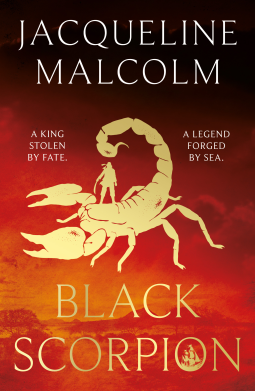
Black Scorpion
Sign In or Register Now to see if this title is available for request.
Buy on Amazon Buy on KoboSend NetGalley books directly to your Kindle or Kindle app
1
To read on a Kindle or Kindle app, please add kindle@netgalley.com as an approved email address to receive files in your Amazon account. Click here for step-by-step instructions.
2
Also find your Kindle email address within your Amazon account, and enter it here.
Pub Date Oct 28 2026 | Archive Date Nov 23 2026
Talking about this book? Use #BlackScorpion #NetGalley. More hashtag tips!
Description
In 1715, Kofi Akwasi III is born to be the next king of Abyssinia in East Africa. Following the sudden death of his parents, he must quickly learn how to lead his people to victory through the country’s ongoing civil war. Guided by the Black Scorpion spirit, Kofi rises from boy to legendary king.
But on a voyage to England, tragedy strikes. Stripped of his family, his freedom and his memories, he is cast into the brutal world of the Atlantic slave trade.
Rescued by pirates, he forges a new life at sea, rising to command a powerful fleet. Yet when his memories return, so too does the pain of all he has lost: his queen, his newborn son and his kingdom.
Set against the sweeping backdrop of Africa, the Caribbean and the eighteenth-century Atlantic, this epic historical adventure follows one man’s relentless quest to reclaim his destiny.
A Note From the Publisher
Available Editions
| EDITION | Ebook |
| ISBN | 9781835746523 |
| PRICE | £4.99 (GBP) |
| PAGES | 328 |
Available on NetGalley
Available to Buy
Buy on Amazon Buy on KoboAverage rating from 2 members
Featured Reviews
 Reviewer 2179953
"Pride goeth before destruction, and an haughty spirit before a fall."
This epic follows Kofi Akwasi III, a ruminative Abyssinian orphaned prince, who is thrust into becoming a king at the young age of 12 where he is expected to run an army, provide for his people and protect his lands against the growing threat of nearby kingdoms, foreigners and the egregious Atlantic slave trade during the 18th century. With the guidance of Kofi's elders, his parent's spirits, an uncle who wants his throne, the gods and Kofi's spirit form, the Black Scorpion, he conquers everyone around him with the goal to take over the continent and ultimately beyond as the King of Kings. As Kofi grows in age, strength and wisdom, so does his hubris.
Shortly after marrying Fatima Khari, the daughter of a lord from a southern kingdom, Kofi decides to depart for England with his pregnant queen in hopes of forming an alliance with the country not realizing he would be making a fateful error. By failing to heed his wife's warning, a premonition she received when she was 12, he sets sail with her on the English ship, The Elizabeth, which kick starts the chain of events that shape the rest of his life.
During a hurricane caused by the gods, circumstances go from bad to worse when the crew of Englishmen he desperately wanted to befriend betray Kofi and he finds himself sinking in the depths of the vast ocean. Separated from his family and miraculously escaping death, Kofi is retrieved from the ocean with his memory wiped of everything he knew, including himself, and is forced into slavery. Kofi will have to remember how to think not like a man or a warrior, but a king to escape captivity, survive amongst pirates and reclaim his rightful title.
Malcolm's captivating writing makes the reader feel fully immersed from the first page. You feel like your breathing, smelling, hearing everything right alongside Kofi throughout his travels and fight for survival. The book is divided into three sections, each appropriately labeled death because Kofi needs to let his ego and stubbornness die in order to truly become the king he is meant to be. Repetition is used throughout the book to build rhythm and intensity and, ironically, slowly but surely helps as he struggles to regain his memories.
Queen Fatima is arguably the most important figure considering she is essential to both his survival and success with her strong spirituality, women's intuition and keen sense of self. I don't believe that Kofi fully grasped that the misogyny and sexism he had been taught and internalized is what prevented him from accepting the fact that he needs women to succeed in life. Merely viewing his wife as a necessary vessel to produce an heir rather than as an equal was vexing to read but, unfortunately, was necessary for his major character development. I hope there is a second installment to this book where these themes can be further explored, and we can continue on the journey with King Kofi Akwasi III.
To all who love reading epics, historical fiction or African mythology, do not walk, run to pick this up as your next read. You will not be disappointed. Thank you to The Book Guild and Jacqueline Malcolm for providing this book for review consideration via NetGalley.
 Priscilla L, Reviewer
The Black Scorpion by Jacqueline Malcolm is a fictional narrative set against the backdrop of the 18th century, ruled by brutal wars and the slave trade.
Kofi Akwasi, the young prince of the Solomonic dynasty, has just passed through his coming-of-age ceremony in his twelfth year and has become a man, while crouching through the plains of the Abyssinian territory with his father during a bloody war. Kofi’s admiration and respect for the ruler, as a stately ruler and father, is apparent, but what becomes of his fate when a tragic incident places the young prince between the warm embrace of power and the cold hands of mutinous death?
The story continuously revolves around the main character, Kofi. He is depicted as an introspective person yet with a mature mind, thrust into the politics of the throne at a young age. Kofi had no choice but to abandon the blissfulness of childhood and take on the enormous responsibility of ruling a large tribe ravaged by greed and idleness as a result of several years of bountifulness and a lack of an external enemy, making each tribe turn against itself. Despite these circumstances, Kofi brought peace and calm from his birthplace and even into other parts of the Abyssinian territory, but “How can a blessed life be so cursed?”
The book is divided into three parts listed as death. It takes the reader through several stages of Kofi’s life, from his early years of coming into power, his quest for more, the unfortunate circumstances he had to grow through, and the latter rays of hope at the end of the book. The Black Scorpion is an intensely packed narrative.
Fatima is another important character in The Black Scorpion. The narrative depicts the beauty of love, the persevering wisdom of a female leader, and the tragic pain that can accompany the loss of a loved one.
The author has a penchant for continuously piquing the reader’s curiosity through her vivid, illustrative phrases. You feel each passing emotion of the protagonist: the pride of being a leader, the love for his queen, the hopelessness of a forgotten past, and the fiery vengeance for a stolen past.
The Black Scorpion also uses a lot of African mythology. The author describes these African gods not just as spiritual entities without emotional affiliations. Their anger, love, and even pain are adequately elucidated by Jacqueline Malcolm, as the author gives life to these characters.
At some points in the book, though, I was confused by the general use and description of the African continent. It felt as if Africa was a large continent with interconnected tribes rather than a home to highly structured states and ruling empires even during the 18th century. Though it is a fictional narrative, I felt there should be realistic bases for the structure and system that predominated the African continent during this period, so as not to leave the reader confused.
But in a better light, the author writes in such a way that she utilizes all five senses in describing this narrative. You feel each passing emotion and mood. You could literally feel the air and smell the surroundings through each passing phase that Kofi had to undergo.
The transatlantic slave trade is an important thematic element in The Black Scorpion. The narrative adequately describes the tragic nature that shaped this inhumane practice on a personalized scale, and Kofi’s fight for independence during this phase.
So, for readers who are curious about the advent and effect of the transatlantic slave trade, and the beauty of an African monarchy through a fictional lens, The Black Scorpion is a must-read.