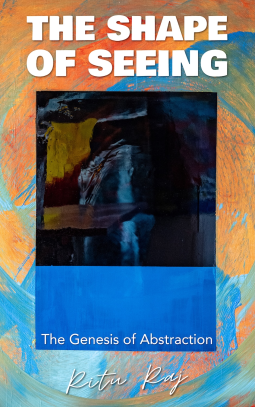
The Shape of Seeing
The Genesis of Abstraction
Sign In or Register Now to see if this title is available for request.
Buy on Amazon Buy on BN.com Buy on Bookshop.orgSend NetGalley books directly to your Kindle or Kindle app
1
To read on a Kindle or Kindle app, please add kindle@netgalley.com as an approved email address to receive files in your Amazon account. Click here for step-by-step instructions.
2
Also find your Kindle email address within your Amazon account, and enter it here.
Pub Date Sep 27 2026 | Archive Date Apr 15 2027
Description
In 2020 the world went silent. Ritu Raj took a length of ordinary cotton string from a kitchen drawer, dipped it in pigment, and pulled it across a canvas. The line it left, shuddering, pooling, refusing control, was not a painting. It was a question.
The Shape of Seeing is the painter's attempt to answer it. Not a memoir in the conventional sense, it is an inquiry into abstraction, perception, silence and attention, written alongside the paintings. It moves from a childhood in New Delhi, among the Indian modernists Souza, Raza, Husain and Swaminathan whom his father, the critic K.B. Goel, wrote about, to a studio in the Arizona desert where thread replaces the brush and gravity completes the mark.
Across twenty chapters, from the geometry of silence and the language of color to the ethics of attention and the infinite return, Raj argues that abstraction is not an escape from reality but a way of meeting it without illusion.
"Perhaps abstraction is simply what happens when words run out."
For readers of art, aesthetics and contemplative nonfiction; for painters, collectors, and anyone who has stood in front of an abstract painting and felt something they could not name.
Available Editions
| EDITION | Paperback |
| ISBN | 9781969063718 |
| PRICE | $17.99 (USD) |
| PAGES | 118 |
Available on NetGalley
Available to Buy
Buy on Amazon Buy on BN.com Buy on Bookshop.orgBISAC Codes
Average rating from 1 member
Featured Reviews
 David W, Media/Journalist
Ritu Raj came to be a painter from a most unusual path; he was a mathematician. He spent decades leveraging his love of numbers as an entrepreneur, starting, developing and selling businesses, from cloud computing to pet hotels. Then he rediscovered painting and has made that the focus of his world. His view of it seems like it comes from, well, a mathematician.
In The Shape of Seeing, a very short book of his way of looking at art, Raj shows a completely different appreciation from most mortals. His own paintings are all abstract, which means they are anything he says they are. And viewers don’t have to agree. As he describes it: “Abstraction moves differently for every viewer. There is no fixed meaning, only the shared tempo of perception.” His way of looking at the world is, to say the least, challenging.
He is lucky that he found his style quickly. Most artists I know are still looking. Everyone wants to be a Monet or a Seurat, with a unique style only they can exploit. Or a Picasso, who found his style several times (blue period, cubist, abstract, etc.) and was identified with all of them.
For Raj, it was COVID-19. During the lockdown, in isolation, he found himself playing with a length of string from a kitchen drawer. He soaked it in paint and dragged it across a canvas. It was a revelation. Depending on the kind of string, and whether he snapped it or dragged it or twirled it or placed it, he discovered a universe of painting possibilities he will never exhaust. String launched his career in a whole new direction, clearly focused.
But the book is more an exposure of his mathematics brain, as he analyzes every conceivable thing about his painting and art in general.
He doesn’t talk about perspective or interpretations. He talks about inquiry and conversation. Every art term you can think takes on a different meaning for Raj. His language is hip and new age. He describes abstraction as “a deepening of reality, rather than a retreat from it.” Or “Meaning appeared, if at all, in the space between attention and accident.” And finally: “The world, as I experience it, is not composed of objects, but of relationships – between light and shadow, form and void, presence and absence. Abstraction mirrors that condition. It does not depict; it reflects.”
He does this with every little aspect, from color to sound (especially silence), to time, to geometry, to lines, to horizons, to attention. He sees with his fingers, he says. Holding the brush, they know exactly what to do before his brain does. They feel and understand the tension in the string, the viscosity of the paint, and on and on.
At first, the book was a revelation. At last, here was an artist eloquent in print as well as on canvas. So this is how it is done, readers might well think - at first. But it soon turns to being too much. In the chapter on shadows, for example, Raj explains the value of shadows, how they influence how viewers see paintings. He says lightness and darkness are not rivals, but “partners in perception.” Black pigment implies tension, while light colors let him “feel light’s weightlessness.”
But his paintings are all abstract. They cast no shadows. They can’t because that would immediately restrict them to being three dimensional objects, something that does not appear on any painting of his that I could see. The whole chapter on shadows simply didn’t apply to him or his work. He is all about the effects of string. So why a chapter on shadows that he does not follow himself?
The book, short to begin with, is even faster to read because most of the paragraphs are one sentence, as he tries to make each one a unique and startling point. The chapters tend to be four to six pages long. There are 20 of them in just over a hundred pages. There is a sameness to the chapters as readers will soon ask themselves what is he going to say bizarrely this time?
But what really became annoying was his use of his own paintings as examples. He doesn’t show them. There are no paintings in The Shape of Seeing. He talks about them by title, as if readers have an image in front of them. And his website is difficult to navigate, because most of his paintings appear in thumbnails (slathered rather than arranged) on the homepage, without titles. So readers will never know what he is referring to in his points in the book.
It became numbing rather than exhilarating. So while I learned a lot about how an artist can be a different kind of human than I usually encounter, the effect on me, at least, was so what? It changes nothing.