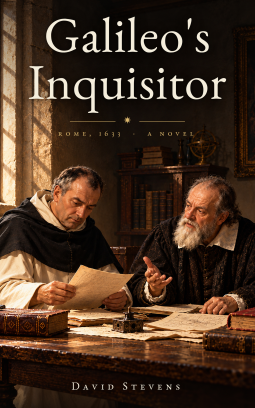
Galileo’s Inquisitor
Rome, 1633 - A Novel
This title was previously available on NetGalley and is now archived.
Send NetGalley books directly to your Kindle or Kindle app
1
To read on a Kindle or Kindle app, please add kindle@netgalley.com as an approved email address to receive files in your Amazon account. Click here for step-by-step instructions.
2
Also find your Kindle email address within your Amazon account, and enter it here.
Pub Date Oct 20 2026 | Archive Date Nov 7 2026
ARC provided by Victory Editing NetGalley Co-op | Decision Publishing
Talking about this book? Use #GalileosInquisitor #NetGalley. More hashtag tips!
Description
Rome, 1633. Galileo Galilei, sixty-nine and ill, has been carried to the Holy Office on a litter. The charge they can name is a piece of paper from 1616. The offence they cannot name is the book in which he put the pope's own argument into the mouth of a fool.
Vincenzo Maculano, Commissary General of the Holy Office, is a military architect and a hard prosecutor. Handed the charge without the reason, he reads the book to the end, and finds something nobody in Rome has noticed. The proof at the heart of it does not work.
What he does with that, in a courtyard, walking an old man round an orange tree, is the business of this novel.
Every date, document, decision and outcome here is the historical record's. The conversations are invented.
Galileo's Inquisitor stands alone and reads in an evening. Readers who want the documented history behind it will find it in Galileo Galilei: What Counts as Proof, published the same day.
A Note From the Publisher
Every quotation in the book is sourced in the notes at the back, and the same source list is at davidstevensbooks.com/galileo if you want to check one against the record.
Reviews posted on or after 1 November help most. Goodreads, your own site and social accounts are all as welcome as the retailers.
Marketing Plan
Galileo's Inquisitor is one of six books publishing together on 1 November 2026 from Decision Publishing: five short narrative histories and a novel, each written to be read in a single evening.
Distribution. Paperback and case laminate hardcover through IngramSpark, returnable, available to the trade at a full 55% discount. Ebook in all major stores.
The series cross-promotes itself. Every book carries, straight after its epilogue, the opening of another book in the series and a link back to the author's site. The six are written to be read in any order and to send readers to each other.
Author site. davidstevensbooks.com carries a research section for each subject: a timeline, the full source list, and direct answers to the questions readers actually search for. Was Galileo tortured? Did he say "and yet it moves"? These pages are the book's long-term discovery engine.
Readers' list. Readers are offered The Trial File, a short free book on what the documents in Galileo's trial file actually say, for joining the list.
Reviews. Advance copies through this listing and through Booksprout ahead of publication.
Companion title. Galileo: What Counts as Proof, publishes the same day and is listed separately here.
Available Editions
| EDITION | Ebook |
| ISBN | 9798953350099 |
| PRICE | $9.99 (USD) |
| PAGES | 174 |
Available on NetGalley
Available to Buy
Buy on Amazon Buy on BN.com Buy on Bookshop.org Buy on KoboBISAC Codes
Average rating from 2 members
Featured Reviews
 Daphne S, Reviewer
An old, learned and opinionated man goes up against the Holy Father of Rome and the teachings of the Holy Bible.
Galileo wrote a book in 1616, that backed up the ideas of Nicolaus Copernicus, in that, the Sun is the centre of the universe, and the Earth and other planets orbit around the sun. The earth rotates daily on its axis, and revolves annually around the sun.
These ideas were met with opposition by the Catholic Church.
Galileo was an accomplished teacher of mathematics, an astronomer and a physician, he had discovered planets using a rudimentary telescope, and done scientific experiments on the movements of tides .
The Roman Catholic Church had given permission for his book to be printed , but later, Pope Urban issued a decree to the effect that God may have made the world by means that man cannot imagine, and demanded that Galileo make an admission that his theories were mistaken.
Galileo instead conceded a fault, but not a confession.
He was charged with heresy, put on trial and his book was prohibited.
His punishment was house arrest.
An interesting read, but some of these scientific details went over my head, its absolute decades since I studied science.
I remember seeing a wonderful display of shooting stars one clear night in France, perhaps Galileo felt the same amazement and admiration for these celestial events taking place in the very heavens he had tried to explain to others?
Science against religion. The Bible against Astronomy. Why do we know the name of Galileo better than that of the Pope that tried to ban his ideas?
A detailed and well researched book. A man who stayed true to his principles.
My thanks to Netgalley and the publishers Victory Editing, Netgalley Coop, for my advanced copy. I will leave reviews to Goodreads and Amazon UK .
A four star read.