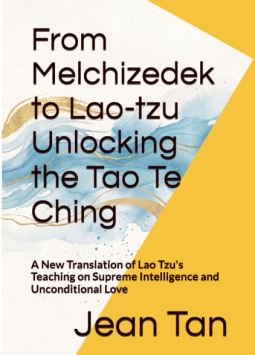
From Melchizedek to Lao-tzu: Unlocking the Tao Te Ching
A New Translation of Lao Tzu's Teaching on Supreme Intelligence and Unconditional Love
Sign In or Register Now to see if this title is available for request.
Buy on Amazon Buy on BN.com Buy on Bookshop.orgSend NetGalley books directly to your Kindle or Kindle app
1
To read on a Kindle or Kindle app, please add kindle@netgalley.com as an approved email address to receive files in your Amazon account. Click here for step-by-step instructions.
2
Also find your Kindle email address within your Amazon account, and enter it here.
Pub Date Oct 6 2026 | Archive Date Apr 15 2027
Talking about this book? Use #SupremeIntelligence #NetGalley. More hashtag tips!
Description
Taoism has been long translated as a type of nihilism. Yet, among the great teachers the Urantia Book surveys, Lao-tzu stands out as the only one whose message is not criticized. Gautama Buddha is praised for his ethics and for his effort to break the caste system. Yet Gautama Buddha's original message is faulted for teaching no personal God, for seeking the passive elimination of desire rather than active spiritual living. Confucius is lauded for his social morality. Yet Confucius teaching is said to have put ethical duty and ancestor-centered tradition in the place of living spiritual experience, at a cost to China's capacity for renewal. The Vedic sages are commended for the height of their metaphysics. Yet their teachings are said to have turned God into an abstract and impersonal "IT IS" rather than a personal Father and so it opened the way to fatalism and social stagnation. Paul is praised for carrying the knowledge of Jesus to the world. Yet Paul's teaching is charged with building a religion about Jesus, burdened with older theories of blood atonement and sacrifice. Muhammad is praised for establishing a clear monotheism. Yet his teaching is criticized for reliance on coercion and fear, and for a lesser view of women.
In contrast, the Urantia Book defends the teaching of Lao-tzu. It defends him first against the charge of passivity. Wu Wei has long been read as apathy, a counsel to withdraw and do nothing. The Urantia Book rejects that reading outright: "Lao's teaching of nonresistance and the distinction which he made between action and coercion became later perverted into the beliefs of 'seeing, doing, and thinking nothing.' But Lao never taught such error, albeit his presentation of nonresistance has been a factor in the further development of the pacific predilections of the Chinese peoples." (94:6.7) What Lao-tzu taught was non-coercion, not inaction.
The Urantial Book defends him next on the nature of the Tao. It calls Lao-tzu "a man of great spiritual vision" who "declared Tao to be the One First Cause of all creation" and taught that man's eternal destiny was "everlasting union with Tao, Supreme God and Universal King" (94:6.3). And it credits him with this saying about a God who answers: "The Absolute Deity does not strive but is always victorious; he does not coerce mankind but always stands ready to respond to their true desires; the will of God is eternal in patience and eternal in the inevitability of its expression." (94:6.6) And it defends him on the question of blame. With Buddhism and Hinduism, the Urantia Book holds that the founders' own concepts carried the seeds of later error. With Taoism, it says that popular Taoism "has very little in common with the lofty sentiments and the cosmic concepts of the old philosopher who taught the truth as he perceived it" (94:6.8). The fall came afterward, in "those spiritually dark ages of China," when religion "degenerated into a pitiful theology wherein swarmed devils, dragons, and evil spirits" (94:6.12).
The fault is laid on later generations, not on Lao-tzu's original teaching. That means that the Tao Te Ching that we have been taught for centuries by traditionalists have been through misunderstanding of the text: Wu Wei as passivity whereas Lao-tzu meant non-coercion, the Tao as impersonal abstract principle whereas Lao-tzu meant a living intelligence. That is not a small matter of emphasis. It changes what nearly every chapter says.
If Lao-tzu’s original message means different meaning from traditional understanding, there is an urgent need for a new translation with the use of new English words with clear meanings. That is what I intended with this book. Your support is earnestly appreciated.
Advance Praise
very interesting and insightful perspective to bridge east and west ancient wisdom. It is a great philosophy reading.
very interesting and insightful perspective to bridge east and west ancient wisdom. It is a great philosophy reading.
Available Editions
| EDITION | Paperback |
| ISBN | 9798178947784 |
| PRICE | $15.00 (USD) |
| PAGES | 191 |