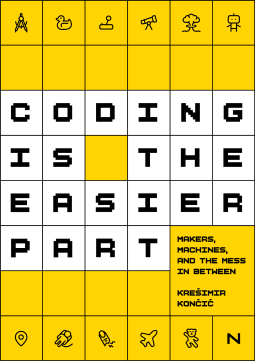
Coding Is the Easier Part
Makers, Machines, and the Mess in Between
with Matt Quandt (Narrator)
Sign In or Register Now to see if this title is available for request.
Buy on Amazon Buy on BN.com Buy on Bookshop.org Buy on KoboSend NetGalley books directly to your Kindle or Kindle app
1
To read on a Kindle or Kindle app, please add kindle@netgalley.com as an approved email address to receive files in your Amazon account. Click here for step-by-step instructions.
2
Also find your Kindle email address within your Amazon account, and enter it here.
Pub Date Nov 3 2026 | Archive Date Dec 25 2026

Talking about this book? Use #CodingIstheEasierPart #NetGalley. More hashtag tips!
Description
“Refreshing, witty, and often wry perspective on the culture, and future of software, cutting through both AI hype and technological doomcasting with equal skepticism” - Lana Todorovic, Editor-in-chief
“A must-read for our time. The audience will find their own paradigms shifting dramatically throughout Končić's sequence of thought-provoking, exquisitely evidenced chapters which ultimately reveal the humanity in programming” - Stephen Dudas, PhD in Literature, Reedsy Discovery
Peak inside:
In just a matter of days, a wave of rushed AI products exposed how far we are from the robots sci-fi writers spent decades crafting. Remember Commander Data, producing Sherlock Holmes–like deductions from his positronic brain; or WALL-E, spinning his tiny treads across a cosmic hush just to chase a crush. Even Arnie the Terminator was really polite when he decimated several police vehicles, with no intention of grazing a single cop. James Cameron even subtitled the sequence “Human Casualties: 0.0” just to soothe our nerves.
Our actual machines are far from the level of Schwarzenegger excellence, but let’s not use this blurb by rattling the skeletons in the AI closet, you’ll need to buy the book for that. What matters here is the narrative that robots will automagically create entire software packages, cure cancers or make coffee in a stranger’s house, with the last one being an eerie holy grail. Some gurus go further, alarming the revolution will wipe illustrators, screenwriters, and musicians off the Earth, while the surviving coders will turn into sweaty blue-collars tapping ceramic tiles instead of their clickety keyboards.
But just like WALL-E, we’ve tread this space before. I wrote my first video game somewhere around 1996, right around the time Microsoft released IntelliSense, a little helper-bot that could pop up and write substantial chunks of code. It was followed by a long parade of code generators, content management systems, and low-to-no-code builders. Even Figma, the designer’s weapon of choice, was made to spout complete user interfaces. On top of that, gig platforms such as Fiverr began offering ghost-coding for just a couple of bucks.
You’re guessing it right: Communities around these gizmos kept shouting that developers could finally rest and sip beach cocktails. But the opposite happened, and the number of makers kept growing over the last 30 years, which brings us to the first irony. Pair the shortage of engineering talent with the ever-growing demand for software, and you get a simple revelation: It was precisely those sleep-deprived programmers who pushed hardest for stronger, more efficient tooling. For example, JetBrains shows that three out of four programmers had already embraced coding copilots. Stack Overflow, the site which has been steadily drained by those copilots, reports similar numbers. The result is always the same: The people supposedly being automated away were first in line to build – and buy – that very same automation.
Is this your kind of book?
Drawing on unusual stories from the Incas’ databases, nuke-stopping machines, Open Source dramas, and today’s AGI / Super Intelligence theater, Krešimir Končić closes the gap between what the industry’s loudest panelists promise and what makers actually have to build, repair, and adapt. In Duda's words, the book makes plain that the future of software is going to require heavy lifting on the part of human beings who are capable of puzzling through the needs, ethics, questions of efficiency, politics, and possibilities of our technology.
Written for developers, designers, managers, entrepreneurs, and curious readers trying to make sense of AI without the hype or the doomsday narrative, the book explores why software will not write itself, why humans are not going away, and why we’re just scratching the surface of what software truly is.
Advance Praise
"A must-read for our time. This is not merely an in-house essay for folks in the coding and programming world. Končić invites a culture to better understand the work, the craft, the creativity, and the humanity of the people building, stumbling through, and reworking a modern era of technology." - Stephen Dudas, Reedsy Discovery, PhD in Literature from Miami University"
"A refreshing antidote to the endless stream of AI hype and doomcasting that dominates today's technology discourse" - Lana Todorovic, Editor-In-Chief
"I've read and edited Krešimir's columns for years, and he keeps doing what most tech writers eventually stop doing: checking, questioning and deeply analyzing the study behind the headline. He turned that worthy habit into a book." - Mia Biberović, Editor in Chief & Director ⋅ Netokracija & Shift Mag, Global Developer Content Team Leader ⋅ Infobip
"An inventive aspect of the work is the interpretation of programming as artistic expression, recognizing how a developer's individual values influence the software somebody else experiences. Equally original is Končić's proposition that businesses determine artificial intelligence adoption at the individual task level, accommodating the varying requirements within a single occupation" - Asher Syed, Readers Favorite
"Krešimir is often ahead of his time in the questions he raises and the connections he identifies, long before they become part of the mainstream conversation." - Robert Kopal, PhD, Full Professor, Head of the Institute for Creativity and Critical Thinking, Algebra Bernays University
Available Editions
| EDITION | Ebook |
| ISBN | 9798997465506 |
| PRICE | |