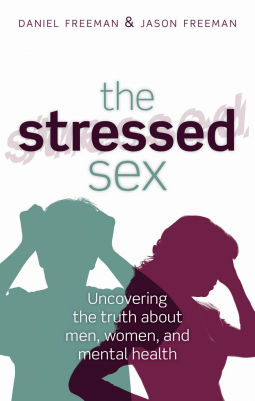
The Stressed Sex
Uncovering the Truth About Men, Women, and Mental Health
This title was previously available on NetGalley and is now archived.
Buy on Amazon
Buy on BN.com
Buy on Bookshop.org
*This page contains affiliate links, so we may earn a small commission when you make a purchase through links on our site at no additional cost to you.
Send NetGalley books directly to your Kindle or Kindle app
1
To read on a Kindle or Kindle app, please add kindle@netgalley.com as an approved email address to receive files in your Amazon account. Click here for step-by-step instructions.
2
Also find your Kindle email address within your Amazon account, and enter it here.
Pub Date Jul 1 2013 | Archive Date Jun 10 2013
Description
Every day millions of people struggle with psychological and emotional problems. The Stressed Sex
sets out to answer a simple, but crucial, question: are rates of
psychological disorder different for men and women? To date, this
important issue has been largely ignored in debates focused on gender
differences.
Daniel Freeman and Jason Freeman present a groundbreaking combination of epidemiological analysis and evidence-based science to get to the bottom of what's really going on. They provide an in-depth look at what the best and most comprehensive epidemiological surveys tell us about rates of specific psychological problems, and mental ill-health in general, across a range of countries. Weighing the evidence from epidemiology, genetics, neuroscience, psychiatry, and cognitive, social, and clinical psychology, they conclude--in a finding that is sure to provoke lively debate--that in any given year, women are more vulnerable to suffer mental problems.
The Freemans then explore the social, psychological, and biological factors that could account for this difference between the sexes. And they tackle other far-reaching questions as well. What is mental illness? How prevalent is it in society? How are such conditions best defined and diagnosed? What causes psychological disorders? How do we balance the various contributing factors?
This is a highly charged issue. To say that women are less mentally healthy than men can threaten women's struggle for equality in society. But if women are more vulnerable to psychological problems, it is a major public health finding--one that should inform treatment, guide research, and perhaps spark social change. The Freemans show us that it is an issue we cannot ignore.
Daniel Freeman and Jason Freeman present a groundbreaking combination of epidemiological analysis and evidence-based science to get to the bottom of what's really going on. They provide an in-depth look at what the best and most comprehensive epidemiological surveys tell us about rates of specific psychological problems, and mental ill-health in general, across a range of countries. Weighing the evidence from epidemiology, genetics, neuroscience, psychiatry, and cognitive, social, and clinical psychology, they conclude--in a finding that is sure to provoke lively debate--that in any given year, women are more vulnerable to suffer mental problems.
The Freemans then explore the social, psychological, and biological factors that could account for this difference between the sexes. And they tackle other far-reaching questions as well. What is mental illness? How prevalent is it in society? How are such conditions best defined and diagnosed? What causes psychological disorders? How do we balance the various contributing factors?
This is a highly charged issue. To say that women are less mentally healthy than men can threaten women's struggle for equality in society. But if women are more vulnerable to psychological problems, it is a major public health finding--one that should inform treatment, guide research, and perhaps spark social change. The Freemans show us that it is an issue we cannot ignore.
Available Editions
| EDITION | Hardcover |
| ISBN | 9780199651351 |
| PRICE | $27.95 (USD) |
Available to Buy
Buy on Amazon Buy on BN.com Buy on Bookshop.org*This page contains affiliate links, so we may earn a small commission when you make a purchase through links on our site at no additional cost to you.