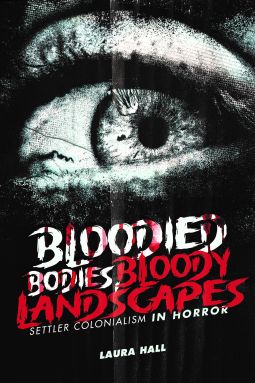
Bloodied Bodies, Bloody Landscapes
Settler Colonialism in Horror
This title was previously available on NetGalley and is now archived.
Send NetGalley books directly to your Kindle or Kindle app
1
To read on a Kindle or Kindle app, please add kindle@netgalley.com as an approved email address to receive files in your Amazon account. Click here for step-by-step instructions.
2
Also find your Kindle email address within your Amazon account, and enter it here.
Pub Date Sep 16 2025 | Archive Date Sep 22 2025
Talking about this book? Use #BloodiedBodiesBloodyLandscapes #NetGalley. More hashtag tips!
Description
ONE OF THE HILL TIMES TOP BOOKS OF 2025
Turning a lens on the dark legacy of colonialism in horror film, from Scream to Halloween and beyond
Horror films, more than any other genre, offer a chilling glimpse—like peering through a creaky attic door—into the brutality of settler colonial violence. While Indigenous peoples continue to struggle against colonization, white settler narratives consistently position them as a threat, depicting the Indigenous Other as an ever-present menace, lurking on the fringes of “civilized” society. Indigenous inclusion or exclusion in horror films tells a larger story about myths, fears, and anxieties that have endured for centuries.
Bloodied Bodies, Bloody Landscapes traces connections between Indigenous representations, gender, and sexuality within iconic horror classics like The Texas Chainsaw Massacre and Friday the 13th. The savage killer, the romantic and doomed Indian, the feral “mad woman”—no trope or archetype escapes the shadowy influence of settler colonialism. In the end, horror both disrupts and uncovers colonial violence—only to bury its victims once more.
Advance Praise
“This is the book I’ve waited my whole movie-geek life for. I found a kindred spirit in Hall, who clearly loves these movies and yet also struggles with their very nature and their meaning. Thus is the reality of the Indigenous horror movie fan, enamored and angered all at once. I’m so thrilled this book exists, for scholars, fans, and fi lmmakers the world over.”
—Jesse Wente, bestselling author of Unreconciled: Family, Truth, and Indigenous Resistance
“Bloody Bodies, Bloody Landscapes: Settler Colonialism in Horror is a must read
for anyone consuming horror media. Laura Hall masterfully executes dissecting the ways in which settler-colonialism is at the core of, sexism, racism, sanism, and white supremacy, and how we see those systems of oppression at work in historical and contemporary horror.”
—Jessica Johns, bestselling author of Bad Cree
“Bloodied Bodies, Bloody Landscapes is brilliant scholarship that pinpoints the ugly truth about the treatment of Indigenous people in horror cinema. But Hall is doing much more than examining tropes of mysticism, savagery, and settler colonialism-as savior in horror; she is directing our attention to the recuperative power of certain portrayals, thereby reminding us that an anticolonial lens can produce whole and full human stories—even scary ones.”
—Robin R. Means Coleman, author of The Black Guy Dies First: Black Horror from Fodder to Oscar
“Bloodied Bodies, Bloody Landscapes seeks to unsettle key concepts in horror by placing it into conversation with settler colonial studies.”
—Jacob Floyd, author of Cinematic Comanches
“Bloodied Bodies, Bloody Landscapes is deadly. It expertly foregrounds the most overlooked horror in this fi lm genre—settler colonialism.”
—Christine Sy, Associate Professor of Gender Studies, University of Victoria
Available Editions
| EDITION | Other Format |
| ISBN | 9781779400802 |
| PRICE | $32.95 (USD) |
| PAGES | 288 |
Available on NetGalley
Available to Buy
Buy on Amazon Buy on BN.com Buy on Bookshop.orgAverage rating from 4 members
Featured Reviews
 Ann B, Reviewer
This was so interesting and I feel like as a horror lover it is a must need to read to fully understand the media that we’re are consuming
Rae B, Librarian
I cannot wait to share this book with my friends and family. Laura Hall does a fantastic job tying the horror genre to colonization!
 Logan K, Reviewer
The book sets before it an impossible task and almost manages it. The author is not here to describe settler colonialism in horror; they are here to argue that settler colonialism is horror. Not in the obvious sense, but in the sense that horror - horror film - as a genre in North America is itself a manifestation of the popular feelings on the Indigenous.
Does it work? Better than I thought it would. The book considers different horror films and series, and how they work to enforce or struggle through the 'civ/sav' binary, with a particular emphasis on the 'Final Girl' trope and its relation to power and violence in the fears of the majority.
The interpretations are often contradictory. Horror writ large is a genre about the monster and the mixture of fear and desire that exists towards it, including using genre as a means to get subversive or heterodox material into cultural production. Here, the same work can be looked at as demanding the awfulness of North American history as it can be to dismissing it.
The book particularly shines in providing a good critical overview of its subjects, building its own analysis on top of it. However, this leads to the book's major weakness. Not all movies are as good a fit, and at points the book turns Procrustean in treating the Indigenous as the only true Other, of which all other others are a subset. Thus, some of the chapters in the middle in particular get tenuous.
I love a polemic, but to break out this tone patrol badge, late in the book the language walks past aggrieved and into derisive (particularly including goes at sarcasm, which is never a good sell in writing). It is unfortunate because author clearly wants to save the best for last, and the works that they have the most strong feelings about, good and bad. It is fun personality that adds to the weight of the work through most of the book, but there it starts to backfire in it making the argument read weaker in being more defensive.
Still, the utility here is intense, both in its overview of different genre interpretations and in its critical framework.
My thanks to the author, Laura Hall, for writing the book, and to the publisher, University of Regina Press, for making the ARC available to me.
Readers who liked this book also liked:
Jeanna Smialek
Biographies & Memoirs, Business, Leadership, Finance, History