*This page contains affiliate links, so we may earn a small commission when you make a purchase through links on our site at no additional cost to you.
Send NetGalley books directly to your Kindle or Kindle app
To read on a Kindle or Kindle app, please add kindle@netgalley.com as an approved email address to receive files in your Amazon account. Click here for step-by-step instructions.
2
Also find your Kindle email address within your Amazon account, and enter it here.
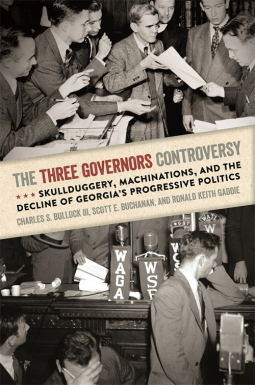
The death of Georgia governor-elect Eugene Talmadge in late 1946 launched a constitutional crisis that ranks as one of the most unusual political events in U.S. history: the state had three active governors at once, each claiming that he was the true elected official.
This is the first full-length examination of that episode, which wasn’t just a crazy quirk of Georgia politics (though it was that) but the decisive battle in a struggle between the state’s progressive and rustic forces that had continued since the onset of the Great Depression. In 1946, rural forces aided by the county unit system, Jim Crow intimidation of black voters, and the Talmadge machine’s “loyal 100,000” voters united to claim the governorship.
In the aftermath, progressive political forces in Georgia would shrink into obscurity for the better part of a generation. In this volume is the story of how the political, governmental, and Jim Crow social institutions not only defeated Georgia’s progressive forces but forestalled their effectiveness for a decade and a half.
The death of Georgia governor-elect Eugene Talmadge in late 1946 launched a constitutional crisis that ranks as one of the most unusual political events in U.S. history: the state had three active...
The death of Georgia governor-elect Eugene Talmadge in late 1946 launched a constitutional crisis that ranks as one of the most unusual political events in U.S. history: the state had three active governors at once, each claiming that he was the true elected official.
This is the first full-length examination of that episode, which wasn’t just a crazy quirk of Georgia politics (though it was that) but the decisive battle in a struggle between the state’s progressive and rustic forces that had continued since the onset of the Great Depression. In 1946, rural forces aided by the county unit system, Jim Crow intimidation of black voters, and the Talmadge machine’s “loyal 100,000” voters united to claim the governorship.
In the aftermath, progressive political forces in Georgia would shrink into obscurity for the better part of a generation. In this volume is the story of how the political, governmental, and Jim Crow social institutions not only defeated Georgia’s progressive forces but forestalled their effectiveness for a decade and a half.
Advance Praise
“The Three Governors Controversy is a
compelling narrative of the widespread notoriety engendered by Georgia’s
1946 election and its aftermath. This history reveals the underlying
conflicts of the succession battle by bringing together a careful
analysis of the politics of the period with an array of popular and
scholarly accounts.”
—Timothy J. Crimmins, coauthor of Democracy Restored: A History of the Georgia State Capitol
“At last we have a comprehensive analysis of one of the most colorful
episodes in the rich annals of southern political history. Bullock,
Buchanan, and Gaddie have succeeded not only in telling an oft-told tale
from a fresh yet still thoroughly engaging perspective but also in
sorting out its various immediate and long-term implications. This book
will be essential reading for scholars and simply irresistible to
southern politics junkies.”
—James C. Cobb, Spalding Distinguished Professor, Department of History, University of Georgia
“The Three Governors Controversy is a compelling narrative of the widespread notoriety engendered by Georgia’s 1946 election and its aftermath. This history reveals the underlying conflicts of the...
“The Three Governors Controversy is a
compelling narrative of the widespread notoriety engendered by Georgia’s
1946 election and its aftermath. This history reveals the underlying
conflicts of the succession battle by bringing together a careful
analysis of the politics of the period with an array of popular and
scholarly accounts.”
—Timothy J. Crimmins, coauthor of Democracy Restored: A History of the Georgia State Capitol
“At last we have a comprehensive analysis of one of the most colorful
episodes in the rich annals of southern political history. Bullock,
Buchanan, and Gaddie have succeeded not only in telling an oft-told tale
from a fresh yet still thoroughly engaging perspective but also in
sorting out its various immediate and long-term implications. This book
will be essential reading for scholars and simply irresistible to
southern politics junkies.”
—James C. Cobb, Spalding Distinguished Professor, Department of History, University of Georgia
*This page contains affiliate links, so we may earn a small commission when you make a purchase through links on our site at no additional cost to you.
*This page contains affiliate links, so we may earn a small commission when you make a purchase through links on our site at no additional cost to you.
Average rating from 1 member
This site uses cookies. By continuing to use the site, you are agreeing to our cookie policy. You'll also find information about how we protect your personal data in our privacy policy.