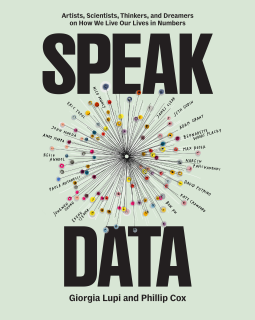
Speak Data
Artists, Scientists, Thinkers, and Dreamers on How We Live Our Lives in Numbers
This title was previously available on NetGalley and is now archived.
Send NetGalley books directly to your Kindle or Kindle app
1
To read on a Kindle or Kindle app, please add kindle@netgalley.com as an approved email address to receive files in your Amazon account. Click here for step-by-step instructions.
2
Also find your Kindle email address within your Amazon account, and enter it here.
Pub Date Nov 11 2025 | Archive Date Nov 10 2025
Chronicle Books | Princeton Architectural Press
Talking about this book? Use #SpeakData #NetGalley. More hashtag tips!
Description
The first pop nonfiction book to explore the definition of data and how we can learn to speak that language features thought-provoking conversations with 17 extraordinary leaders in business, tech, medicine, psychology, health, art, and more who share new ideas about data, unpacking its powerful ability to reveal patterns, tell stories, stir emotion, and illuminate complexity.
Data may be the most powerful force in society today. Data is everywhere, present in every moment, every event, every transaction, or interaction with someone else. Every time you send a text, call a friend, fill out a form, hail a taxi, stream a movie, surf the web, pay a bill, buy groceries, buy anything, take your temperature, count your steps, swipe right (or left), you generate data.
There's data in the weather, in the air, in the ground, in outer space. If you own a smartwatch, you carry data on your body. If you have a cardiac pacemaker, you carry data in your body.
So, what is data, really? It's a question that is surprisingly hard to answer. To some, data means numbers: figures on a screen, dots on a graph. It's also often (falsely) equated with facts, an invariable form of concrete knowledge that always tells the truth. But in reality, data is hardly so incontrovertible. Data is an abstraction of reality, a useful but imperfect representation of real life. Like life, it's full of nuance, imprecision, and ambivalence. It's quantitative and it's qualitative. And it's made by us—humans.
These are some of the ideas that information designers Giorgia Lupi and Phillip Cox explore in their fascinating new book Speak Data: Artists, Scientists, Thinkers, and Dreamers on How We Live Our Lives in Numbers.
Speak Data invites us to see data differently—not just as numbers on a chart, but as a way to understand and communicate who we are, how we connect, and how we make sense of the world. It's grounded in the principles of Data Humanism, a concept developed by coauthor and award-winning information designer Giorgia Lupi, which centers on people, rather than numbers, in its conception of data. In this beautifully illustrated book, the authors present data as a vocabulary that anyone can use, showing that when we truly learn to "speak data," we can open up new worlds of meaning about ourselves and everything around us.
Interviews in Speak Data include:
- Tech pioneer John Maeda on the value of data visualization during global emergencies.
- Marketing legend Seth Godin on how to use data to get people to really care about climate change.
- Museum curator Paola Antonelli on whether data is art.
- Atomic Habits author James Clear on the ways data can (and can't) describe human identity.
- Al data artist Refik Anadol on how big datasets can dream.
- Organizational psychologist Adam Grant on using data to communicate nuance and uncertainty.
- Activist Andy Marra on how to count something that's never been counted before—and why it matters who is asking the questions.
- Writer Naresh Ramchanda on why he's a "data optimist" and how data can close the empathy gap.
- Economist Max Roser on using data to see stories, and not just trends.
- Neuroscientist and physical therapist David Putrino on how tracking long Covid has taught him to think differently about patient data versus patient experience.
- Physician and design researcher Bon Ku on how data revealed a better way to design hospital emergency departments.
- Al scholar Kate Crawford on why questions about the future of AI are really questions about the future of democracy.
- Artist Ekene ljeoma on why we have all the data we need to make change.
- And many more.
Available Editions
| EDITION | Other Format |
| ISBN | 9781797230276 |
| PRICE | $35.00 (USD) |
| PAGES | 256 |
Available on NetGalley
Available to Buy
Buy on Amazon Buy on BN.com Buy on Bookshop.orgAverage rating from 9 members
Readers who liked this book also liked:

Kerri Rawson
Biographies & Memoirs, Parenting, Families, Relationships, True Crime

Publishers Lunch
General Fiction (Adult), Nonfiction (Adult), Teens & YA


Tiffany Hunt
Romance, Sci Fi & Fantasy




Melinda Taub
General Fiction (Adult), New Adult, Sci Fi & Fantasy
Emily Ladau
Health, Mind & Body, Nonfiction (Adult), Self-Help

Paul S. Rothenberg
Biographies & Memoirs, Entertainment & Pop Culture