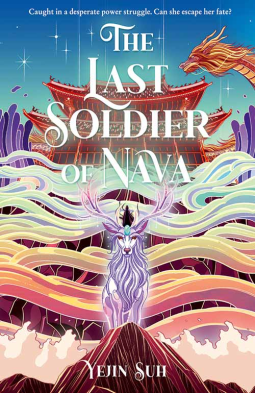
The Last Soldier of Nava
This title was previously available on NetGalley and is now archived.
Send NetGalley books directly to your Kindle or Kindle app
1
To read on a Kindle or Kindle app, please add kindle@netgalley.com as an approved email address to receive files in your Amazon account. Click here for step-by-step instructions.
2
Also find your Kindle email address within your Amazon account, and enter it here.
Pub Date Jul 7 2026 | Archive Date Jul 28 2026
Harper 360 | Magpie
Talking about this book? Use #TheLastSoldierofNava #NetGalley. More hashtag tips!
Description
According to legend, the Soldier drowned entire kingdoms in darkness.
Yet, the Soldier was only a girl, robbed of her will and raised as a weapon for her power-hungry father. When she awakens years later, freedom takes the form of a hidden life and a new name: Shadow.
As war brews and magical dead zones devour the natural world, Shadow is captured and pulled back into court life by her immortal father’s new prodigy, Scarlet, a diabolical woman obsessed with her sister’s murder. A murder Shadow herself committed in a past life.
Shadow’s control over darkness holds the key to restoring the balance of their world, but a serpentine court hides greed, corruption, and her father’s new plot to resurrect his fading magic.
If she’s to survive and save her nation, Shadow will have to hide her past and rely on the woman who captured her—even as they unwind the legends that brought them together and face their growing attraction.
Available Editions
| EDITION | Paperback |
| ISBN | 9780008683474 |
| PRICE | $18.99 (USD) |
Available on NetGalley
Available to Buy
Buy on BN.com Buy on Bookshop.orgAverage rating from 37 members
Featured Reviews
 Amelia E, Reviewer
This book was SO good. I'd recommend readers lock in for this one as it is a bit complicated, as both the main character and the reader aren't really sure what's happening, who to trust, what has happened in the past. If locked in, just accepting the unknown to be unknown, it's an AMAZING book, kind of thrilling honestly. There are so many shocking moments and revelations in throughout the book, and the majority of the time the reader finds out at the same time as the main character, so I enjoyed that, it was like we found out and reacted together at the same time.
For me, the characters truly made this story, like yeah that's kind of how it is with every book, but in this one the characters SHINE, they are SO well written, you don't get too attached, it's not like that, you just follow them, you learn about them, they grow, they fall, opinions change as the story progresses, there's just a lot going on with the characters, IT IS SO GOOD
The world building ia also really good, like I understood the politics and the history, I do wish there was more descriptions of the land though? There was a lot, don't get me wrong, like i knew what the place looked like, I just think for a Korean Mythology book there should be more? I am being picky, but the characters were SO well developed and written, I feel like the world should be described to the same standard. Or there could be an unplanned sequel that could give me what I want after that ending...
This was also the first YA book I have read in a LONG while, but it didn't feel like it, it didn't feel childish, it didn't make me feel immature, it just felt like I was reading a normal book without a significant romance plot? There is a romance plot, but there is zero spice, just one kiss, and two women who would follow each other anywhere.
Lastly, I want to give my opinion on other opinions, because in my opinion; the romantic feelings between the two main characters did NOT come out of nowhere, Shadow clearly found Scarlet visually appealing from the beginning, and Shadow thought about Scarlets appearance and whereabouts SO many times that, for me, would be a bit much for friends. The kiss did NOT come out of nowhere, it was well written, well timed, some may say even cliched timing, like something out of a romantic movie. Yes parts were confusing, but see how you feel after experiencing memory loss, it wasn't that bad, and if you read the book, the timeline is literally the least confusing thing in there. Not everything is spoon fed.
I don't know, maybe I just pay attention or something because I loved this book a lot.
 Eric R, Reviewer
⭐️⭐️⭐️⭐️ A lush, myth‑steeped fantasy with irresistible tension
The Last Soldier of Nava is a captivating blend of Korean‑inspired mythology, sapphic longing, and slow‑unfolding mystery. Shadow’s journey—from a weaponized girl feared as a legendary monster to a woman trying to reclaim her identity after a thousand years—is emotionally rich and beautifully layered. The dynamic between Shadow and Scarlet crackles with suspicion, grief, and forbidden attraction, giving the story a magnetic push‑and‑pull that’s hard to look away from.
The worldbuilding shines with its eerie dead zones, serpentine court politics, and the haunting legacy of a father whose hunger for power spans lifetimes. At times the plot’s many moving pieces could use a bit more space to breathe, but the novel’s atmosphere, character depth, and mythic scope more than make up for it.
A compelling, romantic, and shadow‑soaked tale that lingers after the final page.
 Heather H, Media/Journalist
What a refreshingly quirky queer romantasy! I've read a gazillion fantasy books in my life, but none with this Korean folklore and mythology informing it, so I was hooked from the first page. Shadow and Scarlet are excellent foes turned lovers. I loved learning more about what makes both of them tick, what traumas they suffered, what drives them, and the sources of their magic. I loved the way they antagonized and sympathized with each other. And I loved that just when you think you know them, you learn something that flips your understanding completely on its head. And, and! I loved that neither of them were these blameless, virtuous heroes. They were complicated and scary and perfect for each other. I'll be so excited to read Yejin Suh's next novel.
Thank you to Harper 360 | Magpie and NetGalley for the opportunity to read this book and provide and honest review.
 Kimberly M, Reviewer
Thank you NetGalley and Harper for the reader’s arc in exchange for my honest review.
Shadow is an immortal soldier awoken, and in this she takes the life of an individual. Since then, she lives a quiet, tenuous life with a strange elderly woman. Until Shadow is captured by Scarlet, the sister of the individual she killed. In exchange for her freedom, Scarlet enlists her help to find the Soldier that killed her sibling. All awhile dealing with the inner court politics, the deadly shadow realm taking over the country and other enemies wanting to know her true identities.
I thought this was a very well written book, I liked the concept of it. The cover was what caught my attention because I like Asian/South Asian fantasy books, and this was right up my alley. The characters Shadow and Scarlet were imperfect and brutally cold, which is expected of them for the power they hold. Their positions at court are on unstable ground and what they want in life can’t be more different. I liked the romantic undertones of this book, slow burn and tension filled. I can’t really call it enemies to lovers, because they aren’t really enemies to the knowledge of Scarlet.
The book lost me at times, circling around in directions that I ended up a little lost and had to go back and reread. I found myself writing in events so I remembered what had happened, and sometimes the dialogue went on for longer than I personally enjoyed. The ending was… underwhelming for me and I guess that’s what made me sit back and go “okay then.”
Otherwise it was a great book, and the author really did make a good impression on the debut novel. I would read another book by this author.
 Account D, Reviewer
The book was very good. It definitely sucked me in with the first chapter, which honestly motivates me more to read it. I really like the plot and concept of the book. I thought it was up my alley, and it was. I did find it humorous at times, despite the circumstances one of the characters found themselves in. Even if it was like a side character talking to the MC. Such as in the first chapter with the boy and the coin. That really stood out to me because i actually chucked softly.
Ratings:
- writing: 9.5/10
- descriptions: 9/10
- plot: 10/10
 Amanda P, Reviewer
Wow!
Wow wow wow!
This book was absolutely stunning. The atmosphere created is just so real you’re immediately drawn into it. The characters are so well built and complex and gorgeous I just loved it.
And seeing it all through Shadow? Through her fogging memories and ignorance to the political games around her? *chef’s kiss*
An absolutely stunning read. I cannot recommend it enough.
 Mandie D, Reviewer
This was my first book by this author and I really liked it. Watching Shadow and Scarlet come together and save the world while falling for each other was really cute and sweet and the ending packed a punch without leaving you wondering what will happen next or upsetting you in the perfect way.
Account D, Reviewer
When I first saw this book, I thought this sounds like the perfect book for me. As I do enjoy myself a fantasy read every now and then. And it is queer which is always a plus for me because I myself am Biromantic demisexual so I am usually looking for queer representation.
Ratings:
- plot: 8/10
- Descriptions: 9/10
- writing: 9/10
other
- did it keep me engaged? for a while yes
 Reviewer 1391671
This book jumps right into the world with no explanation, no exposition dumps, no characters giving long winded speeches about the history of the kingdom and how, in it’s 333rd year, it established paved roads. And I love it. The uncertainty — both from Shadow and myself — lent itself very well to the feeling of a book halfway between horror and dream with characters who were exactly what they said they were, even when I wanted them to be something else. The animals were heartbreaking, the constant fights and posturing, on hindsight, made perfect sense, and through it all Shadow is trying so hard to remember nothing, to think nothing, to be nothing.
Shadow is like a broken paladin, someone who has honor and nobility of spirit even though she’s been betrayed — and worse, because she’s been a betrayer. She has spent her life as a tool for someone else’s ambitions, and all she wants is freedom and justice. And maybe to sleep and never wake up.
Scarlet and Apsis are two dynamic and vicious women, both of whom want Shadow to be more than she is, both of whom want to use her. Shadow has no desire to be used again, but she finds it so much easier to be used than to have to make the choices for herself. Honestly, I loved everything about this book. And while I can see the ending being … well, some people’s least favorite part, I actually like the open ended nature of it.
This book isn’t romance forward, and not entirely plot forward. It is, however, very character forward with Shadow having to decide what she wants, and what she’s willing to fight for, even as she tries so hard to not have to fight again. I really hope that the readers who give this a try enjoy this half as much as I did.
Thank you so very much to Net Galley and the publisher for the ARC.
 Brenda Y, Reviewer
Let me start by saying I really liked this quirky sapphic Korean mythological story. It drops you in a place where you have to use some imagination to follow Shadow's story, to piece it all together. We all spend a lot of time reflecting or trying to remember events of our past and Shadow is no different. Their memory is vast and spans 1,000 years. I found this book to be written not in the normal way of Fantasy novels and refreshing for it's prose.
Thank you Harper Collins and NetGalley for the ARC review copy.
Reviewer 1789971
In Yejin Suh's The Last Soldier of Nava, readers embark on an adventure inspired by Korean culture and mythology that’ll have readers going through twists and turns while falling in love with this story about love, loss, and grief.
Long ago, the eternal city of Nava flourished where present day Ik-Song is located. It was ruled in tandem by the Moonbearer and Dawnbringer, who were then kept in balance by the two dragons. Everything changed when the Moonbearer wanted more power and killed a dragon. The city fell, weird weather phenomena began, and dead zones appearing are some of the consequences. But the biggest one was a weapon born from spilled blood known as the Soldier.
Shadow has a secret, and is trying their best to hide, but when your secret is sought after by everyone, the best thing to do is play along. Her memories have gaps in them, and while she can recall what happened, she can’t remember everything. When she meets some of Ik-Song's powerful ruling members, Shadow is caught in a game of conspiracies as she tries to figure out everyone’s agenda before they figure out hers.
I loved that this story is inspired by Korean culture. Much of the setting, clothing, and customs are influenced and evident throughout the story. Plus, this is woven beautifully with the fantasy and mythology setting of Ik-Song that reminds me a lot of how Avatar: The Last Airbender was able to incorporate both East Asian culture, mythology, and fantasy. The themes throughout are about balance and the dichotomies of different elements: light and darkness, good and evil. Such is the duality that lives within us, and is a constant struggle to maintain. Everyone is struggling, and trying to decide whether their actions are for them or for everyone else.
What I enjoyed was trying to figure out everyone’s agenda. Everyone is suspicious of the others, and keeps them at arms length. Still, Shadow and Scarlet were able to find a deeper emotional connection with the other, even though they all kept secrets from the other. They eventually had to trust each other, despite all the secrets, in order to save the world they know and love.
All in all, it was a fun read, and if there are any future plans to continue this story, or to have other interconnected ones, that would be interesting to read.
I received an advance reader copy of this book from Yejin Suh and Harper360 via NetGalley for free, and I am leaving this review voluntarily. My intentions are to write feedback that reflects my genuine thoughts and is written with the book’s genre and target audience in mind. I aim to review fairly and respectfully, focusing on the story’s purpose.
 Demetris P, Reviewer
The Weight of Being Needed
In “The Last Soldier of Nava,” love, memory, and power are measured by who is allowed to live beyond usefulness.
By Demetris Papadimitropoulos | July 9th, 2026
Dreams in fantasy tend to arrive overdressed: crowns, vengeance, restored bloodlines, a kingdom waiting for the underestimated heir. Shadow, the scarred fugitive at the center of Yejin Suh’s “The Last Soldier of Nava,” wants something less ceremonial. In a crowded market, hidden behind a black veil, she imagines being a girl sent by her grandmother to buy scallions and lotus root, perhaps spending a forbidden coin on sweets before returning home for dinner, sleep, and the mild nuisance of tomorrow. A girl made into a weapon does not necessarily dream of becoming a hero. She may dream of errands.
Elsewhere, the story remembers her differently. The Soldier of legend drowned kingdoms in darkness; the girl inside that legend was fashioned from stolen power, stripped of her will, and awakened across centuries whenever the immortal Moonbearer required another massacre. In her latest body she wakes beside the corpse of the revered Desert Rose, runs, borrows a name, and spends a year hidden with an irritable old woman named Sae. There is broth to drink, cabbage to cut, a koi pond to watch. No one asks her to destroy anything. Naturally, she suspects a trap.
More revealing than any throne or battlefield is Sae’s home, built from wood, straw, and tree pulp. Shadow knows it will eventually soften into the ground and vanish beneath the garden. The house gives her shelter without inventing a destiny for her. The Moonbearer wants to raise Nava, the magnificent city he helped destroy, and he will spend anything still alive to do it: Dragons, nations, daughters, soldiers, even the weather. He mistakes permanence for salvation. Sae’s walls can fall without another creature being killed to hold them upright.
Exile ends when Shadow uses her darkness to save a child and is captured by Scarlet, Royal Keeper of Ik-Song. Scarlet is beautiful, imperious, armed with light magic, and inconveniently familiar: she is the Desert Rose’s younger sister, still searching for her murderer. She does not know that the frightened sakasa in her custody is the Soldier herself. Scarlet takes Shadow to the Moonbearer’s Stronghold, calls her an “invaluable prospect,” and uses her to investigate the crime she committed. The arrangement has the tidy moral orderliness of a locked room filled with knives.
Through much of the book, Scarlet conducts that investigation in the culprit’s presence. A newly translated record, a magical test, a remembered name – almost anything can expose Shadow. The two women nevertheless grow closer through court performances, combat, humiliation, rescue, and the peculiar intimacy of watching someone fight. Scarlet becomes the person allowed nearest to Shadow’s body and the person least prepared for what it contains. Once affection enters, confession no longer threatens only Shadow’s life. It threatens Scarlet’s account of her sister.
Rarely does Scarlet mistake herself for a gentle liberator. She binds Shadow, dresses and displays her before the court, tests her abilities, demands access to her memories, and finally speaks the command that wakes the Soldier. Shadow has learned the answering bargain: obedience may purchase protection. Her first idea of trust is therefore not life without a handler but the choice of a less brutal one. Scarlet recognizes Shadow’s vitality long before she respects its boundaries, and the romance is strongest when Suh refuses to pretend those are the same achievement.
In Scarlet, Suh avoids the easier figure of the healing beloved. She is vain, theatrical, impatient, perceptive, and sometimes cruel for the pleasure of producing a response. She provokes Shadow because resistance is the clearest sign that Shadow is still present. Yet the sequence becomes familiar: Scarlet presses, Shadow erupts, danger clears the air between them. More than once, the novel reaches for a blade when a conversation about the Desert Rose might have left the deeper wound.
Prose is among Suh’s strongest means. Her sentences lengthen through fabric, steam, tiled roofs, weeds, wounds, ceremonial armor, then snap into fragments when panic narrows Shadow’s field of vision. Gravel bites bound hands; tofu recalls the exposed softness of a throat; sand wakes a dead woman; cold carries an invasion inside it. Shadow’s noticing is the portion of her that training could not make efficient.
Among the things she sees are persimmons, sweet rice cakes, black grapes, wet hems, koi moving through algae as though grazing in grass. A pure weapon would perceive orders, targets, exits. Shadow sees what she has no military reason to see. Her body also reaches conclusions before her mind: a scar aches, a fist closes, a breath shortens. Sand and winter touch the old terror before she can arrange it into history.
Pushed to fever pitch, however, Suh’s descriptions begin to jostle with the scene. She favors jaws, beasts, flayed houses, blood-colored light, burning skies, magic large enough to bully the horizon. Much of it suits the book. Some arrives after violence, desire, and revelation have already made themselves understood. Her finest effects are often smaller. A bowl of porridge left beside a suspicious girl can hold more moral weight than a palace splitting open.
Across the first part, “White Heat,” Suh balances court intrigue, hidden history, and romantic danger with considerable control. Shadow witnesses a magical remaking that destroys a young man’s face, is dressed and displayed before the court, trains with soldiers, and follows Scarlet into archives where Mourning Day’s saint-and-monster story begins to fail. They discover that the Moonbearer killed the Dragon of the East and fashioned the Soldier from its spilled power. By then tropical market stalls are selling winter furs.
Darkness and light do not behave as advertised. Scarlet’s light scars, exposes, and commands; Shadow’s darkness conceals, shields, and saves a child in the street. Even the part titles cross their elements: heat can be white, ice can drift. Suh occasionally repeats the reversal after the action has already made it clear, but the Moonbearer depends on the simpler version. Moon means savior, darkness means monster. Mourning Day has done the rest.
In Shadow’s recovered memory, the Desert Rose reaches toward the awakened Soldier and sees what the annual ritual will later remove: she is young. The gesture is almost unbearably ordinary. The Rose approaches a girl whose body has been trained to experience touch as threat and command as the only reliable language. Contact collapses into violence. Shadow’s scar and the Rose’s death remain facts. What changes is the confidence with which anyone can say where intent resided.
Many novels would solve this difficulty by declaring Shadow innocent or damned. Suh leaves her between the dead woman and the man who issued the orders. She has killed; the dead do not revive because she was also used. Yet the Moonbearer awakened and directed her as if will were an unnecessary ornament. Shadow must answer for what happened through her without accepting his claim that violence is simply what she is.
Ik-Song’s political crisis repeats the arrangement on a larger scale. The Moonbearer’s promised Nava requires another Dragon’s death, another war, and the sacrifice of the country he claims to defend. Ecological panic becomes military opportunity. Mourning produces a saint, fear produces a monster, and together they produce the ruler who insists that only he can restore order. His dead city will rise if enough living matter is placed beneath it.
The Stronghold is more convincing as a set of rooms, uniforms, ceremonies, and rivalries than as a state that feeds, taxes, drafts, and abandons people. We know who kneels and who plots; we know less about who grows the rice or what happens to families when their villages disappear into dead zones. The Moonbearer has a similar vacancy. His scheme is vivid, his seduction less so. Suh explains why he must be stopped more fully than why intelligent people once believed him.
Readers of Tasha Suri’s “The Jasmine Throne” may recognize the lush sapphic peril and wounded ecology, while readers of C. L. Clark’s “The Unbroken” may recognize a woman trained for use becoming intimate with someone who still holds institutional authority over her. Suh’s book finally wants something more domestic than sovereignty: breakfast without a briefing, sleep without an order, the reasonable expectation of remaining oneself until morning.
On entering “Drift Ice,” the revelations begin queueing behind the same door. Eleven chapters must carry flight, seduction, imperial bargaining, the Moonbearer’s return, Shadow’s reawakening, the truth of the Desert Rose’s death, contact with a Dragon, Sae’s hidden magic, political defections, and the release of Nava’s stolen power. Nothing stalls. Almost nothing is allowed to land.
Particularly costly is the speed with which Scarlet must absorb the truth about her sister. She barely has time to understand what happened before she must negotiate, fight, flee, and command. Crow and Prince Yo-han change allegiance while the world is breaking around them. Sae reappears as the keeper of an older practice, her black stone having called Shadow back whenever the Soldier threatened to consume her. The events fit. The people are asked to change faster than people generally do.
Opening her eyes in the final chapter, Shadow finds rain and no past. She does not remember Scarlet, Crow, Nava, the Desert Rose, or the Soldier. Scarlet introduces herself under another name and tells Shadow she may choose one of her own. “Soldier” was a task pretending to be a name. “Shadow” began as Sae’s description of a girl standing still in darkness. Now no rank, father, court, or legend is waiting to complete the naming.
Unequally divided between the two women is everything that came before. Scarlet retains the nights, lies, battles, touch, and mourning; Shadow receives them as a stranger’s account. She is free of the Moonbearer’s commands, but she has also lost the history through which apology, forgiveness, and love would have had to become ordinary practice. Scarlet knows why a hand on Shadow’s face matters. Shadow must decide whether to trust the hand before she can remember it.
Left in the body are impressions the mind cannot place. Rain feels charged. Shadow’s hands seem to know more than her chosen name. Scarlet remembers a life that Shadow cannot yet claim or refuse. The last pages do not settle whether this is mercy or escape. They leave one woman holding the past for both of them.
One measure of the novel’s uneven strength is the distance between its finest intimate scenes and its hurried finish. I would rate “The Last Soldier of Nava” 83/100, corresponding to 4/5 stars. People praise Shadow’s power whenever it remains available for their purposes. Rulers, soldiers, and nations treasure her when they need something destroyed. Sae is the first person to feed her before asking what she can do.
Suh leaves Shadow at the threshold of a life no one has requisitioned, unable to remember the garden that first taught her what such a life might contain. The reader remembers it for her: the persimmon tree, koi circling beneath green water, a house slowly consenting to become earth. Against the Moonbearer’s project of making the dead permanent, Suh offers a frailer miracle – a girl waking in the rain, not yet useful to anyone, with a morning no one has told her how to spend.
 Sarah R, Reviewer
If you’re on the hunt for a fantasy novel that delivers rich mythology and a gripping narrative, The Last Soldier of Nava should be at the top of your list. The story centers on Shadow, a protagonist with a mysterious past who navigates a world filled with ancient magic and political intrigue. From the get-go, you’re drawn into a beautifully crafted landscape where the stakes are high, and the consequences of power are palpably felt.
What truly shines in this novel is the dynamic between Shadow and Scarlet, both strong female characters. Their relationship is a masterclass in character development, blending humor and tension that keeps you invested in their journey. You’ll find yourself rooting for them as they confront both external threats and their own complicated feelings. Suh’s world-building is impressive, with vibrant settings and the haunting presence of deadzones that add layers to the plot, making the stakes feel even more urgent.
The themes of identity and self-discovery resonate deeply throughout the narrative. Shadow’s quest to understand who she is is both compelling and relatable. This isn’t just an adventure; it’s a thoughtful exploration of what it means to forge your own path in a world that seeks to define you.
Thank you to NetGalley, HarperCollins360, and Yejin Suh for the ARC in exchange for an honest review.
Readers who liked this book also liked:
Brigid Kemmerer
General Fiction (Adult), Romance, Sci Fi & Fantasy





Alta Hensley
Erotica, General Fiction (Adult), Mystery & Thrillers




Katie-Rose Fischer-Price
Children's Fiction, Health, Mind & Body, Parenting, Families, Relationships



Dr. Dale Atkins
Children's Fiction, Health, Mind & Body, Parenting, Families, Relationships

Ben Clanton; Katie Cook; Brittney Williams; Grace Ellis; Jordan Morris; Michael Northrop; Stephanie Cooke; Annie Nishida
Children's Fiction, Entertainment & Pop Culture, Parenting, Families, Relationships