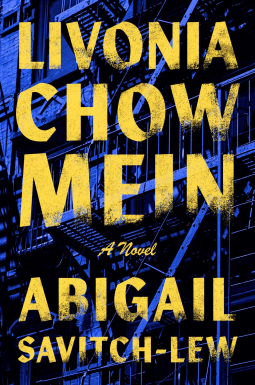
Livonia Chow Mein
A Novel
This title was previously available on NetGalley and is now archived.
Send NetGalley books directly to your Kindle or Kindle app
1
To read on a Kindle or Kindle app, please add kindle@netgalley.com as an approved email address to receive files in your Amazon account. Click here for step-by-step instructions.
2
Also find your Kindle email address within your Amazon account, and enter it here.
Pub Date Apr 21 2026 | Archive Date May 21 2026
Description
In the vein of Happiness Falls and Family Lore, a gripping story of family history and political upheaval centered around a Chinese family-owned restaurant in Brownsville, Brooklyn and its impact on the neighborhood’s Jewish and Black residents over the course of a century.
In 1978, two tenements on Livonia Avenue in Brownsville burn to the ground, killing one resident and displacing dozens of others. It remains unclear who set the buildings ablaze, but the survivors are convinced the culprit is Mr. Wong.
Who exactly is Mr. Wong, and what allegedly drove him to this extraordinary act of violence, is the question that consumes this novel as it plunges into four generations of Wong family history. First is Koon Lai, an immigrant who runs a Chinese restaurant on Livonia Avenue; second, his son Richard, a man desperate for his own chance at the American Dream; and third, Jason, a poet who seeks his escape in the bohemian counterculture of the 1970s, but finds himself an unwitting participant in Brooklyn’s gentrification. In the 21st century, Jason’s daughter Sadie returns to Brownsville as a journalist, determined to unravel the mystery of what happened decades earlier on the night the buildings blazed.
Joining together the present and the past is the community organizer Lina Rodriguez Armstrong, who was also displaced by that fire and who has spent the intervening years fighting for the rights of Brownsville’s residents and organizing a Livonia Avenue community land trust.
A stunning debut from a new talent, Livonia Chow Mein contemplates how the American pursuit of freedom relies on a collective amnesia and challenges us to consider what it would take for us to truly live in harmony.
Available Editions
| EDITION | Hardcover |
| ISBN | 9781668075234 |
| PRICE | $29.00 (USD) |
| PAGES | 368 |
Available on NetGalley
Available to Buy
Buy on Amazon Buy on BN.com Buy on Bookshop.orgAverage rating from 144 members
Featured Reviews
 Andrea D, Reviewer
At the heart of Abigail Savitch-Lew’s striking debut lies a single question: who set fire to the tenements on Livonia Avenue in 1978, and why?
In the Brownsville neighborhood of Brooklyn, two apartment buildings burn to the ground one summer night, leaving one person dead and many more displaced. Rumors swirl, and blame quickly settles on Mr. Wong, the quiet owner of the Chinese restaurant down the block. But as the decades unfold, the truth becomes far more complex.
The story moves through four generations of the Wong family. Koon Lai, an immigrant restaurateur, builds a life out of hard work and hope on Livonia Avenue. His son Richard dreams of his own version of the American Dream but feels trapped by his father’s sacrifices. Jason, a poet in 1970s Brooklyn, longs to escape the weight of family history and finds himself swept up in the counterculture. And in the present day, Jason’s daughter Sadie returns to Brownsville as a journalist determined to uncover what really happened the night the tenements burned.
Interwoven with their stories is Lina Rodriguez Armstrong, a lifelong activist and former tenant of the buildings that were destroyed. Lina has spent decades fighting for her community and now leads a campaign to create a community land trust on Livonia Avenue, hoping to reclaim the future that fire once took away. There's a lot of characters, but it's mostly Sadi and Lina's stories.
Livonia Chow Mein is both a mystery and a multigenerational epic, tracing how families and neighborhoods rise, fall, and remake themselves through time. Savitch-Lew writes with warmth and precision about belonging, displacement, and the fragile promise of the American Dream.
.#simonansschuster #livoniachowmein #abigailsavitchlew
 Librarian 1775997
Livonia Chow Mein is a stunning, generous debut that takes what could have been a single neighborhood mystery—a 1978 fire on Livonia Avenue that kills one tenant and displaces dozens—and turns it into a sweeping, deeply human epic of Brownsville, Brooklyn across a century. Abigail Savitch-Lew follows four generations of the Wong family—from immigrant restaurateur Koon Lai, to his striver son Richard, to Jason, a 1970s poet swept up in bohemian counterculture and unwitting gentrification, and finally Jason’s daughter Sadie, a 21st-century journalist determined to uncover the truth about the blaze—while also centering Lina Rodriguez Armstrong, the Latina organizer who lost her home in that same fire and spends decades fighting for a community land trust on Livonia Avenue. The result is both propulsive and reflective: a layered portrait of Chinese, Black, and Jewish residents whose lives collide around a humble restaurant, as the book interrogates the myths of the American Dream, the violence of urban policy, and the “collective amnesia” that lets whole neighborhoods be burned, displaced, and rebuilt with their stories erased. Savitch-Lew’s prose is clear-eyed and compassionate, her characters flawed but unforgettable, and the political insights are woven in so organically that you feel them as lived experience rather than lecture; by the end, the mystery of who set the fire matters as much as the larger question the novel keeps asking: what would it take for a city—and a country—to remember everyone it has tried to leave behind?
Readers who liked this book also liked:









We Are Bookish
Biographies & Memoirs, Health, Mind & Body, Nonfiction (Adult)

We Are Bookish
Historical Fiction, Literary Fiction, Multicultural Interest