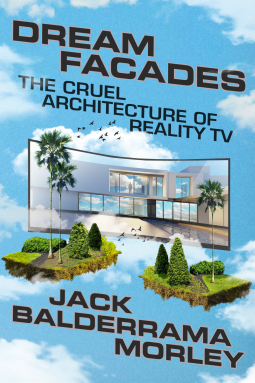
Dream Facades
The Cruel Architecture of Reality TV
This title was previously available on NetGalley and is now archived.
Send NetGalley books directly to your Kindle or Kindle app
1
To read on a Kindle or Kindle app, please add kindle@netgalley.com as an approved email address to receive files in your Amazon account. Click here for step-by-step instructions.
2
Also find your Kindle email address within your Amazon account, and enter it here.
Pub Date Mar 3 2026 | Archive Date Mar 10 2026
Astra Publishing House | Astra House
Talking about this book? Use #DreamFacades #NetGalley. More hashtag tips!
Description
People like reality TV. There’s been a lot written about the cult of celebrity, how this "reality" angle draws us in through a mix of voyeurism and relatability. But when we look at the houses on these shows, what are we seeing? Predominantly, multi-million-dollar single-family homes in areas that forcibly removed minority groups and mimic the style of a whitewashed age. Why do we watch and covet these conservative homes, while professing to want lives unbound by heteronormative patriarchy and outside of suburban fantasia?
Jack posits two main theories: that our relationships with these shows (and social media) have conflated our physical dwellings with the spaces projected onto and projected out from our screens to create a ‘physical-digital hybrid home’ that we see as representative of our actual home; and that what we actually covet when we covet these houses is safety and security, not the specifics of the styles being sold.
Dream Facades focuses on seven reality TV shows: Selling Sunset; The Kardashians; The Real World; The Bachelor; Trading Spaces; The Real Housewives of Atlanta; and Fire Island, and their specific associated architectural style. Morley takes us through reality TV’s labyrinthine properties to illuminate what makes us covet these spaces and devour these shows, and what that says about America, ourselves, and the future of design.
Marketing Plan
MARKETING AND PUBLICITY PLANS • Original magazine articles by author on current reality TV shows • Reach the HGTV world by getting copies to Home & Garden, House Beautiful, Country Living, Architectural Digest, and home TV shows • Podcast interviews on pop culture and reality TV shows • Academic outreach to archiecture programs • NYC bookstore launch featuring figures from the architecture, reality TV, and criticism worlds • Big mouth outreach to TikTokers and reality stars • Cover reveal on Astra House social media • Library promotion • Influencer outreach
Available Editions
| EDITION | Other Format |
| ISBN | 9781662602924 |
| PRICE | $28.00 (USD) |
| PAGES | 304 |
Available on NetGalley
Available to Buy
Buy on Amazon Buy on BN.com Buy on Bookshop.orgAverage rating from 16 members

Featured Reviews
 Andrea D, Reviewer
Dream Facades is smart, readable nonfiction that takes something familiar and asks a harder question underneath it: why do the houses on reality TV feel so powerful? Jack Balderrama Morley approaches reality television not as a guilty pleasure to mock or defend, but as a cultural archive, one that reveals how deeply ideas about safety, success, and belonging are baked into American dreams.
What makes the book work is Morley’s focus on architecture as narrative. By looking closely at the homes featured on shows like Selling Sunset, The Real Housewives of Atlanta, The Bachelor, and Trading Spaces, he shows how these spaces are not neutral backdrops but carefully constructed symbols, shaped by histories of exclusion, suburban aspiration, and racialized ideas of comfort. The argument that we are not really coveting design details but a feeling of protection and stability is convincing, and it helps explain why these homes remain seductive even as viewers become more skeptical of the lifestyles being sold.
Morley’s concept of the “physical-digital hybrid home” is one of the book’s strongest contributions, offering language for the way screens blur into lived space, and how our sense of home is now shaped as much by what we watch as by where we live. The writing stays accessible and the analysis moves smoothly between pop culture, architectural history, and contemporary social critique without feeling like a lecture.
Dream Facades is thoughtful and critical. It left me thinking differently about the houses we scroll past, binge-watch, and quietly internalize, and about how desire and capitalism (and racsim) shape what we think a good life is supposed tto resemble.
#DreamFacades #JackBalderramaMorley #Nonfiction #PopCulture #RealityTV #Architecture #NetGalley
 Abby M, Media/Journalist
I've often expressed discontent over the dysphoric feeling that so many of us feel in terms of being disconnected to our homes, our bodies, and each other in late-stage capitalist America. Jack does a great job of laying out how this alienation has been sold to us architecturally through the lens of reality television.
 Reviewer 942283
What connects the history of public housing in America, a novel about interracial romance, Native Americans getting displaced, and 'The Real Housewives of Atlanta'? A lot, apparently. This book is a fascinating deep dive into the way houses and homes figure in reality TV shows. There's so much research that went into it, which is very impressive, but not as impressive as the author's almost encyclopaedic knowledge of various reality TV shows and their multiple seasons. When a writer has a personal interest in the topic, the passion shines through.
What I liked about having my attention drawn to the setting is that it is not something the audience would usually do, being busy watching drama unfold as they will. But the houses and sets are intentional too, even if we don't notice them. I haven't watch a lot of reality TV (some 'Terrace House,' a little 'Singles Inferno,' a lot of 'Drag Race,' that one viral episode of 'Temptation Island'—"Montoya por favor!"—one season of 'Queer Eye,' and a few episode of 'MTV Cribs' or '16 and pregnant' back in the day) but I might start so I can see what he means about the types of backdrops used and what aspirations they symbolise.
Houses are revealed here to be desires made visible; what someone (single, divorced, straight, gay, participant, voyeur) might wish for in love, career, or social validation is shown through their pursuit of home ownership or a specific kind of living space that externalises their ideal self. On the national scale, perhaps even the international scale, why do we the audience keep watching these shows or trad wife content? What do they give us, what secret desires do they speak to? This book breaks down in great detail the possibility that we keep feeding the entertainment machine because of historical forces so massive they're invisible despite being all-pervasive.
 Elaine H, Reviewer
A must read for anyone that loves reality TV. I love anything that illuminates how smart and interesting reality TV is, this really highlights how deep these stories can go.
 Zoe S, Reviewer
“I saw the best minds of my generation enthralled by drone shots of glass walls sliding open to infinity pools that fell into the canyons above Los Angeles.”
Dream Facades is a fascinating book about the physical American landscape’s connection to reality television. Morley draws on the history of racial segregation, colonization, gentrification, etc. to give foundation to the analysis of reality tv homes and neighborhoods, while also mixing in architectural trends and general cultural analysis throughout. His writing is smart and funny without being too academic or jargony, making the book informative but not dense.
I liked the multidisciplinary approach and thought it was very accessible for a wide audience of readers. I’ve never read about architectural history and I thought that aspect was very interesting. The book has a good balance of reality tv, history, sociology, and architecture, so it’s not too heavy even though it relays a lot of information. I especially liked the section about The Real Housewives of Atlanta, but the strongest section was definitely the final one, aptly titled “People didn’t come here 500 years ago to make friends”. The reality stars talked about in this book are also remarkably wide ranging, Morley mentions everyone from Kim Kardashian to RuPaul to Honey Boo Boo to Nara Smith to Kim Zolciak-Biermann to Dasha Nekrasova to Heidi Montag, so there’s definitely something for everyone. If you are someone who likes to think deeply about pop culture, you will love this book!
Thanks to NetGalley and Knopf for the ARC!
 Cheryl M, Reviewer
Fascinating and well-researched, Dream Facades: The Cruel Architecture of Reality TV by Jack Balderrama Morley dives deep into the world of reality TV and why people love it, the desire for homeownership, popular home styles, real estate's dark past of redlining and steering, and the adverse effects on people of color and the LGBTQ+ community. Focusing on seven reality TV shows, Selling Sunset, The Kardashians, The Real World, The Bachelor, Trading Spaces, The Real Housewives of Atlanta, and Fire Island, along with their associated architectural styles, the author reveals the appeal of these spaces and why people keep tuning in.
I'm not sure quite what I expected when I requested Morley's Dream Facades, but my curiosity was piqued by two things: wanting to know why people watch reality TV and how this media could influence future design. As someone in real estate, reading this book was a cross between professional inspiration and cultural analysis.
What I enjoyed most about Dream Facades was all the historical perspective on house styles, the discussions on important pieces of legislation shaped by our biases, and a look into the start of reality TV and its continued impact. Considering my love of history and how I like to analyze popular shows from my childhood, this is likely no surprise. I took copious notes and added numerous reference books to my already enormous to-be-read pile. I also appreciated getting to know more about a television genre that I know little about, but that my children mention.
The only place I struggled was with the conclusion of the book. The passion Morley has for returning stolen land and the need to develop a process for accomplishing that task is clear, and it's not the role of this reviewer to defend or argue against it. While it ties into their larger discussion of how the multi-million dollar homes featured on reality TV are in areas where people of color were forcibly removed, and how coveting them goes against our professed desire to live "unbound by heteronormative patriarchy and outside of suburban fantasia," these statements are not as well-developed as the rest of the text, ending the book in a way that is more like, "we can do it if we try" instead of the thoughtfully crafted and spectacularly articulated information throughout. If I were yearning for a strong call to action, I didn't find it.
That aside, I would read this book again, alongside some of the resources cited, as Morley brings the reader through a riveting media study.
Librarian 879168
This one surprised me. The framing of reality TV through the lens of architecture and American cultural desire is so smart and unexpected. Morley unpacks how the houses on these shows function as stage sets for aspiration, shame, and spectacle — and the class critique woven throughout is sharp without being preachy.
Media/Journalist 1170014
Maybe it’s because my main hobby (reading) can be cognitively demanding, but I’ve never really gotten into prestige TV. I like reality shows, the dumber and more toxic the better. I want to watch beautiful, ridiculous people search for love and feud with rivals and (more often than not) end up in legal trouble. So this whip-smart book inspired by reality television represents a true marrying of my interests.
Reality shows here serve more as a jumping-off point for thoughts on architectural history, American society, and philosophical theory than the main topic of focus. The Bachelor’s mansion inspires a fascinating chapter about the history of “Mediterranean-style” homes, while home makeover shows yield thoughts on gentrification and born-again Christianity. For that reason, I think the appeal of this book is not limited to die-hard reality TV fans.
This was one of the most interesting nonfiction books I’ve read in a while and I would love to read more by this author.
Thank you to the publisher for giving me access to an eARC of this book!
Readers who liked this book also liked:

Nafissa Thompson-Spires
General Fiction (Adult), Historical Fiction, Multicultural Interest

Deesha Philyaw
General Fiction (Adult), Multicultural Interest