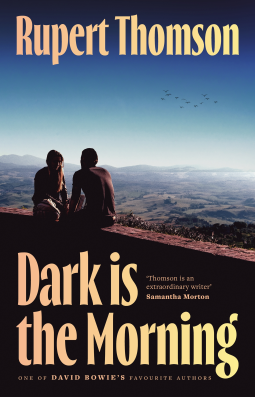
Dark is the Morning
This title was previously available on NetGalley and is now archived.
Send NetGalley books directly to your Kindle or Kindle app
1
To read on a Kindle or Kindle app, please add kindle@netgalley.com as an approved email address to receive files in your Amazon account. Click here for step-by-step instructions.
2
Also find your Kindle email address within your Amazon account, and enter it here.
Pub Date May 7 2026 | Archive Date May 7 2026
Head of Zeus | Apollo
Talking about this book? Use #DarkistheMorning #NetGalley. More hashtag tips!
Description
Sometimes love isn’t where you belong.
Gino, a troubled young man, suddenly realises that his childhood sweetheart Franca can give his life the happiness and stability he needs. They seem made for each other, and move to a remote house in the countryside. Franca soon gives birth to a son so handsome that people come from miles around to see him - but his sheer beauty causes Gino to doubt that he is truly the boy's father.
Descending into pathological jealousy towards a married man who had been Franca's lover, Gino is unable to stop himself imagining the worst, and embarks on a violent path that has catastrophic effects on those around him.
Available Editions
| EDITION | Hardcover |
| ISBN | 9781035909629 |
| PRICE | £20.00 (GBP) |
| PAGES | 256 |
Available on NetGalley
Available to Buy
Buy on Amazon Buy on BN.com Buy on Bookshop.orgAverage rating from 25 members
Featured Reviews
 Ben D, Reviewer
Dark is the Morning is the latest novel from the British born novelist Rupert Thomson. He has been writing since the late 1980s but only more recently seems to have been gaining critical attention, with the publication in 2023 of How to Make a Bomb (U.S. title Dartmouth Park).
This latest novel, befitting a man who has lived in various parts of the world, is set in Italy, where 9 year old schoolgirl Franca has told schoolfriend Gino that she will marry him one day - but when this prophecy comes true, there is something in her past which sends Gino towards madness. This short novel gripped me throughout, with engaging characters and situations. I read it in one breathless sitting, drawn on by Thomson's prose.
This is the second of his works which I have now read, and I will be seeking out more of his works off the back of this one, which is high praise indeed.
Thank you to Netgalley and the publishers for the ARC.
 Reviewer 1834429
Gino, a troubled young man, struggling to find his place and purpose in the world, finds the stability he needs when he marries his childhood sweetheart, Franca. But when Franca gives birth a boy who is so beautiful, Gino questions if he is the boy’s father. The stability married life had given him rapidly unravels as Gino questions Franca’s devotion, which drives him to seek out her old lover.
This is a very sweet yet sad story of love between childhood sweethearts that quickly turns dark as we descend with Gino into his violent paranoia. The characters were well drawn and the prose kept me turning the pages.
Probably not one for you if you’re not a fan of books without dialogue tags.
 Michael J, Educator
Rupert Thomson is a remarkably consistent writer in terms of the quality of his novels, even as he rarely repeats himself. Although there are echoes in Dark is the Morning of his last two novels, How to Make a Bomb and Barcelona Dreaming, notably in its tracing of the disintegration of Gino, its central figure, his new novel is convincing in its depiction of both the initially charmed relationship between Gino and Franca and its Italian setting. Divided into three parts with two first person narrators, the fairly short novel is impressive in the ground it covers and particularly in the sense of dread it builds in the reader (or at least this one) well before events begin to unravel. Fairly early on, Gino says of Franca, "Her real life happened in the discrepancy between her outward appearance and her inner spirit". This is both lovely writing and implies that the same cannot be said of Gino, which sets in motion all that follows. A fine novel - Rupert Thomson should really be better known and celebrated.
 Caroline B, Reviewer
I’ve no idea why the British novelist, Rupert Thomson, isn’t better known. He’s the author of 13 critically acclaimed novels and he writes beautifully.
This novel is set in Abruzzo in Italy in the early 2000s. It is the sad and poignant story of the relationship between Gino and Franca, the corrosive power of his jealousy, the impact which the birth of their son has on Gino and the tragic events which this sets in train.
It’s narrated in the first person by Gino with chapters at the beginning and end narrated by a British ex-pat, Harry, who has a house in the area and is a friend of Gino’s.
I loved:
- the evocation of the wild and mountainous landscapes of Abruzzo;
- the writer’s obvious affinity with the food and culture of the area, including the strawberry festival at Nemi;
- that there is something of a fairy tale or fable about the book emphasised by the references to Roman mythology and the other worldly character of Gino and Franca’s baby;
- the portrayal of Gino’s difficult relationship with his father.
However, I was less convinced by the chapters narrated by Harry which bookend the novel. I wasn’t sure what his perspective was meant to add to the story and I found the sections about his relationship with his wife to be a bit of a digression in what is a very compelling and pacy narrative which reads very quickly. For me it would have been an even stronger book, if we also heard directly from Franca.
Thanks to Bloomsbury and NetGalley for the ARC.
Susan O, Reviewer
Rupert Thomson's one of those authors who delivers well turned out, interesting fiction with little brouhaha. His work ranges widely from the early days of Soft!, a satire on the advertising world, to Secrecy, set in the Medici court of seventeenth-century Florence. Dark is the Morning takes us to a small town in Abruzzo where a young man’s happiness unravels spectacularly.
Still living with his parents in his mid-twenties, Gino’s finally put the partying days that landed him in rehab behind him, seeking out Franca after his father reminds him of her childhood proposal. Their reunion swiftly turns into love, then marriage and a pregnancy that takes Gino by surprise. but before long he's torturing himself with speculation about Franca's past, delusions that even the British man he thinks of as his second father seems unable to diffuse.
Thomson bookends Gino’s narrative with Harry’s whose visit to a burnt-out house sets us up nicely for drama and a degree of suspense in the brief opening passage. Gino unfolds his own story, early hints suggesting a self-sabotaging jealousy that will destroy the unexpected happiness he and Franca enjoy. The suspense is handled well, foreshadowing adding to the tension, but what sets this absorbing, atmospheric novel apart is Thomson’s summoning up of small-town Italian family life together with his evocation of landscape and legend.
Gabrielle D, Reviewer
Fans of Ian McEwan and/or narrators that slowly descend into psychosis… do I have a read for you!
I randomly chose this book, and I’m shocked that I had never heard of Rupert Thomson before. His writing really reminded me of Ian McEwan, but without the political angle. I literally raced through this in a few hours, it was so spectacular.
This story centers on a man named Gino, a former addict who’s approaching his mid-thirties in small-town Italy. Eager to escape his father’s griping and wanting to make something of his life, he decides to reconnect with his childhood sweetheart, Franca. The majority of the story details their fairy-tale romance, following the pair as they fall in love, redo a country house, have a baby, etc…. But Gino’s intense jealousy over a previous fling of Franca’s begins to consume all of his thoughts, threatening to derail their lives (and spoiler….by God, does it…)
I haven’t read a novel this immersive in a while. I wholeheartedly recommend this book and will definitely be pursuing more books by Thomson.
Thank you so much to @netgalley for the E-ARC. Coming May 2026.
 Martin V, Reviewer
I’ve enjoyed everything I’ve read by Thomson to date, with particular highlights being the dystopian Divided Kingdom (2005) and the more recent (and wildly different) Never Anyone But You. I also reviewed his most recent novel, How to Make a Bomb, last year. As such I was excited to be notified about this one.
Dark is the Morning takes place in Abruzzo, Italy, predominantly in the early 2000s. At its centre is a relationship between Gino, who after a mis-spent youth is trying to get his life back on track, and Franca, who told him when they were children that they would one day marry. The novel is set up as a romance, in which two outsiders look set to make amends for their failure to get it together during some initial adventures as teenagers. However, we know from the start that things are unlikely to be as simple as that, via means of words that conclude its introductory chapter, narrated by the Englishman Harry who (from the present day) refers ominously to ‘those events’ that took place in the early 2000s.
Initially, things do run almost too smoothly for the young lovers, who marry, inherit a dilapidated and isolated farmhouse, and soon after become parents. A combination of factors conspire to undermine this seemingly perfect scenario. We’re aware from early on that Gino has somewhat auto-destructive tendencies, and a past that includes both substance abuse and violent events. And despite marrying the woman who professed here loyalty to him from a young age, and subsequently offered him ‘all of myself’, he also demonstrates a propensity for jealousy, showing signs of suspicion over her post work drinks. He also learns early in their relationship of a previous affair she had with a married rich local businessman, Enzo Pierozzi. Never entirely comfortable with being made privy to this secret relationship, he is unable to file it away and is instead determined to confront Enzo, and when he does so he is taken aback by his beauty, which sits in contrast to his own negative self-image.
When Gino and Franca’s son is born, the story takes on a slightly different tone, with the reaction of everyone around them to the child’s beauty having a kind of quasi-mythical element to it. People stop them in the street, travel from far afield to visit their remote house, and generally treat the baby as some kind of miracle. While the book is set in rural Italy, and subsequently populated with characters who may be inclined towards religious fervour, it nonetheless seems to take the story outside of a purely realist mode and into the realms of the fantastical, heightened further as the child ‘speaks’ to Gino. His words are a manifestation of what Gino has already been building to, a fierce paranoia built around the idea that the child is not his - that his impossible beauty could not have come from two outsiders, and must therefore be the result of a further infidelity, which takes him in only one direction, ultimately with disastrous consequences for him and everyone around him.
It’s a typically brilliantly crafted piece of storytelling from Thomson, which draws on techniques from myths and fables to explore ideas of fate and destiny. We’re drawn in early on by the compelling characters and beautiful scenery, with our enjoyment of the developing love story undercut by warnings seeded from the start. And then something intervenes to send things spiralling out of control, and the rest of the book is read with a growing sense of horror as Gino seems increasingly doomed to destroy the life he has clawed back for himself. While its central themes are those of jealousy and paranoia, there’s something deeper in its character study of Gino. Despite encouragement from surrogate father-figure Harry that his son’s beauty is not evidence of infidelity but of a beauty within himself that he cannot see, Gino is ultimately unable to believe that narrative, seeing himself as fundamentally and irredeemably flawed, a belief that ultimately leads him to his disastrous end.
The framing of the book by Harry is an interesting choice on Thomson’s part. I did have a few questions as to why he gives this character such a prominent voice in what’s clearly the story of Gino and Franca. But on reflection I do think there is a logic to it. Given its fabular qualities, it’s a book that almost demands a ‘storyteller’ framing. Harry makes sense as an outsider in most senses, not from the culture that generates the relationship and also produces some of the instigating oddness that catalyses Gino’s undoing. Yet at the same time he’s developed a lifelong (albeit mostly arms-length) connection with Gino and is therefore able to offer fatherly interventions and a commentary drawn from his own experiences of a relationship that has seen its troubles but is managed in some way. He’s also intrinsically connected to their story, despite his distance. He doesn’t just frame the book, but also their relationship - present at an incident that defined their failed teenage attempts to connect, and also involved (as a kind of doomed quasi-Shakespearean ‘messenger’) in their final unravelling.
Overall: This is up there with the best of Thomson’s work, a modern-day tragic fairytale with a haunting quality that I suspect will linger long after reading. (9/10)
Alexa M, Reviewer
Thanks to NetGalley and the publisher for an advance copy of this book.
I enjoyed How to Make a Bomb and this is another good read. I am not entirely sure when the book is set but it has a timeless feel about it and the author has captured the feel of small town Italy.
You feel for Gino but he is the author of his own misfortunes in his suspicions and recklessness. For me it was not made clear whether this was due to his own character or as a result of his poor relationship with his father when he was growing up although I must say, his mother and father seemed ordinary, nice people.
I thought more would have been made of the beautiful child but that is just a small thread in the story.
There is a sense of doom throughout the book culminating in what I suppose is an inevitable resolution.
 Nemra N, Reviewer
Dark Is the Morning is an atmospheric novel that follows two strangers who awaken in an unfamiliar, seemingly abandoned city with no memory of how they arrived. As they navigate empty streets and shuttered buildings, Rupert Thomson builds a quiet but persistent tension, using spare prose and careful pacing to heighten the sense of dislocation. The stripped-back setting allows the psychological dimensions of the story to take center stage, creating an intimate exploration of identity and human connection under pressure.
Thomson’s writing is precise and controlled, yet emotionally resonant. The novel’s minimalist structure works to its advantage, focusing on mood, character, and the fragile trust that develops between the protagonists. Dark Is the Morning is a thoughtful and compelling work that rewards close reading, offering a subtly powerful meditation on isolation, memory, and resilience.
 Sudeshna B, Reviewer
I will be the first to admit that I did not see this particular book coming, and I am so glad that it did. Dark is the Morning begins as a sweet love story but quickly spirals out of control into something much darker and more disturbing. The jealousy that Gino exhibits is so palpable that you simply cannot turn away, even when it becomes destructive. It is a beautifully written, intense, and psychological read.
Reviewer 1491639
i was so taken into this story. it was so quite but so very loud. its ones of those that doesn't need shocks or things to knock you off your seat. it does that by its closeness to the characters and what they are doing, going through. we are seeing it, somehow right up close. and that is where the hits comes. the hits to the heart and mind as we see how this life, these peoples lives play out. what begins as something creeps so seamlessly into something else. and with it so does that feeling in your own heart as you read it. a foreboding. and again not with twists or shock factor happenings. just sit, just follow and feel it right there with the pages as they turn.
and i found myself lingering long after. and even to the title. Dark. is. the morning. wow that is so powerful.
what Gino does and feels thrums from the pages. you want him to stop. you want to stop him. but you instead have to sit on the sidelines and watch it happen to him and then to those around him from it. a love story that quickly descends into something so much darker than you thought it would going in to the read. but wow was it amazingly written.
even now i sit here and can feel it all again as i replay moments in this book or even think of Gino.
its a psychological read and they are my best reads. im a sucker for them each and every time. and yes they make me feel too much every single time, haha. but arent books the best when they do that. book appreciation can come in many forms. the thinking they give us in ones like this is just one of them.
what is also brilliant in this book for me was not painting Gino as a villain. it was almost a desperate need for him to stop, not go there, dont think that way. there us an unsettled feeling to do with how he feels it is consumes him. and somehow you almost feel it from the start. because of who and how Gino and Franca are, what they go through there is automatically this weight to "perhaps you need to not carry that with you before you come together" kind of wince to the reading lol. its like Gino was spiralling even before he was spiralling. and with each new moment for the couple you could feel this would not be painted in the same colour for Gino. and that i think was more of what didn't make me see him as just a nasty book villain. it came from within him, how he felt about himself robbed him of so much and zeroed in the pain and issues he felt in life. how he couldn't see himself as anything but dark made all around him live according to that belief. he was damaged, he was ill in many ways. and thats what made me feel sad for him. and also there is that dread there. because that self hate can often be the worst thing of all for a person and where it can take you to. we see that all here. and it was just so sad.
this book was a brilliant read. so close to the bone but in the only way a book like this should be to get such feeling from it. it deserved me as a reader to feel so much.
books like this never cease to amaze me. arent authors so clever? but boy do i need to go and hug a doggy right now...
 Madeleine F, Reviewer
This was an absolutely fantastic read. Beginning as a tender love story, but descending into a dark tale of distrust and jealousy -- I was completely rapt. Intense, gripping, atmospheric and thrilling.
 Cathy J, Reviewer
Gino seems to have everything. He’s recovered from a period confined to a psychiatric hospital as a result of an act of violence he carried out, he’s living a mostly drug free life, he has a good job, and has been reunited with his childhood sweetheart, Franca. Their love for each other has been rekindled, they have found the perfect house in a beautiful location and Franca has given birth to their son, Elio.
But Gino is a man who seems bent on self-destruction, perpetually going over in his mind his father’s criticisms of his inadequacy and shortcomings. Gino is unable to rid himself of the idea that he cannot possibly be the father of a baby as astoundingly beautiful as Elio, examining his own features in the mirror and finding no similarity. ‘I was looking for my son’s face in my own, and I could find no trace of it. It wasn’t there.’ Unable – or unwilling through an innate paranoia – to accept Franca’s assurances that she has not been unfaithful, he begins to stalk the man he believes to be Elio’s father, a man with his own reputation for violence. Increasingly afflicted by disturbing dreams and unable to control his feelings of jealousy, Gino commits a devastating act from which there is no going back.
There is a pervasive sense of unease throughout the book, manifested by things such as a mysterious and unexplained episode in the life of the house’s previous owner. On the other hand, there are wonderful descriptions of the landscape of Abruzzo, Italian food and wine. Dark is the Morning is a slow burn of a novel but one which gradually builds to a crescendo. It’s dark but also sad because you’re left with a lingering sense of what could have been for Gino, Franca and Elio.
Readers who liked this book also liked:

Publishers Lunch
General Fiction (Adult), Nonfiction (Adult), Teens & YA
Lexi Davis
General Fiction (Adult), New Adult, Romance




We Are Bookish
General Fiction (Adult), Mystery & Thrillers, Sci Fi & Fantasy
Marie Bostwick
Historical Fiction, Literary Fiction, Women's Fiction