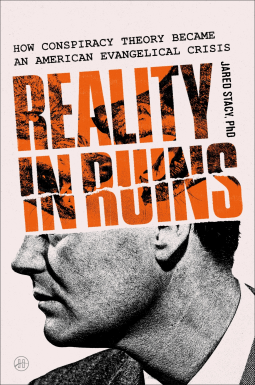
Reality in Ruins
How Conspiracy Theory Became an American Evangelical Crisis
This title was previously available on NetGalley and is now archived.
Send NetGalley books directly to your Kindle or Kindle app
1
To read on a Kindle or Kindle app, please add kindle@netgalley.com as an approved email address to receive files in your Amazon account. Click here for step-by-step instructions.
2
Also find your Kindle email address within your Amazon account, and enter it here.
Pub Date Mar 17 2026 | Archive Date May 12 2026
Talking about this book? Use #RealityinRuins #NetGalley. More hashtag tips!
Description
For anyone who has ever said, “It feels like we’re living in different realities,” an unforgettable read and definitive explainer of the strange history of evangelical conspiracy theory.
Conspiracy theories are at the root of the most pressing political problems of our time, yet their influence cuts just as personal. Suspicion has fractured families, communities, churches, and our very social fabric, as one person’s fact is another’s fake news.
In Reality in Ruins, Dr. Jared Stacy braves the untold history of conspiracism in American evangelicalism and the anxiety at the heart of this radioactive movement that affects us all. In a new age of what he calls “Disreality,” many are left reeling in the ruins of what was once a common world, now splintered by warring ideologies, religious and political extremism, and cults of certainty. Dr. Stacy reports from the inside as someone raised and even ordained in one of the nation’s most conservative denominations. Now, as a historian and post-evangelical theologian, Dr. Stacy traces the currents of pain, panic, and power that have thrust the evangelical church into a theological crisis with consequence for everyone.
For concerned citizens, Christians who are sounding the alarm on Christian Nationalism, and anyone grieving the relationships paranoia has ruptured, Reality in Ruins profiles the problem, validates your pain, prepares you for good resistance, and empowers you to become the truth-tellers a common world deserves.
Available Editions
| EDITION | Other Format |
| ISBN | 9780063453753 |
| PRICE | $27.99 (USD) |
| PAGES | 304 |
Available on NetGalley
Available to Buy
Buy on Amazon Buy on BN.com Buy on Bookshop.orgAverage rating from 12 members
Featured Reviews
 Pete F, Media/Journalist
This is the fruit of Stacy’s PhD work on evangelical obsession with conspiracy theories. He insightfully condemns how evangelicals have tied conspiracy theories with “orthodox Christian belief,” yet graciously explains reasons why people are drawn to conspiracy theories. Though conspiracy theories dehumanize the “Other,” he is careful to not dehumanize those who buy into conspiracy theories.
Through the book, Stacy shares a few glimpses into his own faith journey, toward seeing God’s Word as Jesus rather than the Bible and to stop defending the term “evangelical.” He claims that totalities can only be named from inside, yet he doesn’t grasp his own “insider status” as an evangelical. He clearly shows how the fluid term “evangelical” has been used both to unite and to distance (he calls this “a no-true-Scotsman in constant flux”). With that background, he is careful not to claim the label “evangelical” for himself in such a way to say, “Those evangelicals are not real evangelicals.”
Part of his background in evangelicalism centers around the Falwell legacy of Liberty University and Thomas Road Baptist Church in Virginia. I found particularly interesting the Virginia-based histories. For example, the tavern where Jefferson wrote Virginia’s slave codes became the site of the Woolworth's famous for the sit-ins protesting racial injustice. In another story of evangelical syncretism, Eberhard Bethge (friend of Dietrich Bonhoeffer) once visited Jerry Falwell’s Thomas Road Baptist Church and was given two pins, an American flag and a “Jesus First!” pin.
Early in the book, Stacy explains that story is always stronger than facts. In an accelerating world of information overload, we grasp for explanations—he calls them “totalities.” “Totality” promises to explain all of reality by “enclosure” of a single perspective. (For example: when a “biblical worldview” requires you to hold a sanitized view of American history.) This “hidden knowledge” leads to a feeling of superiority. Not only do we seek the promise of certainty—which leads to pride—but we also desire belonging—which makes us suspicious of outsiders. “Conspiracism appeals in this moment of change precisely because it offers certainty bound up in community.” We might visualize these as: totality > certainty > pride and totality > belonging > suspicion.
Since all facts are couched in story, this means we can’t argue a friend out of a conspiracy theory with better facts. “Telling the truth is never less than the facts, but always more.” As followers of Jesus, we have a better story to tell, and a better belonging to receive.
I found the fourth chapter particularly helpful, listing ingredients in conspiracy thinking. (I almost wish he had organized the next few chapters to sort into these four categories.) These “plot devices” are: (1) apocalyptic (revealed) knowledge that feels exclusive, (2) individualism that assumes a single mastermind with an agenda, (3) a moral call to resist, and (4) fear of losing political freedom.
In response, he argues that (1) God’s public revelation invites us into (2) caring for the common good of the whole world through solidarity. The Christian story is not “Gnostic” hidden knowledge meant for the select few, but for the good of the whole world.
Because we fear change, totality is “truth established by violence”—in our own effort. He cites Jacques Ellul to explain our use of technique and management.” This certainty in the objectivity of our perspective leads to a suspicion toward the external threat of “them.”
Stacy argues for (3) good suspicion of ourselves (particularly asking, “Why do I want this to be true?”). “Good suspicion” is “the courage to say ‘I don’t know’ in a time when what is taken to be true is established through violence.”
(4) Ironically, in fearing the loss of political freedom, we voluntarily give up freedom for authoritarian certainty. Instead, we can find true freedom only in Christ. Rather than Scripture prescribing a particular political arrangement (our modern idea of “nationhood” is arbitrary), “When the Scriptures speak of proper Christian respect for governing powers, they do so with a truly dizzying array of possible political arrangements in view, recognizing the acts of God taking place in any sort of political arrangement.” No matter how political structures change, God is always at work so we don’t have to fear.
Christians receive Jesus (the Truth) as reality. “So the difference lies in whether we become a people who claim to possess the truth, or people claimed by the truth…” Jesus does not promise us certainty, but instead relational “communion.” In fact, Christian “conversion” is an ongoing process of change. “Encounter means altering the shape of your life.” This reminds me of Hartmut Rosa’s focus on how “Resonance” changes us in ways we can’t control.
Stacy's grassroots ecclesiology (the Church as the “sand in the machine” in the title of the final chapter) is clearly influenced by Stanley Hauerwas. In sum, rather than a posture of grasping to control the state (with “technique”), we are invited into a posture of receiving how God is already working.
One of the most powerful moments was when Stacy brought up his fresh understanding of Psalm 119:105. In contrast to how the term “biblical” is used to support totalities, God’s Word is not a promise to reveal everything all at once. “A ‘lamp to our feet’ is the smallest sort of light source imaginable. It casts light for our next step, and that’s enough.”
 Janine S, Reviewer
I approached this book much like previous ones about evangelism in America (Jesus and John Wayne (Kristin Kobes Du Mez, 2021), The Power Worshipers (Katherine Stewart, 2022), The Seven Mountains Mandate (Matthew Boedy, 2025), The False White Gospel (Jim Wallis, 2024) with the hope of trying to discern what I was missing in my understanding of Christianity in today's America. It seems to me I'd gone down a rabbit hole in looking at what Project 2025 is trying to do and as if I'm living in one Christian reality and the evangelicals in another. Then enter this book - for me it is the "aha" or "eureka" to my weary soul.
Reality in Ruins gets to the heart of the destructive nature of American evangelism: it's reliance on conspiracy theories and suspicion have created fractures in communities, churches and our society. Consider Kristen Kobes Du Mez's subtitle to her book, Jesus and John Wayne: How White Evangelicals Corrupted a Faith and Fractured a Religion. Dr. Stacy is building on this subtitle but expanding it for a deeper dive in exposing the "theology" that undermines evangelism.
As I read in a 2024 New Yorker article, there is fear and anxiety at the heart of American evangelism. This creates per Dr. Stacy, Disreality, which to evangelicals mean their world "reeling from the ruins of what was once a common world". This world is not what they want it to be. It is
filled with warring ideologies, religious and political extremism, and cults of certainty which evangelicals either want to destroy or at least slow down the changes that can't be halted.
In taking apart the evangelicals' disreality, Dr. Stacy provides background to the fractured evangelical world and at least for me validated that what I was seeing is not what Jesus's message is. Rather in this evangelical world, it's distortion that seems to rule. I was so struck by his pointing out that the Bible is a story not a "cipher to contemporary geopolitics" and it doesn't authorize many of the things evangelicals cling to like the world being literally created in seven days. I also was greatly comforted by Dr. Stacy saying in so many words what I've been saying simply: Who made these people God? Who authorized these people to tell me and others they had all the answers. Finally, I particularly enjoyed Dr. Stacy providing historical background the evangelism and the various paradigms within it.
This is an important book! A must read for anyone like me striving to understand what happened to Christianity in America. It is also a book that empowers one to tell the truth. How greatly this is needed. Thank you, Dr. Stacy.
I would like to thank NetGalley and HarperOne for giving me the privilege of reviewing this awesome ARC.
Readers who liked this book also liked:









Ben Devlin
Literary Fiction, Mystery & Thrillers, True Crime