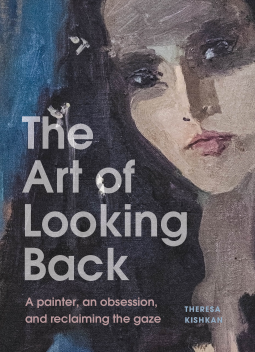
The Art of Looking Back
A Painter, an Obsession, and Reclaiming the Gaze
This title was previously available on NetGalley and is now archived.
Send NetGalley books directly to your Kindle or Kindle app
1
To read on a Kindle or Kindle app, please add kindle@netgalley.com as an approved email address to receive files in your Amazon account. Click here for step-by-step instructions.
2
Also find your Kindle email address within your Amazon account, and enter it here.
Pub Date May 29 2026 | Archive Date Apr 30 2026
Description
A former artist’s model and muse reclaims her image and voice, dismantling the male gaze that once framed her.
At 23, Theresa Kishkan met an artist who became obsessed with her. She was young, she was flattered, and the situation quickly overwhelmed her. He drew and painted her for a few months, after which she went away for a year. When she returned, she was determined not to resume the relationship.
But the artist made contact with her after the birth of her first child and became a family friend, bringing gifts of paintings. Those images hung in Theresa’s home, and one in particular reminded her almost daily of her younger self, in ways both positive and not so much. She avoided looking too closely at his images of her and at his long, passionate and often troubling letters.
Decades later, while sorting old correspondence, she was taken back to those early days and began, at last, to write about her relationship with the now-deceased artist. The Art of Looking Back is a meditation on the male gaze, on reclaiming one's younger self, and on agency: how we lose it, how we find it again. This poetic memoir asks questions about older men and younger women and girls, and the persistence of that dynamic in art.
Advance Praise
“Nuanced and poetic, The Art of Looking Back details the evolving understanding of a mature woman looking at the tapestry of feelings and experiences from her younger years, especially triggered by memories of a well-known older man’s obsessive enchantment with her as a flowering young woman through to her middle years.
Filled with rich reminiscences from earlier years and critical questions posed as an older woman, Theresa Kishkan’s poetic and vibrant writing grapples with youth’s evolving self-image, the reactions and decisions creating life’s trail, and the questions and insight that age can bestow.”—Christina Johnson-Dean, writer, teacher, and art historian
“This ground-breaking book examines concepts of shame and complicity and obsession, and so it is, by turns, disturbing, heart-breaking, and infuriating. But most of all it is relentlessly honest and beautifully written.”—Caroline Woodward, author of Light Years: Memoir of a Modern Lighthouse Keeper and other titles
“Theresa Kishkan travels an odyssey of her own memories and a lifetime of reflections to recover her younger self from an avaricious, obsessive older man and a society all too eager to judge or look away. By translating the passage of time and knowledge earned along the way into new memories, Kishkan brings the reader on her quest for reclamation. Have our cultural times changed enough to meet the author’s gaze?”—India Rael Young, curator of art and photography at the Royal British Columbia Museum
“Theresa Kishkan’s The Art of Looking Back excavates art, memory, and the boundaries we cross—willingly or not. She recalls her late-1970s style—a faded jean jacket, flowers in her hair, a green hat, or was it red?—while confronting the lingering discomfort of being painted nude without consent by an older, married artist, Jack. She also encounters his even more unsettling depiction of his pre-adolescent daughter—a painting she later purchased and brought home. Each glance revives unease: why did she make it her own? Writing back to histories of domination, Kishkan joins muses and models like Fernande Olivier and Elsa von Freytag-Loringhoven, reclaiming the gaze. Unflinching and vividly rendered, this memoir probes complicity and betrayal, showing art’s power to bear witness—and to expose the perpetrator—decades later.”—Irene Gammel, director of the Modern Literature and Cult
Marketing Plan
Key Selling Points
- Author reputation. Theresa Kishkan is a well respected writer of poetry, essays and fiction.
- Unique insight. The author is a woman in her 70s reflecting on her youth in the Victoria, BC art scene and her own agency.
- Previously unaddressed content. The painter, Jack Wilkinson, is a respected figure in the Canadian arts community, and this memoir adds new insight to his legacy.
Available Editions
| EDITION | Other Format |
| ISBN | 9781997702061 |
| PRICE | $27.95 (USD) |
| PAGES | 216 |
Links
Available on NetGalley
Available to Buy
Buy on Amazon Buy on BN.com Buy on Bookshop.orgAverage rating from 7 members
Featured Reviews
 Ellen R, Reviewer
This book really put me in Theresa’s mind as she seeks to make more sense of the events of her younger years. When an older artist becomes obsessed with her, she didn’t comprehend it at the time the way she does now. She takes us back in time with how the relationship was and her perception then and now. When he contacts her again later on and becomes a friend of the family she is again trying to come to terms with the past and finally decades later, she revisits everything and examines older male artists, younger women, and art. The writing is beautiful and the overall takeaways are fascinating. I received an advance review copy for free, and I am leaving this review voluntarily.
Review will be posted on Instagram and Amazon on pub day and links added to NetGalley.
 Kelly P, Reviewer
I instantly saw this as a movie while reading. Theresa’s descriptive language made me feel like I was there within the pages of the book. The writing is excellent and moves the stories along at the perfect pace. I enjoyed the subject matter and the ability to reflect on earlier parts of our lives. Thanks to NetGalley for the ARC.
 Amanda D, Reviewer
I savoured every page of this memoir. Again and again, I found myself reflecting on its passages, and even without any prior knowledge of who Theresa Kishkan is, I could uncannily relate to some of her memories. There’s something deceptively simple yet compelling in the way she writes. Her prose is beautiful, drawing the reader into moments that feel deeply intimate.
Kishkan paints her scenes with vivid clarity while gently reclaiming her younger self, allowing memory to unfold with honesty and tenderness. Highly recommend.
Review will be posted on Instagram closer to publication day, and links added to NetGalley.
 Heidi T, Educator
Theresa Kishkan has written a deeply compassionate analysis of her own younger self and the troubling attachment that a painter, who was both older and married, developed for her when she was in her early 20s. As a budding poet with an adventurous spirit, the young Kishkan was keen to launch herself into the world, but she was susceptible to the demands men made on her, which in this case involved wanting to sketch and paint her, including in the nude; more troublingly, however, he also wanted to stake a claim on the young woman, complaining about her cold departure, and begging for her attention and affection.
Over the course of her sometimes painfully honest self-reflection and her complex reconstruction of the past, Kishkan considers the the figure of the artist's muse (usually gendered as female). She reclaims a crucial voice for an often silent and talked-about subject, the object of the typically male painter's possessive and defining gaze.
While the passages describing Kishkan's adventurous travel in Greece and Ireland are among the most pleasurable to read, her account of the painter's confession of his obsession with his own teenage daughter, who physically resembles Kishkan, is excruciating.
Kishkan also includes in the text some of the painter's works, haunting images that suggest an unhealthy fixation that extends well beyond admiration.
But the broader project of the book is an ambitious one: to pick through memories and documents of the past in search of a less fragmentary truth than Kishkan experienced about the experience at the time is was occurring. With her hard-won wisdom, she is able to turn back on the painter some of his claims on her attention, her time, and her care, pointing to the fundamentally selfish nature of his obsession.
The author writes beautifully about art and selfhood, about the timorous spirit of young women during an era that was repressive of their sexuality even while it held them accountable for men's desires and actions.
For British Columbia readers, this is also a fascinating portrait of Victoria during the era of the significant Limners Society, a group of artists and writers that included (as well as Kishkan's portraitist), crucial figures like Myfanwy Pavelic and poet-critic Robin Skelton.
 A R, Reviewer
Thank you to Thornapple Press and NetGalley for letting me read The Art of Looking Back: A painter, an obsession, and reclaiming the gaze by Theresa Kishkan!!
Pub: May 29th
This nonfiction book is Theresa Kishkan reflecting on her relationship with Jack Wilkinson, an artist who became obsessed with her, and the effect of the many forms of gazes she has been the recipient of throughout her life.
It is gorgeous. It is written through reflections, leaping through time and space to wherever Kishkan is being taken by memory. We see her as a child, young adult, artist, mother, grandmother, and everything in between.
It is a reflection of being a woman in a society that values the male gaze, and the portrayal of women in that world.
How and why is certain pieces of art created, and what does it really portray? What do you really see when you look at that painting? Is it you?
Strongly, strongly recommend for anyone interested in a personal story marred by obsession, love, life, and almost above anything else, art.
 Janine S, Reviewer
This is a complex memoir but fits well in the age of the Epstein files questioning what is it a male sees in contemplating a female. Its philosophical musings and book structure - topical and time changes merge into reflections over time - lend themselves well in pondering many of the observations the author is making.
The book comes from a relationship with the deceased painter, Jack Wilkerson. He painted many pictures of the author when she replaced his daughter as his muse - sine of these appear in the book. Jack’s relationship with his daughter when revealed is excruciating to read. What is this older male obsession with a young girl? The author herself looking back 40 years I think continues to wonder herself.
More importantly the book explores the depiction of women in art especially from the woman in the painting’s perspective. As the author considers herself in the picture, you can appreciate that while maybe initially flattering, the relationship that went into its creation also caused her grief and harm.
This is thinking person’s memoir - by that I mean, it’s not a linear story about a life that’s easy to read. This is a creative stream of consciousness that makes you seek the heart of the author’s life and purpose c
I’d like to thank NetGalley and Thornapple Press for allowing me to read this ARC.
 Deborah T, Reviewer
In her memoir, The Art of Looking Back: A Painter, An Obsession, and Reclaiming the Gaze, Theresa Kishkan paints herself as the object of her female gaze. In fifty vignettes ranging in length from a paragraph to a several pages, the longest ten pages, we read an honest, heartfelt, vulnerable, and deeply inquiring conversation the author has with her younger self. On one level, Kishkan’s memoir offers a retrospective on the long, complicated friendship she had with Canadian artist Jack Wilkinson, a man almost three decades her senior, old enough to be her father. On another level, Kishkan offers a glimpse into the cultural context of what it is to come of age in the 1970-1980s in Victoria, British Columbia. And on still another level, we gain insight for how to look back on youthful folly, unwieldly power dynamics, and personal agency from the vantage point of an older, compassionate, and wiser self.
Kishkan is twenty-three when she first befriends Wilkinson and sits, sometimes nude, as model and muse, while he sketches and paints, and he remains a family friend long after she marries and has children. Kishkan writes beautifully and honestly and allows herself to be vulnerable in this very personal memoir; despite the personal focus, however, the memoir isn’t solipsistic. Rather it prompts readers to consider how the personal intersects with the more broadly political, the cultural codes for women coming of age in the 1970-1980s, and the network of connections that inform the understory of the publishing world at that time. Throughout, Kishkan aspires to be true to who she is despite the prevailing familial and societal expectations.
Readers familiar with Canadian culture of that time will recognize several prominent people: poet Robin Skelton and wife Sylvia Skelton; painter John Wilkinson and wife Marie Wilkinson; film-maker Atom Egoyan; Kishkan’s publisher, Dick Morriss; and an unnamed Scottish poet with a beautiful wife. To understand the cultural milieu and her younger self, Kishkan draws from theories of art, psychoanalytic theories, literary histories, correspondences from John Wilkinson, and a Catalogue Raissoné, a compendium of Wilkinson’s sketches and paintings and other visual pieces well placed throughout the book. The visual art suggests great richness and complements Kishkan’s written text; both work together to condense emotion to an essence as Kishkan questions her past behaviour, decisions, friendships, and relationships. With lyrical, poetic prose and an open heart and mind, Kishkan achieves a graceful acceptance of the mysteries of her younger self. The Art of Looking Back succeeds on many fronts: as an honest memoir; as an inquiry into the effects of complicated shame, guilt, and remorse; as a reconciliation of public and shadow selves; as a sketch of the local arts and publishing scene of the time; and, above all, as a kind of freedom that is available when the shadow we carry is released with a veil of words that tellingly reclaim – in art and in life – Kishkan’s female gaze.
Readers who liked this book also liked:


T. S. Eliot
Essays & Collections, Nonfiction (Adult), Reference