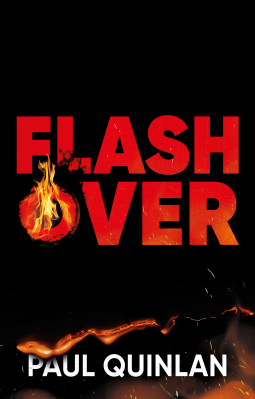
Flashover
This title was previously available on NetGalley and is now archived.
Send NetGalley books directly to your Kindle or Kindle app
1
To read on a Kindle or Kindle app, please add kindle@netgalley.com as an approved email address to receive files in your Amazon account. Click here for step-by-step instructions.
2
Also find your Kindle email address within your Amazon account, and enter it here.
Pub Date Nov 28 2025 | Archive Date Feb 13 2026
Talking about this book? Use #Flashover #NetGalley. More hashtag tips!
Description
In the summer of 1971 two young boys stumble across the mutilated bodies of a young mother and a Catholic priest. When crucial evidence they provide is ignored by police, the wrong man is convicted. As he languishes in prison, a series of similar macabre double-killings takes place in the years that follow.
When one of the boys reaches adulthood, he realises that he can identify the true perpetrator. He also meets and falls in love with the daughter of the wrongly convicted prisoner, but they now become the new targets of the true killer and his accomplice.
Flashover is the story of psychopathic and misogynistic serial murder, miscarriage of justice, political ambition, and the redeeming power of love. Against a background of religious uncertainty and political change, we follow the story of two young people whose lives have been turned upside down by murder, and their pursuit of justice. At the same time, we are introduced to the killers, who are driven by a desire for political advancement, and the pathological need to inflict sadistic suffering on others.
A Note From the Publisher
Available Editions
| EDITION | Paperback |
| ISBN | 9781836285458 |
| PRICE | £10.99 (GBP) |
| PAGES | 336 |
Available on NetGalley
Available to Buy
Buy on Amazon Buy on BN.com Buy on Bookshop.orgAverage rating from 3 members
Featured Reviews
 Paul W, Reviewer
Paul Quinlan’s “Flashover,” which is enthralling enough as a straight murder thriller, made for an even more absorbing read for me with its background detail about postwar British and Italian politics – things that the novel’s protagonist, Rick Harrington, is researching for his PhD thesis and which were especially interesting for me for my having spent considerable time in Europe in the immediate aftermath of the war with my Army officer father.
Showing his well-researched knowledge of Italy’s postwar political scene, for instance, Rick notes that the country “has the largest communist party in Western Europe,” though its "communists are not much like East European commies: they are much more independent of Moscow. Their major leaders since 1945 … have trodden their own ‘national path to socialism.’ … They would no more dream of trying to instigate some kind of Bolshevik-style revolution than they would of trying to bring the monarchy back.”
And not just purely academic, Rick’s interest in postwar European affairs, but eminently personal, with how his father, an Irishman who joined some fifty thousand of his countrymen serving with the British during the war, felt that the Axis powers had to be stopped “from dominating Europe,” an objective that was “as much in Ireland’s interest as anyone else’s. Where was the advantage in the newly independent state swapping British suzerainty for German domination?”
Of equal interest, too, Europe’s postwar politics, to another of the novel’s main characters, an unsavory politician, Luke McCardle (evidence of his unsavoriness: his use of a PA so ruthless as to have picked up the moniker of the “Albino Rottweiler”), who in a lunch with Rick delivers a veritable disquisition on Thatcher’s England:
“(She) timed the election well, of course, and we were never going to beat her, but we have made modest incursions into the Tories’ dominance. Kinnock is definitely more marketable than the last leader, and our campaign was light years ahead of the disaster zone that was 1983. Everything is much more professional now, and the leadership has got to grips with the hard left, who were a bloody menace.”
Especially interesting for me, as I say, such observations about postwar European politics, and, indeed, with the Italian angle, reminiscent for me of a favorite novel of mine of Italian location, William Styron’s “Set this House on Fire.”
Finally, though, for all Quinlan’s novel’s interest for me as an absorbing look at Europe’s postwar politics, it’s primarily a murder thriller, with a literal bang-up opening, when the then-12-year-old Rick and a friend come upon the corpses of a couple who’d been engaged in amorous activity before being murdered — the killings the more salacious for the woman being married and the man being a priest.
Saying more would be giving away too much, other than to say that along the way of Rick looking into the murders, which it turns out are related to several others over the years, he falls into an endearing romance, and the novel’s murders have a real-life basis which was in fact depicted in a Netflix series.
Still, enthralling enough as the murder story was on its own terms, I couldn't help but think that, with the political backdrop, there was the potential for a grander or more ambitious effort in the vein even perhaps of someone so illustrious as Styron. Also, on an admittedly pedantic note, there were occasional jarring shifts in point-of-view – when, for instance, in a lunch conversation between Rick and McCardle, the POV suddenly shifts from omniscient to full-on first person – that will no doubt be of little concern to the general reader but were off-putting to the English major in me.
Regardless, an intriguing and fast read, the novel, and with its flirtations with a larger canvas, having me looking forward to whatever Quinlan might come up with next.
Readers who liked this book also liked:
Paul S. Rothenberg
Biographies & Memoirs, Entertainment & Pop Culture

Marie Bostwick
Historical Fiction, Literary Fiction, Women's Fiction

Sara Bradley; Emily Timberlake
Cooking, Food & Wine, Essays & Collections