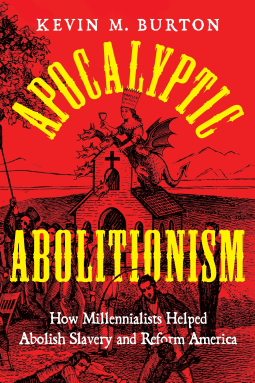
Apocalyptic Abolitionism
How Millennialists Helped Abolish Slavery and Reform America
This title was previously available on NetGalley and is now archived.
Send NetGalley books directly to your Kindle or Kindle app
1
To read on a Kindle or Kindle app, please add kindle@netgalley.com as an approved email address to receive files in your Amazon account. Click here for step-by-step instructions.
2
Also find your Kindle email address within your Amazon account, and enter it here.
Pub Date Jun 2 2026 | Archive Date Mar 30 2026
Talking about this book? Use #ApocalypticAbolitionism #NetGalley. More hashtag tips!
Description
Shows how apocalypticism helped drive anti-slavery abolitionism and inspire progressive social reform in nineteenth-century America
In March 1844, Melissa Botsford of Meriden, Connecticut, defiantly left her local Methodist church because it supported slavery and other “sins” that permeated America. Botsford was among one hundred thousand other abolitionists who abandoned their evangelical churches throughout the decade. These protesters came out with a stern apocalyptic warning: God would soon judge America—and its churches—for the sins of slavery and race prejudice.
It has long been assumed that apocalypticism is antithetical to social reform. Yet in Apocalyptic Abolitionism, Kevin M. Burton uncovers the untold story of how apocalypticism shaped the abolitionist cause and helped destroy slavery in the United States. Contrary to popular opinion, the revival fires of the Second Great Awakening did not drive most evangelicals to progressive social reforms like abolitionism. Neither were the denominational schisms during that period a fight between northern abolitionists and southern slaveholders. Rather, before the Methodist and Baptist denominations split along sectional lines, most abolitionists, particularly members of the Adventist movement, had already left their churches in what was likely the largest mass exodus from mainstream evangelicalism in American history, precisely because most evangelicals opposed radical social reform movements. This volume makes the case that evangelicals receive undeserved credit for antislavery, and that it was apocalyptic abolitionists who led the way.
Drawing from rare and overlooked sources to create a database of biographies of nearly 2000 people to track their religious affiliations and activism over time, Burton offers invaluable data to develop a robust framework for understanding apocalypticism, evangelicalism, and social reform politics of the nineteenth century.
Advance Praise
"In this bold and brilliant book, Kevin Burton reveals how belief in an imminent biblical apocalypse fueled social reform. Focusing on the intersections of race, gender, politics, and religion, Burton shows that those most convinced the world was ending were often the ones most committed to changing it for the better. This is a masterful and provocative reinterpretation of the roots of abolitionism." ~ Matthew Avery Sutton, author of Chosen Land: How Christianity Made America and Americans Remade Christianity
"Kevin Burton has made original, crucial contributions to the social and religious histories of the United States by bringing together two of its central themes: Adventism and social reform. Burton’s valuable accomplishment serves everyone interested in millenarian convictions and anti-slavery by showing how the first contributed to the second." ~ Nell Irvin Painter, Princeton University
"A groundbreaking and stunningly meticulous book that establishes beyond doubt the role of Adventists at the forefront of the abolitionist movement. It likewise strikingly overturns the claim that apocalypticism and social reform cannot coexist. Historical research and writing at its very best and a major contribution to American religious history." ~ John Corrigan, Florida State University
Available Editions
| EDITION | Other Format |
| ISBN | 9781479839469 |
| PRICE | $30.00 (USD) |
| PAGES | 336 |