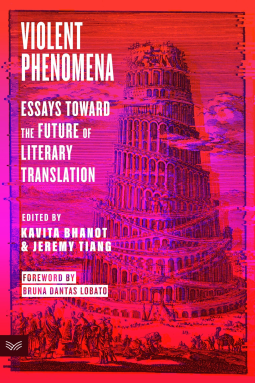
Violent Phenomena
Essays Toward the Future of Literary Translation
This title was previously available on NetGalley and is now archived.
Send NetGalley books directly to your Kindle or Kindle app
1
To read on a Kindle or Kindle app, please add kindle@netgalley.com as an approved email address to receive files in your Amazon account. Click here for step-by-step instructions.
2
Also find your Kindle email address within your Amazon account, and enter it here.
Pub Date May 19 2026 | Archive Date Jul 14 2026
Talking about this book? Use #ViolentPhenomena #NetGalley. More hashtag tips!
Description
“These essays, deftly blending the political and the personal, offer fresh, galvanizing, and passionate perspectives on literary translation.”—Jhumpa Lahiri
A manifesto in 22 essays, Violent Phenomena breaks stale rules about who can and should translate, envisioning a future more reflective of the beautiful polyphony of literature in all languages.
?What would it take to unlearn centuries of colonial influence over the books we read? The values, institutions, and structures that determine which of the world’s books and authors are translated, and by whom, are in dire need of disruption. Violent Phenomena brings together established and emerging translators from around the world to guide the way.
Frantz Fanon wrote in 1961 that “Decolonization is always a violent phenomenon,” meaning that the violence of colonialism can only be counteracted in kind. As colonial legacies linger today, what are the ways in which we can disentangle literary translation from imperial violence? In stark contrast with their predecessors, who were trained to be as “neutral” as possible, the contributors to Violent Phenomena demand engagement with the translator’s identity, voice, and cultural context, which shapes the result and in turn has an outsize influence on how a writer’s work is received.
From Anton Hur on “The Mythical English Reader” to Sawad Hussain’s “Why Don’t You Translate Pakistanian?,” these essays face the hard questions head on, offering readers the tools they need to demand a new literary playing field.
Features a new foreword by award-winning translator and author Bruna Dantas Lobato.
Available Editions
| EDITION | Other Format |
| ISBN | 9780063321229 |
| PRICE | $18.99 (USD) |
| PAGES | 336 |
Available on NetGalley
Available to Buy
Buy on BN.com Buy on Bookshop.orgAverage rating from 9 members
Featured Reviews
 Hamad A, Reviewer
**VIOLENT PHENOMENA: 21 ESSAYS ON TRANSLATION — ed. Kavita Bhanot & Jeremy Tiang**
★★★★★
The most striking thing about this collection is the sheer range of voices it holds together without flattening them. Contributors from across the world — Anton Hur, Sawad Hussain, Mona Kareem, Khairani Barokka, M. NourbeSe Philip, among many others — bring wildly different contexts, languages, and stakes to the same central question: what does it mean to translate, and for whom, when the institutions that govern translation are themselves products of colonial history?
The title comes from Frantz Fanon's 1961 observation that decolonisation is always a violent phenomenon. Bhanot and Tiang take that provocation seriously. The essays that follow don't offer a unified thesis so much as a chorus of irreconcilable perspectives, each one insisting on the specificity of its own situation. Anton Hur's piece on the mythical English reader is wry and precise. Sawad Hussain's essay, responding to the question "why don't you translate Pakistanian?", is sharp enough to draw blood. Together they build something more persuasive than any single argument could: a picture of a field in urgent need of rethinking, seen from twenty-plus different vantage points simultaneously.
What Bhanot and Tiang understand, and what makes their editorial vision so effective, is that the personal and the political in translation are not separate registers. Every essay here is allowed to be both at once. The result is a book that functions simultaneously as manifesto, memoir, craft discussion, and provocation — and that manages, somehow, to be all of those things without feeling scattered.
Essential reading, not just for translators.
Readers who liked this book also liked:





Publishers Lunch
General Fiction (Adult), Nonfiction (Adult), Teens & YA

Marshall J. Moore
General Fiction (Adult), Horror, Sci Fi & Fantasy