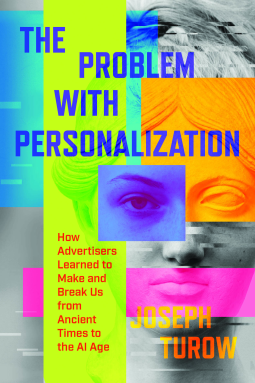
The Problem with Personalization
How Advertisers Learned to Make and Break Us from Ancient Times to the AI Age
This title was previously available on NetGalley and is now archived.
Send NetGalley books directly to your Kindle or Kindle app
1
To read on a Kindle or Kindle app, please add kindle@netgalley.com as an approved email address to receive files in your Amazon account. Click here for step-by-step instructions.
2
Also find your Kindle email address within your Amazon account, and enter it here.
Pub Date Jun 11 2026 | Archive Date Jun 1 2026
Talking about this book? Use #TheProblemwithPersonalization #NetGalley. More hashtag tips!
Description
A respected voice on technology shows how seemingly simple ads help dismantle democracy and public discourse.
Whether you’re intentionally shopping or casually browsing social media, something is following you: ads. Their creators seem to know your income bracket, politics, age, location, medical conditions, and tastes in clothing, food, and romantic partners. As advertising firms use predictive AI to discover your hot buttons and generative AI to push them, your online world becomes an increasingly bespoke—and isolated—place. The fervid competition around personalization in digital marketing has given rise to an ecosystem of advertisers, media outlets, tech companies, and retailers who monetize your data while threatening the health of our media, discourse, and sense of community. In this urgent book, award-winning author Joseph Turow shows how we got here, and how to change direction.
The Problem with Personalization shatters common beliefs about advertising history by showing that individualized ads are not new. Today’s AI-enabled advertisers draw on past aspirations and assumptions about personalization while weaponizing data in unprecedented ways that drive social fragmentation and the disappearance of shared social reality. Informed by interviews with marketing insiders and covering the latest technology advances, Turow accessibly explains how artificial intelligence sifts through our data to tag and target us wherever we go with personalized videos, pictorial billboards, audio messages, and more. A logical next step for advertiser support is tailored entertainment and news, a shift that further destroys the common ground necessary for a functioning democracy.
A must-read for all who care about the future of public discourse, The Problem with Personalization reveals how targeted advertising has altered how we’re seen and what we see in return.
Advance Praise
“The Problem with Personalization is an extraordinary history and call to action from one of this country’s most prolific and insightful media scholars. Turow brings readable prose and accessible stories alongside a critical warning about manipulation and disempowerment in today’s surveillance-based economy. This book should be read by anyone and everyone who is concerned about their privacy, their autonomy, and their future.” -- Ari Ezra Waldman, author of “Industry Unbound: The Inside Story of Privacy, Data, and Corporate Power”
“At last. This is the book we need to understand how advertising works in our era of data-driven online personalization and generative AI. Drawing on history, interviews, and content analysis of the digital machinery of advertising, Turow offers a masterful intervention in current privacy debates, providing much-needed recommendations for improving the advertising techniques shaping our societies.” -- Angèle Christin, author of “Metrics at Work: Journalism and the Contested Meaning of Algorithms”
Available Editions
| EDITION | Other Format |
| ISBN | 9780226837338 |
| PRICE | $27.50 (USD) |
| PAGES | 288 |
Available on NetGalley
Available to Buy
Buy on Amazon Buy on BN.com Buy on Bookshop.orgAverage rating from 4 members
Featured Reviews
 Reviewer 1870399
Thank you, University of Chicago Press, for providing this book for a voluntary review via NetGalley. All opinions are my own.
In The Problem With Personalization Joseph Turow provides a comprehensive history of targeted advertising and how it has evolved since Roman times to today. He convincingly shows that the end goal of ads is to sell something, oftentimes to the detriment of the consumer in ways that erode privacy, social structures, and democracy. Turow starts with the period prior to the rise of industrial marketing in the nineteenth century and ends with today's increasingly sophisticated targeting and personalization techniques based on artificial intelligence and machine learning.
Turow covers the development of department stores and chain stores, the rise of radio and television and the techniques used to track the corresponding audience (e.g., Nielsen ratings), the emergence of mailing lists, coupons and direct marketing, the use of internet cookies and barcodes, how mobile phones, starting with Apple's iPhone and HTC's Dream, enabled a whole new level of personalization, the details of how Google and Meta use their platforms to track user's preferences, habits, and activities, and the impact artificial intelligence and machine learning (via supervised, unsupervised, and reinforcement learning) is already having on targeted advertising.
Turow closes with a discussion on how governments have (and haven't) addressed privacy issues for their citizens and provides a list of recommendations to enable consumers to retain their privacy. He justly raises concerns about how extreme personalization impacts the reality each individual sees, which can prevent society to come to a shared understanding to learn what is necessary to keep the society going. Ultimately, our democracy suffers, which is why the topic of personalization and where it is headed is of utmost importance to our collective good.
I highly recommend The Problem with Personalization to all as a wake-up call since in today's internet-connected world essentially no one is immune to personalized advertising and its negative impact on society. Thank you, Joseph Turow, for the educational and eye-opening read.
Readers who liked this book also liked:














Hamish McKenzie
Business, Leadership, Finance, Nonfiction (Adult), Professional & Technical

Paris Marx
Business, Leadership, Finance, Politics & Current Affairs, Professional & Technical