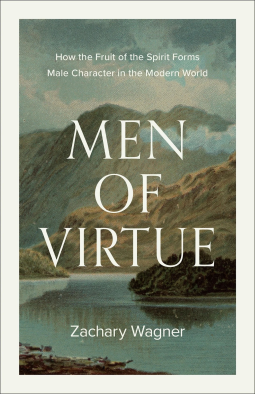
Men of Virtue
How the Fruit of the Spirit Forms Male Character in the Modern World
This title was previously available on NetGalley and is now archived.
Send NetGalley books directly to your Kindle or Kindle app
1
To read on a Kindle or Kindle app, please add kindle@netgalley.com as an approved email address to receive files in your Amazon account. Click here for step-by-step instructions.
2
Also find your Kindle email address within your Amazon account, and enter it here.
Pub Date May 26 2026 | Archive Date Jun 5 2026
Baker Academic & Brazos Press | Brazos Press
Talking about this book? Use #MenofVirtue #NetGalley. More hashtag tips!
Description
The fruit of the Spirit can shape our vision for biblical manhood in today's complex world. In Men of Virtue, Zachary Wagner offers a distinctly Christian vision of masculinity inspired by the virtues Paul commends to all believers. Perfect for men's discipleship groups and campus ministry contexts, this resource shows readers
· how the fruit of the Spirit guides biblical character development;
· a nonpartisan, theologically grounded vision of masculinity; and
· what it looks like for men to live out scriptural virtues in distinct, embodied ways.
Written for Christian men (and the women who love them), this book offers a fresh biblical vision of masculinity that calls men into a new kind of strength, character, and purpose.
Available Editions
| EDITION | Paperback |
| ISBN | 9781587436710 |
| PRICE | $19.99 (USD) |
Available on NetGalley
Average rating from 4 members
Featured Reviews
 Jeff S, Reviewer
Powerful. Controversial. Desperately Needed. This is one of those books where "Preacher" is stepping on *everyone's* toes (while aiming for their hearts, as the old joke goes). Left. Right. Woke. Based. Southern Baptist. Cooperative Baptist. Andrew Tate. Elliot (fka Ellen) Page. Don't matter. Wagner openly proclaims you're all wrong, and here's why. Yet even while doing this in a fairly direct, uncompromising manner... he also has (and shows within the text here) quite a bit of heart and compassion for everyone, no matter where they happen to currently find themselves in this particular discussion.
As one example that particularly stood out, at one point Wagner proclaims (apparently quoting someone else?) "A Christian is someone who is always more willing to die than to kill.", when speaking to Jesus' pacifism.
But this is truly the heart of the book, from the introduction:
"This book is not a call for us to take back the culture from the 'feminists' or the 'bigots' or whoever your preferred scapegoat may be."
Instead, Wagner uses the famous Pauline "Fruits of the Spirit" - Love, Joy, Peace, Patience, Kindness, Faithfulness, Gentleness, and Self Control - to walk us through a fairly balanced view of what male virtue *should* be according to the Bible itself.
One area that I always look at in Christian nonfiction is the use of prooftexting - citing Bible verses out of context in support or opposition of some point or another - and here, while Wagner decries the practice in the introduction... he actually uses it fairly often throughout the text. Not as horribly as some other authors, and indeed in focusing so much on expounding the famous verse from Galatians he actually provides quite a bit of the overall context of *most* of what he discusses... there's enough "throw away" proof texting here that it almost constitutes slamming his pinkie toe onto the corner of the bed and snapping it (as I did while reading this book!). Painful in the moment and an unforced error... but ultimately not actually harmful. Yet it still cost him a star on my rating, because I try to be consistent about removing that star *any* time I see the practice used as my one "weapon" in my personal war against all vestiges of the practice.
If you're interested in Christian ethics and virtue at all, you're going to need to read this book. Wagner truly does an excellent job of looking at the topic from a remarkably balanced view while actively ignoring many more hot button culture war issues - and actively telling you he is going to and his reasons for doing so.
If you're not interested in Christian ethics or virtue - or perhaps even question whether that last phrase is an actual oxymoron - this book isn't going to be for you. Which the cover and description should have told you, but I'm telling you here now as well. Just leave it alone if you are so adamantly anti-Christian or anti-organized religion generally or what have you. You're only going to make yourself upset as you read it and if you review this book you're more than likely going to make yourself look like a jackass. So *please*, just leave it alone. This book isn't for you, and that is perfectly ok. It has an audience, that audience simply doesn't include you.
Overall though, this book really is a solid examination of its premise, written in a very approachable style and using a cohesive narrative structure quite well indeed.
Very much recommended.
 Ian S, Librarian
I am discerning the Roman Catholic permanent diaconate at the moment. I skew toward the left-wing of the church, so I was thinking this book might help me reach across the divide that occurs in our big tent. in the United States.
I was pleasantly surprised this was written without ideology at the center. I would say it asks big questions about the fabric of our society and centers some universal Christian truths - like our desire for wholeness.
Recommended for any men that are seekers, with open minds toward new ways of seeing things in our Christian world, rooted in scripture and tradition.
Readers who liked this book also liked:

Albert Monteys
Comics, Graphic Novels, Manga, Literary Fiction, Politics & Current Affairs

Audrey Niffenegger
General Fiction (Adult), Literary Fiction, Sci Fi & Fantasy
Jared Diamond
Business, Leadership, Finance, History, Nonfiction (Adult)
Stuart Gibbs
Children's Fiction, Comics, Graphic Novels, Manga, Middle Grade