Twin Lotuses
This title was previously available on NetGalley and is now archived.
Send NetGalley books directly to your Kindle or Kindle app
1
To read on a Kindle or Kindle app, please add kindle@netgalley.com as an approved email address to receive files in your Amazon account. Click here for step-by-step instructions.
2
Also find your Kindle email address within your Amazon account, and enter it here.
Pub Date Apr 14 2026 | Archive Date Mar 24 2026
Oni Press | Magnetic Press
Talking about this book? Use #TwinLotuses #NetGalley. More hashtag tips!
Description
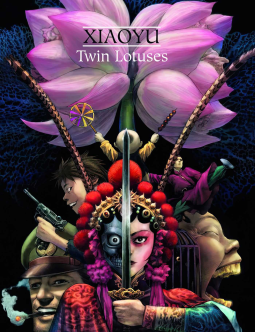
Fan is a young Chinese engineer who lost his wife in a Japanese bombing raid in 1937. Mingfeng was a popular performer at the local opera, and he is devastated by the loss. Distraught, he builds an extraordinary automaton that replaces her at the theater. Meanwhile, war rages throughout the city, and orphaned children run wild under the direction of local potentates in an attempt to thrive and survive. When those potentates take notice of the mysterious beauty, suspicions and desires start to grow. Mix in an American airman and the tensions of war, and things build to an explosive finale.
Masterfully mixing a snapshot of war-torn China with the philosophical sci-fi questions of a Philip K Dick novel, Twin Lotuses is a beautifully illustrated story capturing an ugly time and the flicker of hope, love, and ambition that shone through it all.
Available Editions
| EDITION | Hardcover |
| ISBN | 9781962413510 |
| PRICE | $29.99 (USD) |
| PAGES | 324 |
Available on NetGalley
Available to Buy
Buy on Amazon Buy on BN.com Buy on Bookshop.orgAverage rating from 11 members
Featured Reviews
 Brian S, Educator
Big thanks to Oni Press and NetGalley for sharing an advanced copy of Twin Lotuses, an epic historical horror-sci-fi story that takes place during the Japanese occupation of China in the late 1930s. I wasn’t sure what to expect with this comic, but it has a lot to offer for fans of different genres. The story follows two plotlines that are interconnected. There is a group of war orphans who are struggling with survival in war torn China. These kids are faced with trying to navigate the traditional and superstitions of old China, while also seeking out food and avoiding territorial and gang battles with other groups of marauding kids. Zhang Xiaoyu’s establishes a few characters who are known primarily by their appearances—for example, there’s Snot Nose, who seems to have a perpetually runny nose, and Hair lip, whose got a cleft in his lip. The scenes with these kids are earthy and brutal, filled with fluids, waste, and often violence, as the kids seek to find protection and food by aligning themselves with or against other groups. I loved how Xiaoyu used close-up drawings to draw our attention to these kids’ hard-scrabble existence. The kids are contrasted with Fan, an educated, upper-class man who presents reason and science as a counter to the superstitions and traditions of these kids. Fan has designed an early robot, a kind of automaton, that performs in the opera while he controls this robot offstage. We learn that Fan’s wife, Mingfeng, was a well-known opera performer who was killed by the Japanese bombing of China. Fan’s insistence in science is not only an indication of his education and knowledge, but also serves as a way for him to call for more education to counter the destructive engineering of the Japanese. He claims that Japan’s success in dominating China in the 1930s is due to their engineering and scientific know-how while China maintains its traditional and superstitious ways. Although this wasn’t the main conflict presented in the story, I loved how subtly Xiaoyu presents this argument and seems to seek out a way to find balance between science and tradition.
As Fan’s automaton performer gains greater recognition and popularity, we learn that Mingfeng survived the bombing but was separated from Fan. She sent letters to him, hoping to reconnect and eventually finds him with her doppelganger robot who has seemingly replaced her in performances of traditional Chinese opera. Fan is elated to reconnect with his lost love, but Mingfeng wants him to abandon his robotic creation since she finds it unsettling and upsetting. Fan faces a conflict as he is proud of his ultimate creation, and he struggles with sending his creation away. Will he abide by his wife’s desire to replace her replacement? Or will he find a way to accommodate both his human wife and her robotic double? Xiaoyu sets up a compelling dynamic for a fantastic finish of the story. There’s double-crossing and back-stabbing throughout the second half of the story, and it helps to show the kind of chaos that endured during and after the Japanese occupation. Both Xiaoyu’s story and artwork create two different worlds that are inhabited by different groups of people. It’s both evocative and morbidly fascinating, and it highlights the kind of challenges and struggles that different people have with surviving amid chaos and tragedy. I really enjoyed this book not only for its story, but also for the creative and detailed artwork. Highly recommended!
 Michael H, Reviewer
Zhang Xiaoyu is one of China’s most sought after illustrators, and has won his country’s top comics awards twice. Twin Lotuses demonstrates why (and looking at preview images of his art for 2017’s Savage Highway from Humanoids further solidifies his deftly brilliant hand). As noted in the book’s opening pages, for the Chinese twin lotus flowers represent love, as well as brotherhood and deep affection among siblings, themes that dominate Zhang’s story throughout the entirety of the work in various ways. Set during World War II, the villagers of Yangtze live under the threat of Japanese bombers, along with the tension between the past and the encroachment of modernity. China’s cultural movement toward science and democracy makes for oftentimes uncomfortable bedfellows alongside lingering superstitions, beliefs in ancient demons, and memories of life under an emperor.
Technological advances are mistaken for otherworldly horrors by 11-year-old Snot-nose when he meets the engineer Fan. Fan is well-educated, having studied in Britain and Germany, and has lost his wife to the Japanese’s aerial bombardments. Mingfeng was a popular stage actress, and Fan has recreated her in a beautiful automaton he is able to control by remote, allowing the operas she once starred in to continue beyond her passing. Snot-nose believes Fan has god-like powers, despite being told repeatedly that the engineer is strictly mortal.
Twin Lotuses is as operatic as Mingfeng’s productions, and the above merely scratches the surface. Zhang’s story is bold and epic in its intimacy. It’s a grand historic narrative, a coming of age piece set against the backdrop of war, and a small-scale crime story. It’s about love and marriage and grief, of a man trying to find purpose in the wake of tragedy and carrying on the only way he knows how. It’s also about corruption, abuses of power, murder and violence. War takes place in the skies above, but also between friends, family, and rivals.
I’ve long maintained that comics can be just as ambitious and eloquent as prose, and Twin Lotuses is a great example to support my case. Zhang brings the drama to life with his beautiful illustrations, but the end result is a potent piece of literature that transcends mediums as much as Zhang’s work crosses genres. There’s a depth and richness to the work here that transcends its visual sumptuousness alone. The technology that brings Mingfing to life is clearly beyond the time period, but it’s no less believable given how deeply grounded this larger-than-life marionette is in context. She feels real in spite of her artificiality, sometimes scarily so, which only adds another layer of tension to the proceedings. Still, Twin Lotuses feels far more like a Chinese version of The Godfather by way of Scorsese’s criminally overlooked Hugo than The Terminator thanks to its wide scope and lush eloquence, not to mention its focus on culture and the inhabitants of Yangtze.
Twin Lotuses and Zhang himself impress on a number of fronts, but it’s the black and white illustrations that prove most striking and captivating. Zhang’s work is astounding, from the opening spread of a passenger ship that finds itself under attack, to the open-air markets populated with shoppers, merchants, rickshaws, caravans of goods being transported, and ox-drawn wagons. Each of Zhang’s large-scale pieces are awesome in their theatricality and wonderfully “shot,” giving the book a rich cinematic feel. This is the work of an artist perfectly in command of his skills and abilities, with a keen eye for lush details. Not a single frame felt phoned-in or lazy, or suffering from the sacrifices mandated by a time crunch. When we talk about art, this is what we mean.
Admittedly, I know little about Chinese customs, culture, or history, yet I still found Twin Lotuses to be intimately accessible. Perhaps more importantly, it made me want to know more about China and its history in order to better appreciate this work even more. Zhang’s book makes for a wonderful ice breaker between cultures given its universal themes surrounding the human struggle. It’s a heartfelt love letter to a bygone era, one that’s also just flat-out beautiful the whole way through.
 Millie O, Reviewer
Twin Lotuses is one of those comics that sticks with you long after you’ve finished reading. The art style is unsettling in the best possible way, a bit rough, a bit eerie and it fits the story perfectly. It constantly keeps you on edge, like something is slightly off, and that feeling never really lets go.
What really stands out is how fearless the comic is when it comes to tough topics. It doesn’t play it safe or sugarcoat anything. Instead, it dives straight into uncomfortable themes and trusts the reader to handle them. That honesty makes the whole story feel more raw and real.
Another big strength is how it opens a window into a lesser-known part of history, especially for a Western audience. It doesn’t feel like a textbook lesson, through, it’s woven naturally into the narrative, which makes discovering this unfamiliar perspective even more powerful.
The comic also masters the art of understatement. It doesn’t explain everything outright, and that’s exactly why it works so well. The gaps in the story leave room for your imagination to run wild, adding layers of mystery and making the experience feel deeper and more personal.
And finally, the characters are fantastic. Each one feels clearly distinct and memorable. You can see who they are not just in what they say or how they behave, but also in how they’re drawn. Their designs reflect their personalities perfectly, making them instantly recognizable and believable.
Readers who liked this book also liked:

Kumi Makimura
Children's Fiction, Children's Nonfiction, Comics, Graphic Novels, Manga

Osamu Tezuka
Comics, Graphic Novels, Manga, Entertainment & Pop Culture, Mystery & Thrillers

Kumi Makimura
Children's Fiction, Comics, Graphic Novels, Manga, Science
Stephanie Williams
Comics, Graphic Novels, Manga, Entertainment & Pop Culture
DaVaun Sanders; Marvel
General Fiction (Adult), Sci Fi & Fantasy
Ed Brubaker
Comics, Graphic Novels, Manga, General Fiction (Adult), Mystery & Thrillers