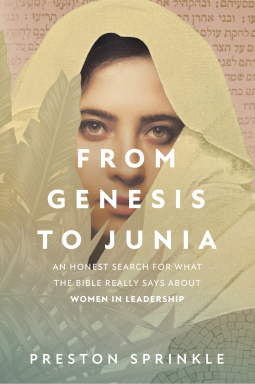
From Genesis to Junia
An Honest Search for What the Bible Really Says About Women in Leadership
This title was previously available on NetGalley and is now archived.
Send NetGalley books directly to your Kindle or Kindle app
1
To read on a Kindle or Kindle app, please add kindle@netgalley.com as an approved email address to receive files in your Amazon account. Click here for step-by-step instructions.
2
Also find your Kindle email address within your Amazon account, and enter it here.
Pub Date Mar 3 2026 | Archive Date Mar 3 2026
Talking about this book? Use #FromGenesistoJunia #NetGalley. More hashtag tips!
Description
Starting from a place of genuine searching, bestselling author Preston Sprinkle challenges assumptions and models gracious theological inquiry in this thoughtful exploration of what the Bible says about women in church leadership.
What does the Bible really say about women serving in positions of leadership in the church? It’s one of the church’s most debated and divisive topics. Many Christians read Scripture in light of preconceived conclusions, rather than engaging in a patient and thorough study of what the Bible actually says.
From Genesis to Junia offers something rare: an honest journey through Scripture that begins with questions rather than answers. With theological rigor and a pastor’s heart, Preston Sprinkle opens the Bible with fresh eyes and invites us along as he examines key passages from Genesis to Revelation―weighing historical context, interacting with a variety of scholarly perspectives, and holding familiar views up to Scripture. This informative and spiritually profound book provides:
- A respectful challenge to both complementarian and egalitarian assumptions
- Insightful analysis of texts such as 1 Corinthians 11, Romans 16, and 1 Timothy 2
- A model for navigating controversial topics in the church
This open-hearted approach to a complex issue offers a healthy example for dialoguing about tough theological questions. Readers will walk away not with superficial answers but with biblical confidence, deeper understanding, and a gracious posture for engaging with others.
Available Editions
| EDITION | Paperback |
| ISBN | 9780830785803 |
| PRICE | $19.98 (USD) |
| PAGES | 304 |
Available on NetGalley
Available to Buy
Buy on Amazon Buy on BN.com Buy on Bookshop.orgAverage rating from 13 members
Featured Reviews
 Reviewer 1503116
Preston Sprinkle's Journey Through Scripture on Women's Roles
From Genesis to Junia — Book Review
Preston Sprinkle
Overview of the Book
From Genesis to Junia is Preston Sprinkle’s careful, open‑handed exploration of what Scripture actually says about women in church leadership. Rather than beginning with a predetermined conclusion, Sprinkle begins with questions — and invites readers into a genuine search for biblical clarity. Moving from Genesis to Revelation, he examines key passages, weighs historical and cultural context, and interacts with a wide range of scholarship. The result is not a manifesto, but a model of humble, rigorous theological inquiry.
Key Ideas and Arguments
Sprinkle structures the book around the most debated texts and themes:
Creation and the Fall — What Genesis 1–3 reveals (and does not reveal) about gender, authority, and God’s design.
Women in the Old Testament — How God calls, commissions, and empowers women in Israel’s story.
Jesus and Women — The countercultural way Jesus honours, teaches, and commissions women.
Paul’s Letters — Detailed engagement with 1 Corinthians 11, 1 Corinthians 14, Romans 16, and 1 Timothy 2, including linguistic, cultural, and historical analysis.
Junia and the Early Church — A fresh look at the women who led, taught, hosted churches, and served as apostles and co‑labourers in the gospel.
Sprinkle’s central conviction is that Scripture must be allowed to speak for itself — even when it challenges our assumptions, traditions, or comfort zones.
Strengths of the Book
Intellectual honesty — Sprinkle refuses to oversimplify complex passages or force tidy conclusions where Scripture leaves tension.
Balanced engagement — He critiques both complementarian and egalitarian arguments with fairness and respect.
Pastoral tone — The writing is gentle, humble, and deeply aware of the real people affected by this conversation.
Scholarly depth — His training in New Testament studies is evident, but he communicates in a way that is accessible to non‑academics.
A model for disagreement — The book demonstrates how Christians can wrestle with difficult issues without hostility or fear.
Potential Limitations or Tensions
Readers who want a definitive, one‑sentence conclusion may find Sprinkle’s open‑ended posture challenging.
Some may feel he gives too much weight to scholarly debate; others may feel he doesn’t go far enough.
Because he intentionally avoids aligning with a camp, readers on both sides may wish he pushed harder in their direction.
These tensions, however, are part of the book’s integrity — it is intentionally a journey, not a verdict.
Who This Book Is For
Church leaders navigating questions of women’s roles
Bible study groups exploring difficult passages
Christians who feel caught between complementarian and egalitarian frameworks
Anyone wanting to model gracious theological disagreement
Readers who appreciate scholarship delivered with humility and pastoral sensitivity
Pastoral Reflection
Sprinkle’s approach feels like a breath of fresh air in a conversation often marked by defensiveness and division. His willingness to ask honest questions — and to let Scripture unsettle him — is a posture the church desperately needs. Whether or not readers agree with all his conclusions, the book invites us to slow down, listen carefully, and trust that God’s Word is strong enough to withstand our questions. It also honours the women who have faithfully served Christ throughout history, often without recognition or permission.
Memorable Takeaway
This book doesn’t tell you what to think — it teaches you how to think biblically, humbly, and courageously about one of the church’s most important conversations.
 Erin E, Reviewer
Preston Sprinkle’s new book From Genesis to Junia: An Honest Search for What the Bible Really Says About Women in Leadership lives up to its subtitle, in my opinion. The social media posts I’ve seen building anticipation for its release didn’t make it obvious which side of the debate the author was writing from. I now know this was very intentional. And he kept me guessing…right to the end. The book is more of an invitation to peek over his shoulder, to come along on the twists and turns of his research journey, which is impressively thorough. I think what makes this book different (and also very powerful) is that Sprinkle did not set out with a particular agenda in mind. His discoveries feel like they are happening in real time. Of course, every author comes to their topic with some degree of bias, but he makes it clear that he doesn’t “have external pressures — a job, a church, relationships — nudging me toward one view over another” (p. 12). As tempted as I was to flip ahead and read the final pages to satisfy my curiosity, I resisted the urge. And I was rewarded, moved to tears actually, with his concluding paragraphs. I don’t want to spoil the journey for you either, so let me conclude by saying this is a book rooted in exegetical precision, not emotional appeals. Despite its plethora of footnotes, it is very accessible, an easy read for anyone interested in the topic of women in leadership. I love that he had the manuscript torn to shreds by respected scholars on all sides. The final draft preserves that sense of respectful dialogue. There is no whiff of condescension or name-calling. The fact that I had trouble discerning if or where he would land shows me that no matter which side of this debate we identify with, we could have a lot more in common than we might initially assume. I am incredibly hopeful that maybe, just maybe, this will be a book to inspire more dialogue and deeper understanding of this issue, for those who disagree with one another or with the author’s conclusions.
Please note: I received an advanced reader copy from the publisher for review, but all opinions are my own.
Educator 1166855
Sprinkle strives for a fair assessment of the evidence and various interpretations concerning various areas of Scripture which have been 'battlegrounds' on the question of women in church leadership. I think his fairhandedness is evident not just in tone and substance of the book, but also from the book's endorsements from both sides of the aisle – endorsements from complementarians such as Craig Blomberg and William Mounce, and egalitarians like Sandra Richter and Sandra Glahn.
Sprinkle goes through Genesis 1-3, followed by two chapters on surveys of women in the Old Testament and in Jesus's ministry, and a chapter on leaders and leadership in the early church (based on Acts and the New Testament epistles). He then moves more into the weeds of New Testament texts, analysing Romans 16 (to explore women in Paul's ministry), the role of female prophets from 1 Corinthians, headship and submission in Ephesians 5:21-33, headship in 1 Corinthians 11:3-12, and the role of women in churches in 1 Cor 14:34-35 and 1 Tim 2-3. As stated above, Sprinkle takes an even-handed approach weighing between competing interpretations of the texts, siding with complementarian scholars at times (eg. affirming that "head" (kephale) conveys a sense of 'authority' on top of 'source' based on Greek literature and Paul's use of the word, rejecting egalitarian interpretations (eg. Philip Payne) that kephale means 'source'/'prominence' without any sense of authority (pp 184-185)) and egalitarian ones at others (eg. based on scholarship on the Greek text and ancient history of Ephesus and Paul's structure of 1 Timothy, agreeing that "Paul prohibits wealthy women from teaching men in a domineering way (1 Tim. 2:12), then appeals to the Genesis creation account (vv. 13- 14) to combat a local genealogical myth (Artemis's firstborn status and Ra's deception) that empowered female religious leaders to think they were superior to men. Paul then concludes by confronting another Artemis myth, declaring that God—not Artemis—is the one who saves women through childbirth (v. 15).").
Overall, this book makes for an even-handed treatment of the relevant biblical texts, and would be one I recommend to people looking into this issue, though I may disagree with Sprinkle at certain points. Recommended.
 Kristen G, Reviewer
The tone of the book is accessible and almost conversational (knowing his voice, I could easily imagine how well this translates to an audio book). While thorough in scope—leading the reader through both the Old and New Testament—my only complaint is that I would have liked him to dive deeper into certain passages and arguments. For example, his argument about not taking 1 Timothy prescriptively could’ve been bolstered by emphasizing Paul’s “contradiction” between disallowing women deacons (3:12) while commending them in other passages.
Though at 300 pages and offering supplementary articles on his website, I understand the publishers hesitancy to allow another one or two hundred pages, which I would’ve happily read. I can, however, thank the publisher for choosing footnotes over endnotes. Thank you, Publisher (4.5/5 rounded up).
Furthermore, Preston weighs out arguments with integrity, dismissing fallacious arguments no matter how popular and steel manning opposing views. His thought and honesty is refreshing on such a polarizing topic. Anyone seeking to understand the topic/ controversy about women in church leadership should read this book (and then Exiles!).
 Josh R, Reviewer
Well researched. Very thorough.
The only thing that gets a little tiresome is him concluding each chapter with "But I don't know where I'm going to end up with...keep taking the journey with me!" I appreciate him trying to be balanced and open-handed, and I think he was during the process. The constant assurance that he is trying to do that, though, feels a little "pick me." Humanizing, maybe, but I think the research he does speaks for itself, and I think he presented it well.
Alex G, Reviewer
I had the privilege to read the advanced copy from the publisher. Ever since Mike Winger's video series came out, I was waiting for a book that would respectfully deal with the question of women in leadership/teaching, and not strawman and misrepresent the scholarly mountains of work surrounding the topic on both sides.
Dr. Preston, actually engages with the scholars on both sides and in between. And does so, with both academic rigor and honesty, but also with a heart and posture that is open to actually be persuaded.
The last chapter "Landing the Plane" summarizes everything well, and delivers emotionally. But don't read it ahead of time. Just follow the journey along from page 1. So far, the best I've read on Women in Leadership/Teaching.
 Hannah V, Reviewer
'From Genesis to Junia' is a thoughtful, thorough, and refreshingly honest exploration of what Scripture actually says about women and leadership in the church. As someone who has followed Preston Sprinkle for years and listened as he publicly wrestled with this topic, I was especially encouraged to see his full research and reasoning laid out so carefully here.
Sprinkle approaches this highly debated subject with humility and intellectual integrity. He began writing without knowing where he would land, and that commitment to objectivity shows. Rather than rushing to a cultural application, he focuses on building a solid biblical foundation first, which helps create common ground in an area where Christians often disagree strongly.
I also appreciated his transparency throughout the process. He openly shares where certain arguments challenged him, surprised him, or fell short, which made the book feel both rigorous and relatable. His conclusion is nuanced and thoughtful, and not reduced to a catchy slogan or oversimplified stance.
As someone who has long felt dissatisfied with many standard Complementarian and Egalitarian arguments, I found this book deeply helpful. Whether you agree with his conclusions or not, 'Genesis to Junia' models how to study Scripture carefully, honestly, and with a sincere desire for truth. I highly recommend it to anyone wrestling with these important questions.
Special thanks to David C Cook and NetGalley for providing an advance review copy. I received this book for free and am leaving this review voluntarily. All opinions expressed are completely my own.
Reviewer 726671
Well written. Well researched. I enjoyed the write it as I go style before he had come up with his own final thoughts. Also appreciate how open handed it is and that he gives space to talk about the opposing side to his conclusions. All-around, well done.
 Jessica K, Reviewer
I saw an interview with Preston Sprinkle where he said that he used to be a complementarian but through Bible study had shifted his views. This is a balanced look and I appreciate that Sprinkle is speaking out on this issue.
Elsa T, Reviewer
My daughter’s name is Junia, so that probably tells you where I land in this debate. Because of that, I went into this book with both interest and nervous hope. I’ve listened to Preston Sprinkle’s podcast for several years, and I wasn’t sure where he would ultimately land on the question of women in leadership, church, and home.
One of the strengths of this book is that it sounds exactly like Preston. The writing style is approachable, conversational, and pastoral, while still being careful and methodical. It’s clear that a great deal of research sits behind the book, but it never feels academic in a way that makes it inaccessible. He works through Scripture slowly, paying attention to historical, cultural, and linguistic context, which makes the book feel trustworthy even if you don’t fully agree with every step of his reasoning.
As the book goes on, it becomes harder not to notice how much the complementarian position depends on maintaining certain assumptions that don’t always hold up when the biblical text is read in its full context. I say this as someone who was a lifelong complementarian. It took several years of reading, listening, and wrestling with other books, articles, sermons, and podcasts—by both women and men—before my position changed. Letting go of that framework opened the door to a fuller appreciation of the kindness of God and the way His design for the Church can be more diverse and more beautiful than I had been taught to expect. My hope is that this book will be the start of that journey for many readers.
I appreciated Sprinkle’s emphasis on service as the defining mark of leadership. It brings a new (ironically) perspective and shifts the focus away from hierarchy and toward Christlike character. I was also holding my breath during the chapters on kephalē, because the idea that men and women could be equal in the church but not in the home has always been troubling to me. I appreciated that his conclusion there stayed somewhat open-ended instead of forcing a clean system where the text doesn’t quite give one.
I also respect that in the end he admits that “soft complementarianism” has less merit than “strong complementarianism.” If the principles are truly biblical, shouldn’t they apply in every situation? When applied consistently, the position can start to feel difficult to make sense of, not only biblically but logically too.
Even when I disagreed with smaller conclusions along the way, I found myself wondering whether that ultimately matters as much as we think it does. Sincere readers of Scripture can take different paths and still arrive at similar convictions. We have the Word of God, but not an instruction manual for how to interpret every passage, and maybe that should humble us. It should push us toward curiosity instead of certainty and lead us back to the life and words of Jesus as our clearest guide. Some questions may remain unresolved, but we still have to move forward in love and unity.
My hope is that this book sparks deeper study rather than ending the conversation. If these things are true, they shouldn’t stay in the theoretical realm. Imagine the life of future generations of believers if women were free to live and serve without unnecessary constraints. It’s one thing to debate these issues, and another thing entirely to live as though our conclusions actually matter.
Readers who liked this book also liked:
Steven A. McKinion; Benjamin T. Quinn
Christian, Religion & Spirituality








Thom S. Rainer
Christian, Nonfiction (Adult), Religion & Spirituality