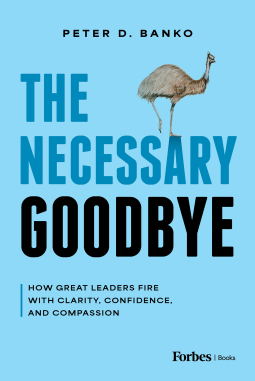
The Necessary Goodbye
How Great Leaders Fire with Clarity, Confidence, and Compassion
This title was previously available on NetGalley and is now archived.
Send NetGalley books directly to your Kindle or Kindle app
1
To read on a Kindle or Kindle app, please add kindle@netgalley.com as an approved email address to receive files in your Amazon account. Click here for step-by-step instructions.
2
Also find your Kindle email address within your Amazon account, and enter it here.
Pub Date May 12 2026 | Archive Date May 12 2026
Talking about this book? Use #TheNecessaryGoodbye #NetGalley. More hashtag tips!
Description
The Necessary Goodbye is a practical, eye-opening guide to one of leadership’s most misunderstood and avoided responsibilities: firing someone. Written for new and emerging leaders, aspiring executives, and anyone navigating real-world team challenges, this book delivers a confident, compassionate roadmap for leading through tough transitions.
Drawing from nearly two decades of CEO-level experience, Peter D. Banko offers a direct and deeply human approach to handling terminations with clarity, confidence, and respect. This is not another corporate management manual. It’s a leadership education rooted in wisdom, real-world stories, and references to literature, psychology, music, religion, and culture.
You’ll learn how to:
- Handle termination conversations with empathy and precision
- Reframe firing as a leadership act—not a personal failure
- Preserve trust, culture, and team morale during tough decisions
- Lead from your values, even when the path is difficult
If you’re leading people or preparing to, The Necessary Goodbye gives you the perspective and tools to do what’s necessary, and do it well.
Available Editions
| EDITION | Other Format |
| ISBN | 9798887508122 |
| PRICE | $29.99 (USD) |
| PAGES | 288 |
Available on NetGalley
Available to Buy
Buy on Amazon Buy on BN.com Buy on Bookshop.orgAverage rating from 16 members
Featured Reviews
 Demetris P, Reviewer
What Power Owes the Person It Removes
In “The Necessary Goodbye,” Peter D. Banko makes the case for firing with clarity while exposing the danger of confusing decisiveness with judgment
By Demetris Papadimitropoulos | April 27th, 2026
A book about firing people should make a humane reader sit straighter, especially when it calls firing an underused instrument of authority. There is a version of that argument that would be all blade and no conscience, a management creed that mistakes decisiveness for virtue and speed for courage.
Peter D. Banko’s “The Necessary Goodbye: How Great Leaders Fire with Clarity, Confidence, and Compassion” brushes close to that danger, sometimes with both elbows out. Yet its better conscience is more humane than its hardest metaphors allow. This is not finally a book about how to enjoy carrying the axe. It is a book about whether the hand holding it has done the work not to confuse force with judgment.
Banko’s subject is one of leadership’s least photogenic duties: the moment when someone has to leave. Not resigning after a tasteful transition lunch, not departing for a grander title elsewhere, not “pursuing new opportunities” in the soft-focus dialect of corporate announcements, but being told, clearly and finally, that their place in the organization has ended. His case is that leaders are trained for nearly everything except this, inclined to avoid it, and often more damaging in delay than in decision. Bad fits calcify. Underperformers are protected by affection, politics, fear, or inertia. Toxic people acquire small courts of protection. Good employees leave first. Teams learn that stated values are wall art. The room begins to smell faintly of whatever no one has admitted has died there.
That is where the book earns its title. Most leaders already know firing is sometimes necessary, even if they bury the knowledge beneath another committee, another improvement plan, another soothing phrase from the Human Resources hymnbook.
Banko’s more unsettling claim is that endings have an ethic. If organizations know how to recruit, celebrate, onboard, flatter, and honeymoon with talent, then they ought to know how to end working relationships with equal care and candor. A goodbye can be necessary without being careless. A termination can be firm without becoming theater. A person can be wrong for a role without becoming the villain in the leader’s private epic.
“The Necessary Goodbye” opens with a comic roll call of firing euphemisms – de-cruit, dehire, deselect, downsize, 86ed, the old heave-ho – and that opening establishes much of Banko’s method. He likes lists, jokes, provocation, and the sudden hard turn. One minute the reader is smiling at corporate language; the next he is invoking public executions, Old West hangings, and the managerial urge to “send a message.” He is funny, but rarely decorous. He writes like a leader who has spent too many years in rooms where everyone knows the truth and no one wants to say the noun first.
His authority is not theoretical; it comes smudged with the work. Banko presents himself as a healthcare executive shaped by turnarounds, unpleasant rooms, and more than fifty direct termination conversations, with indirect responsibility for far more job losses through restructuring and organizational change. His origin story supplies the necessary counterweight. He began not as a destined executive but as a young Notre Dame student failing aerospace engineering until Sister Marie de Pazzi, a hospital CEO and Grey Nun, saw leadership in him before he saw it in himself.
That anecdote matters because it complicates the book’s severity. Banko is not only interested in removing people; he also knows what it means to be recognized, redirected, and saved from the wrong future.
The structure gives the book both its engine and its trapdoor. After early chapters on talent, performance, inaction, and why leaders avoid firing, Banko builds the middle around twelve “firing archetypes” drawn from Jungian language: the Lover, Rebel, Innocent, Everyperson, Hero, Caregiver, Explorer, Ruler, Jester, Magician, Creator, and Sage. Each chapter describes the archetype in its healthy form, then shows how its shadow version can damage a team or organization. The Lover may bring passion and intimacy, but also misconduct. The Rebel may challenge stale systems, but also turn dissent into sabotage. The Innocent may simply be a good employee caught in layoffs, mergers, or a strategic pivot. The Everyperson may be beloved and hardworking but unable to lead through changed conditions. The Hero may rescue a system until hubris makes the rescue mission all about himself. The Sage may bring hard-won wisdom until wisdom refuses to leave the chair.
The archetypes work when they behave like lanterns, not gavels. The strongest chapters name recognizable leadership dilemmas: firing someone who did nothing wrong, removing someone everyone loves, confronting the exhaustion of the savior, distinguishing compassion from martyrdom, admitting one has been dazzled by charisma, and helping wisdom exit before it curdles into entitlement. The framework gives readers a vocabulary for recurring workplace patterns, and it keeps the book from becoming a laminated HR script.
But every sorting system has a cost.
People do not fail as neatly as symbols do. A termination may be less about a shadow archetype than about bad hiring, weak onboarding, unclear expectations, poor feedback, board cowardice, burnout, structural dysfunction, discrimination, or a leader who mistook discomfort for evidence. Banko knows some of this, and the later chapters add reflection, team input, legal caution, patience, and process. Still, the archetype middle sometimes turns complexity into costume. At its weakest, the book risks making a human being too legible too quickly, as if the right mythic label could do the work of judgment.
Banko’s prose has the same split temperament. It is kinetic, referentially ravenous, restless on the page, and happily undisciplined. He moves from Michael Jordan to Nick Saban to George Steinbrenner, from Dante’s frozen lake to “The Lion King,” from “SpongeBob SquarePants” to M&A redundancies, from “The Muppet Show” to board politics, from Taylor Swift’s “Anti-Hero” to the unpleasant task of firing the workplace Hero. He draws on the hard-call executive candor of “The Hard Thing About Hard Things” by Ben Horowitz, shares some practical kinship with the humane directness of “Radical Candor” by Kim Scott, and stands closest in theme to “Necessary Endings” by Henry Cloud. Yet Banko’s book is stranger than those comparisons suggest.
It has a wand. It has an emu. It has enough kings, traitors, geese, sharks, martyrs, magicians, and football coaches to populate a leadership retreat designed by a very intense theater department.
The abundance is part of the pleasure, and part of the bill. Banko’s sentences often land in crisp commands: performance matters; be kind, not nice; do not surprise people; get in the room; do not humiliate the person; communicate more than feels natural. Then the paragraphs swell into catalogues, analogies, and anecdotal volleys. The style creates momentum, but not always poise. It has voltage. It also has a tendency to bring three suitcases for an overnight trip. Some readers will find this invigorating. Others may long for a quieter page, or at least a brief moratorium on cultural references until the next exit interview.
The book finds its hinge in the distinction between kindness and niceness. Niceness, in Banko’s account, is often self-protection in a cardigan. It smiles, delays, avoids conflict, preserves the leader’s preferred self-image, and lets everyone else pay the cost.
Kindness is harder. It requires truth, preparation, timing, support, accountability, and action. To be kind is not to prolong a failing fit indefinitely. It is to make the decision with care, to avoid surprise, to involve HR and legal early, to provide severance and outplacement where appropriate, to preserve dignity, to avoid the petty humiliations of the cardboard box and the security escort, and to communicate clearly to the team left behind. Here the book’s advice becomes conduct.
Its most durable achievement is its attention to what the room does afterward. Many leadership books would stop once the script is delivered. Banko is more interested in the echo and debris: the team that has been compensating for the person, the board that privately supported the move and publicly flees it, the surviving employees watching how the organization treats someone on the way out, the person’s family and future, the leader’s conscience. “The Necessary Goodbye” understands that an exit is not a door closing quietly. It is a pressure wave moving through a system.
That is why the “Innocent” chapter matters so much. Banko tells the story of a promising, high-performing leader removed because financial reality and strategic change made the role expendable. The person had done much right. The organization had changed around them. Banko regrets the decision, and that regret gives the book needed oxygen. It reminds the reader that not every goodbye is a correction. Some are sacrifices to circumstance. Some are the cost of decisions made elsewhere. Some involve good people whose only failure was being in the wrong seat when the map was redrawn.
The “Everyperson” and “Sage” chapters make the wound harder to simplify. The beloved, hardworking, community-rooted leader may not be the leader the next moment requires. The wise, long-tenured advisor may become a blockage if he cannot leave the stage. These chapters resist the easy pleasure of condemnation. They show the pain of firing someone likable, historically valuable, or once essential.
Fit is not moral worth. A person can matter deeply and still need to go.
Here is the trouble: the book’s language of compassion often has to wrestle its language of command to the ground. Banko reaches frequently for images of battle, predation, treachery, execution, kingship, enemies, sharks, and cutting things out. Some of these images are apt. Leadership does involve politics, resistance, and consequences. Anyone who has worked in a large organization knows that the meeting after the meeting is not a mythological creature. It is usually sitting three chairs away, pretending to take notes. But the pileup can be harsh. At moments, the prose sounds a little too fond of the blade it otherwise wants to discipline.
A book about firing cannot afford to be casual about power; power is already in the room, wearing the better suit. Banko’s best pages show that he knows this. The pages where the gloves come off, and perhaps should not have, make the reader wonder whether he always remembers it. The claim, in the Hero chapter, that leaders automatically deserve loyalty because of title and position is one of the book’s least persuasive assertions. Loyalty may attach to role, but it is deepened by conduct and damaged by the same. Elsewhere, Banko’s own counsel is wiser: leaders should listen, gather evidence, include the team, reflect, discern, own mistakes, and ask whether they want to be right or get it right. The book’s safeguards are stronger than some of its slogans.
Chapter 19, “The Blind Eye,” is another revealing pressure point. Banko admits that leaders cannot always fire immediately. Political capital, protected employees, board dynamics, timing, and risk may block clean action. His alternatives – narrowing scope, isolating the person from important work, repeating boundaries, changing reporting lines – are pragmatic but ethically uneasy. He knows they can feel unkind. They may also be the reality of large organizations where perfect courage meets imperfect authority. Here the book is useful in the way a locked utility closet is useful during a flood: necessary, unpleasant, and not something one wants to admire for too long.
The final chapters keep the archetype gallery from hardening into a wax museum of managerial grievances. “Be Kind, Not Nice” turns the question inward. “The Role of the Team” argues for slow hiring, careful assessments, deliberate team-building, and judgment that is supported by HR but not outsourced to it. “Resistance Is Futile” may overindulge the shark imagery, but it correctly recognizes that major people decisions generate rumors, backlash, and opportunism. “Getting It Right” gives the concrete guidance many readers will come for: take your own temperature, take the team’s temperature, involve HR and legal, plan carefully, keep the termination conversation brief, do not waffle, do not blame the board or HR, provide support, and honor the room afterward.
The afterword, “Good Birth and Good Death,” changes the book’s altitude. Banko argues that organizations lavish attention on beginnings: the recruitment courtship, the interview dinners, the glowing announcement, the first-day agenda, the honeymoon of early patience. They are far less attentive to the “messy middle” of re-recruiting, appreciation, feedback, resources, development, compensation, and everyday care. By the time an ending arrives, the relationship may already have been deteriorating for years. Banko’s final metaphor is larger than firing: organizations need better rituals for endings. They need work funerals, wakes, reflection, gratitude, and closure. Good endings, he argues, make better beginnings possible.
The afterword gives the argument its cleanest turn because it finally names the book’s real subject: organizational mortality. What could have been a narrow leadership manual becomes a meditation on the way institutions celebrate arrivals and mishandle departures. Companies love beginnings because beginnings flatter everyone involved. Endings are harder because they require memory, accountability, and the humility to say that something once alive no longer is. In a workplace era marked by restructuring, exhausted managers, anxious employees, and constant reinvention, that idea has pressure beyond the page. Not because the book chases the latest workplace panic, but because it diagnoses an old habit in contemporary dress: institutions love growth language and hate death language.
I do not think “The Necessary Goodbye” is a fully controlled book. It is too uneven for that. Its references sprawl. Its archetypes sometimes simplify. Its endnotes are a crowded neighborhood: strong houses, flimsy porches. Its voice can be charmingly over-caffeinated, then merely loud. Its reach occasionally exceeds its grip. It sometimes speaks as if decisiveness were more trustworthy than it is. Leaders, like everyone else, can be wrong with conviction.
But it is memorable, and it would help in the actual room, which is more than many smoother leadership books can claim. More than that, it is revealing in the more interesting sense: it exposes the temperament behind the counsel. Banko’s impatience with avoidance gives the book force. His religious and servant-leadership vocabulary gives it conscience. His executive stories give it scar tissue. His jokes keep it from becoming solemn. His harshest metaphors show exactly why the subject requires the gentler discipline he recommends.
My final rating is 82/100, which corresponds to 4/5 Goodreads stars.
The score marks a book with practical value where it matters – before, inside, and after the meeting – held back by repetition, overreach, and command-language that grows teeth. “The Necessary Goodbye” is most worth reading not because it teaches leaders to fire. Any number of lawyers, consultants, handbooks, and grim calendar invites can do that. Its value lies in the more demanding question beneath the procedure: what does power owe the person it has decided no longer belongs?
Banko’s answer is imperfect, sometimes loud, sometimes too fond of the battlefield. But when the book is right, it is bracingly humane: clarity without performance, firmness without humiliation, generosity without self-congratulation, an ending that does not pretend it is painless but refuses to make pain the point. The goodbye may be necessary. The gracelessness is optional. Somewhere between the emu walking forward and the wake held for what has ended, the book finds its most telling image: leadership not as the art of never letting go, but as the discipline of opening the door without setting the house on fire.
 Mary R, Reviewer
In today's environment, there have been unfortunately times for the Necessary goodbye as a manager. This book was well thought out and gave me some insights to use when/if I have to make these hard choices in the future. I overall enjoyed the book and glad to have it as a reference in my career.
 Reviewer 213889
Peter D. Banko’s "The Necessary Goodbye" is a high voltage, refreshingly blunt exploration of a topic most managers treat as a legal hurdle or a spreadsheet error. Rather than viewing firing as a mere administrative task, Banko reframes the exit as a profound test of a leader’s ethics. He argues that while most executives are experts at the honeymoon phase of hiring and onboarding, they often behave like cowards when it comes to the funeral of a working relationship.
This shift in perspective highlights a sharp distinction between being nice and being truly kind. In Banko’s view, niceness is often just conflict avoidance wrapped in a cardigan to protect the leader’s ego, whereas kindness requires the directness necessary to preserve an employee’s dignity. To help navigate these difficult waters, he introduces twelve Jungian archetypes, such as the Shadow Hero or the curdled Sage. These personas provide a clever, if sometimes rigid, vocabulary for identifying exactly when a team member has transitioned from a valuable asset to a stagnant or toxic force within the organization.
While these archetypes offer a helpful shorthand for workplace patterns, the book’s energetic tone occasionally moves at a restless pace. Banko jumps from Notre Dame anecdotes to Taylor Swift and SpongeBob with an intensity that might give some readers whiplash. The prose is heavily peppered with battlefield metaphors, occasionally revealing a temperament that seems a bit too fond of the blade of authority. At times, this command and control style threatens to overshadow the servant leadership heart that the author claims to champion, potentially oversimplifying complex human failures into mythic caricatures.
Despite that occasional overreach, the book remains a deeply practical guide for anyone who has felt the stomach turning dread of a scheduled termination. It is particularly effective when focusing on the aftershocks of a departure, coaching leaders on how to manage the remaining team and the echo that a termination leaves in a company’s culture. By challenging readers to consider what power owes a person at the exact moment their livelihood is being taken away, Banko provides an essential manual for the messy middle of management. Ultimately, he proves that a necessary ending does not require a lack of grace, showing that it is possible to open the door for someone without burning the house down behind them.
Readers who liked this book also liked:



Tony Castro
Biographies & Memoirs, Entertainment & Pop Culture, Nonfiction (Adult)





Tim Leatherman; Chris Kornelis
Biographies & Memoirs, Business, Leadership, Finance