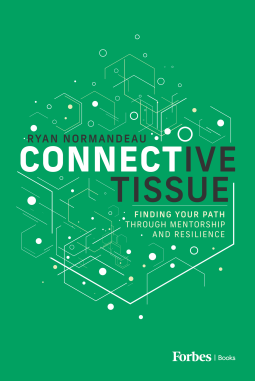
Connective Tissue
Finding Your Path Through Mentorship and Resilience
This title was previously available on NetGalley and is now archived.
Send NetGalley books directly to your Kindle or Kindle app
1
To read on a Kindle or Kindle app, please add kindle@netgalley.com as an approved email address to receive files in your Amazon account. Click here for step-by-step instructions.
2
Also find your Kindle email address within your Amazon account, and enter it here.
Pub Date May 12 2026 | Archive Date May 12 2026
Talking about this book? Use #ConnectiveTissue #NetGalley. More hashtag tips!
Description
In Connective Tissue, Ryan Normandeau reveals the raw truth behind medical device sales, a field where missing a single screw can mean disaster and where most success stories happen off the record. From the chaos of the OR to the quiet power of mentorship, he shares how he built and sold two medical device companies before age forty, with no legacy, no connections, and no backup plan.
This isn’t a guidebook. It’s not a glossy sales pitch. It’s a straight account of what it takes to survive—and thrive—when you’re not handed the rulebook.
You’ll get a rare glimpse inside spine surgery, healthcare sales, and the mind of someone who’s seen it all, from trauma cases to boardrooms.
Perfect for readers who value resilience, mentorship, and grit over flash and fluff.
Whether you’re curious about surgical sales or just seeking your own right path, Connective Tissue delivers perspective, not platitudes—and shows that even a rep in the back of the room can shape lives.
Available Editions
| EDITION | Other Format |
| ISBN | 9798887503585 |
| PRICE | $29.99 (USD) |
| PAGES | 168 |
Available on NetGalley
Available to Buy
Buy on Amazon Buy on BN.com Buy on Bookshop.orgAverage rating from 7 members
Featured Reviews
 Sheila T, Reviewer
I received a free copy of, Connective Tissue, by Ryan Normandeau, from the publisher and Netgalley in exchange for an honest review. This was an interesting read on medical devices, how you really have to pay attention, cause problems can lead to death.
 pattie m, Librarian
I must admit - I'm not totally sure how this book ended up in my TBR pile!
It was a solidly written book and was written with a clear purpose that the author does an amazing job of accomplishing. Instead of a dry, boring book about an obscure, little s
known profession - this book is human, funny, brutally honest and open. His plan for being a success in this field could definitely help someone simply succeed in Life!
Good read - even though I have no desire to sell medical equipment (I'm grateful people do!).
 Demetris P, Reviewer
How to Matter Without Standing in the Light
“Connective Tissue” is strongest when it reveals the skill, humility, and pressure of support work in the operating room
By Demetris Papadimitropoulos | April 28th, 2026
The most important person in the room is not always the one standing in the surgical light. In “Connective Tissue,” the surgeon has the room’s brightest claim. The patient carries the consequence. Ryan Normandeau stands at the back table with trays, screws, counter torques, Kerrisons, and the cold knowledge that invisibility is not unimportance.
His best metaphor arrives early: the medical device rep as the caddie in the OR. The golfer gets the camera. The caddie carries the bag, reads the course, anticipates the next shot, and knows the difference between help and interference.
In Normandeau’s world, the game is someone’s spine.
That metaphor gives the memoir its grip: the spotlight is elsewhere; the useful work is here. “Connective Tissue” is nominally about medical device sales, especially spine hardware, but the gleaming hardware is only the visible part. The titanium stabilizes the spine; trust stabilizes the room. This is a book about work that disappears into success and becomes disaster when done badly. The checked tray. The sterile backup. The right tool ready before the surgeon asks. The mistake admitted before silence becomes concealment. A patient under anesthesia may never know the rep’s name. The work matters precisely because no one is meant to notice it.
Normandeau begins with the least brochure-safe lesson. In his first week as a medical device representative, a lateral lumbar fusion goes terribly wrong when a cobb nicks the iliac vein. His mentor orders him out of the room. Normandeau watches through a small rectangular window as the surgical team fights the bleeding, tries to stabilize the patient, and arranges emergency transport. Only later does he learn the patient dies. Before ambition, blood. Before any account of companies built and sold, he shows us the room where a career in “sales” stands beside mortality and is told, correctly, to get out of the way.
From there, the memoir recedes to the people who taught his body where to stand. Normandeau grows up with his single mother in New Hampshire: apartments, thin money, adults arriving and disappearing. He is steadied by men who become fathers by showing up. Grandpa Ron, a Marine veteran and mechanic, teaches him how to repair discarded cars and how to stay calm when something breaks. Jeff, his stepfather, turns grief into motion through hockey, lacrosse, dawn practices, and team discipline. Ron is murdered during an armored-car robbery by the No Name Gang when Normandeau is nine. The loss could have become the book’s ready-made wound. Instead, it becomes an empty space with a person’s shape. Jeff steps in with the unshowy devotion of idling outside a rink before sunrise: driving, coaching, buying skates, recording games, refusing to confuse a bad play with a ruined life.
Before the OR, the rink: another cold place where position, trust, and timing matter. Normandeau learns that he is often fast but not fastest, capable but not always first, useful because he watches the best players closely. He is a second-line player with a first-rate watcher’s eye, and he learns that not being the star can become its own education. He initially imagines becoming a surgeon, studies aquatic biology, takes the MCAT, and works in a lab radiolabeling genes in zebra fish. Then Tony, a neurosurgeon and family friend, gives him the kind of advice that changes a life by refusing to flatter it. Medicine may not be his path. Medical device sales might be.
Doors open because people are willing to lend him their names. A first interview at NuVasive does not land him the job. Dave Decker tells him he has the traits – confidence, aggression, resilience – but not yet the proof. Become Rookie of the Year at Coventry Health Care, Dave says, and NuVasive will hire him. Normandeau does it. He sells, learns, builds broker relationships, saves Smyth Jewelers a large sum on its benefits plan, buys a Breitling as a talisman of arrival, and returns with the plaque. Dave keeps his word. This is one of the memoir’s quiet rebukes to the self-made myth: someone opens a door, someone sets a test, someone remembers the handshake.
The prose gets its hands dirty when apprenticeship becomes a tool on the floor. At George Washington University Hospital, John Hyatt, Normandeau’s supervisor, becomes an older-brother guide; Dr. Joe O’Brien becomes a profane, exacting teacher. On Normandeau’s first day, O’Brien drops a counter torque to the floor, rendering it unsterile. Normandeau panics. John calmly reveals the backup. Lesson: always have two of every necessary instrument. Later, when Normandeau sets up three Kerrisons with identical bite widths instead of the needed range, John makes him find the right instruments and then tell the surgeon, even though the error has already been corrected.
He fixes it. John makes him confess it.
Dr. O’Brien’s response – “Sounds like he’s fucking learning” – could be stitched above the back table. Competence is not never dropping the tool; it is having the second tool and telling the truth. Normandeau’s better instinct is to leave the sting in. The mistake matters because the patient matters. The confession matters because trust is not built by looking clean after someone else has mopped the floor.
The caddie metaphor could have been cute. It becomes, instead, a code under fluorescent light. Know your place. Know your value. Speak only when needed, but be ready before anyone asks. Do not pretend you are the surgeon, but do not fail the surgeon because your ego wanted to stand in brighter light. This is the book’s sharpest trick: it makes back-table labor visible without putting a halo on it. The medical device rep is not the hero of the operation. The rep is also not furniture. He is part of the room’s safety system, and the room knows it even if the patient never will.
The prose is best when it can touch metal. Normandeau writes in an unvarnished, profane register, with a cadence that feels half locker room, half surgical corridor. He is most alive with objects under pressure: blood filling an access tube, trays with hundreds of instruments, Ron’s grease-streaked arms, Jeff’s Bauer 5000 skates beneath the boot bench at 5:15 in the morning, Kosta Kobakof’s empty coffee cup in a diner booth, Kelley’s broken foot, Ghanaian dust, a bear rearing against granite. The nouns do the work. The tools carry memory. The body remembers what the slogan cannot.
The prose falters when it does not trust those nouns. Many chapters open with a test, widen into memoir, then turn squarely toward the reader: show up, own it, go all in, build relationships, be authentic, know yourself. The counsel is earnest, and most of it is true. It is also advice already rubbed smooth by other hands. The dropped counter torque teaches more about readiness than a paragraph on readiness can. The wrong Kerrisons teach more about accountability than a framework on accountability can. Normandeau’s best rooms already know what they mean; the book’s least interesting habit is its occasional need to underline them with a marker thick enough for the last row of the arena.
The lesson machine that makes the book easy to carry is also where it creaks. “Connective Tissue” is sturdy, accessible, and built for quick handling. Childhood becomes sports; sports become sales; sales become the OR; the OR becomes entrepreneurship; entrepreneurship becomes family reckoning; family reckoning becomes cross-border charity; charity becomes mentorship; mentorship becomes a last rack of principles. The pattern is clean: scene, lesson, reader application. It gives the book momentum and makes it legible to readers who want not only a story but something to carry out of it.
It also produces repetition. Relationships, reputation, preparation, humility, integrity: all are supported by experience, and all return often. By the late chapters, the reader may feel that the instrument has been counted twice, then counted again to make sure we noticed the counting. The lists organize the wisdom; the rooms generate it.
Normandeau’s climb through territories, deals, and trust is brisk and concrete. He turns around territory, moves through NuVasive and DePuy Synthes, meets Kelley, an orthopedic spine surgeon whose first meaningful assessment of him is that he must be a douchebag, and eventually marries her. Their long-distance relationship is treated as another disciplined practice: flights, red-eyes, consistency, follow-through. Then home interrupts the hustle. Kelley, nine months pregnant, falls while getting ginger ale in the middle of the night and breaks her foot while Normandeau is away on business. She continues operating on patients, undergoes surgery herself, and gives birth soon afterward. He realizes that being indispensable to strangers is not the same as being present for the person whose pain you should have been there to notice.
That turn complicates the grind the memoir otherwise admires. Normandeau does not renounce ambition. He redesigns it. Entrepreneurship becomes less a fantasy of conquest than a bid for control over time – for the ability to be home. He founds 1st Avenue Consulting after a memorable meeting with Kosta Kobakof, a K2M executive whose old-school presence gives the chapter the air of a power breakfast staged in a diner that forgot to pretend it was glamorous. Kosta has already looked into him. The deal comes not from charm in the moment but from reputation accumulated over years: surgeons vouching, mentors testing, colleagues remembering that he did what he said he would do.
The entrepreneurship pages work when they stay operational: split cases, compatibility puzzles, follow-up habits, hiring instincts, and the quiet terror of being one bad hire from trouble. They also open the door to the book’s most difficult air: commerce at the edge of the incision. Normandeau is candid about sabotage, ego, reps behaving badly, social temptation, surgeon relationships, guideline differences, and the “Wild West” feel of certain corners of the industry. He knows the field can reward the wrong appetites. His answer is decency and discipline: be honest, do the work, keep your head down, preserve your reputation.
That answer has integrity. It also leaves some hard questions standing in the hallway. The subject invites questions the memoir raises more often than it stays with: how money moves near medicine, how dependence on reps shapes surgical practice, how informal trust operates when incentives do not perfectly align, how a patient’s ignorance of the rep’s presence complicates the drama of professional pride. “Connective Tissue” is far more interested in becoming the right kind of person inside the system than in opening the machinery itself. That choice keeps the book warm and practical. It also caps its depth.
In the Ghana chapter, generosity needs its steadiest hand. Normandeau’s nonprofit, 33 Spine Align, gives the success story a moral afterlife. He describes mission trips with FOCOS Orthopaedic Hospital in Accra, fundraising, surgical costs, children with spinal deformities, and the collective work of surgeons, donors, partners, and local institutions. Patient letters from Akorfa and Moses give the chapter feeling with a signature at the bottom. The book is careful, at its best, to show that the work is collective, not solitary rescue. And yet the chapter also carries travelogue voltage: militia, trucks, alligators, mansions, close calls. That energy is part of Normandeau’s storytelling, but it sits beside patient vulnerability with some unease. The chapter works best when access, not adventure, is the point.
A few shelfmates help triangulate what Normandeau has made. “Kitchen Confidential” by Anthony Bourdain comes to mind for its backstage candor about a high-pressure trade outsiders tend to misunderstand, though Normandeau is far more earnest and instructional. “Shoe Dog” by Phil Knight flickers in the entrepreneurial sections, where a business is built through risk, relationships, and nerve. But the most useful neighbor is “The Checklist Manifesto” by Atul Gawande. Gawande thinks in systems; Normandeau thinks in rooms, mentors, and tests. Both understand that heroic confidence is a poor substitute for preparation, communication, and humility. Both know that in a room where the body is at stake, the small procedural thing is never small.
The conclusion, “Choose Your Own Adventure,” sends Normandeau into the Maine woods, where he is charged by a black bear and shoots it after a dog diverts the animal. It is vivid and theatrical: danger, instinct, luck, readiness. It is also not the book’s sharpest emblem. The bear gives the book a last spike of adrenaline; the caddie gives it meaning. The bear turns crisis into spectacle. The caddie turns usefulness into a philosophy.
My rating: 81/100, which corresponds to 4/5 stars. That score fits a book stronger than an ordinary career memoir but not as searching as its richest material might have allowed. “Connective Tissue” is unfeigned, tactile, and practical. It makes visible a profession most readers encounter only when everything has already gone right. It gives mentorship weight, rejects the self-made myth with welcome consistency, and understands that back-table labor can carry consequence with a pulse. Its weaknesses are not hidden: repetition, shelf-familiar advice language, an occasional habit of explaining what the room has already proved, and a partial rather than sustained engagement with the more difficult questions surrounding medical-device sales.
Still, the center holds because the rooms do. Normandeau’s life is full of people who step in at the right moment: Ron, Jeff, Tony, John, Dr. O’Brien, Kosta, Kelley, Kwadwo. He is not made from inheritance in the usual sense. He is assembled from people who drove, vouched, corrected, stayed, and cared enough to tell him when he was wrong. That is the book’s tenderness, not softness, tucked beneath the profanity and surgical hardware.
The bear may charge, but the truer image is quieter: a rep at the back table before the first incision, checking the tray again, not because anyone will applaud him if everything goes right, but because if everything does go right, no one will need to know he was there.
Heather M, Reviewer
This book was outside my normal reads, but I am so glad I had the opportunity to read it. Who knew a book about medical device sales could be so interesting and informative. The peeks behind the curtain were really interesting and informative. It definitely gave me a new appreciation for this field and I appreciated the author writing about such an interesting topic.
Thank you to NetGalley and the publisher for an advance copy of this book in exchange for my honest review.
Readers who liked this book also liked:



Tony Castro
Biographies & Memoirs, Entertainment & Pop Culture, Nonfiction (Adult)



Tim Leatherman; Chris Kornelis
Biographies & Memoirs, Business, Leadership, Finance