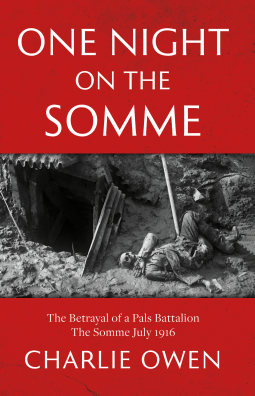
One Night on the Somme
The Betrayal of a Pals Battalion The Somme July 1916
This title was previously available on NetGalley and is now archived.
Send NetGalley books directly to your Kindle or Kindle app
1
To read on a Kindle or Kindle app, please add kindle@netgalley.com as an approved email address to receive files in your Amazon account. Click here for step-by-step instructions.
2
Also find your Kindle email address within your Amazon account, and enter it here.
Pub Date Apr 28 2026 | Archive Date May 8 2026
Troubador | Troubador Publishing
Talking about this book? Use #OneNightontheSomme #NetGalley. More hashtag tips!
Description
On 1 July 1916, the Lonsdale Pals Battalion went into action with thousands of other British troops and were massacred.
Eight days later, the shattered and traumatised survivors were assigned to undertake another attack across no-mans-land that would inevitably lead to more deaths and injuries.
They ensured that the attack failed and the entire Battalion was subsequently publicly disgraced as part of a policy to ignore the growing problem of shellshock. This humiliation was covered up for over 100 years.
One Night on the Somme is the story of that massacre, the humiliation, the cover up and the eventual rehabilitation of the Battalion’s reputation under an inspirational Commanding Officer.
A Note From the Publisher
Available Editions
| EDITION | Ebook |
| ISBN | 9781806345984 |
| PRICE | £4.99 (GBP) |
| PAGES | 264 |
Available on NetGalley
Available to Buy
Buy on Amazon Buy on BN.com Buy on Bookshop.org Buy on KoboAverage rating from 5 members
Featured Reviews
 PETER C, Reviewer
One Night on the Somme is one of the most poignant and well-researched books on the Western Front that I have read. Extremely powerful account of the Lonsdale Regiment being virtually annihilated on a badly planned attack on the German lines. Their brutal treatment by the unsympathetic and uncaring British General Staff after the heroic attack is appalling.
I really loved the way that the author researched several soldiers' families, discovering their living relatives and former homes. The Pal's Battalions were a dreadfully thought-out concept, resulting in many villages and small towns losing most of their menfolk. Some families losing sons and Fathers.
Highly recommended for military history buffs.
Ben M, Reviewer
I received a ebook of “ One Night on the Somme” from Goodreads free to read and review. My thanks to Goodreads, the publisher and author for giving me the opportunity to read this engrossing and vey moving book.
The author presents the reader with a very personal of the “ small picture” ( as opposed to the Big Picture” ) the Great War (1913- 1918) one that is focused on a single unit, one of the “ Pals” regiments. These consisted of men from some British counties where the soldiers were encouraged to join up with their friends and co- workers in to serve together -pals”united to play their part. As a recruiting pitch, it was ingenious, relying on camaraderie as a cohesive binding thread to keep morale high .One wonders, in hindsight of course, if the people who conceived the idea ever had inkling that the wholesale slaughter of trench warfare would that mean entire villages’ casualty rolls would mean the winnowing of entire families in one battle. That is what happened, and the book records that.
It is a very moving book . Here the horrors of trench warfare are told, as they have been related many times before, but on a very personal level. The reader reads of this attack and that one, a raid to get prisoners, or ‘ straighten up the lines “ , and reads the names of the casualties, and then sees the photographs of the men some boys , really, bravely looking back across the hundred years that have passed. There were the “ other ranks”, teens not old enough to shave and their officers, sporting thin moustaches that were supposed to make an impression of resolve. The reader senses their courage, ,but also senses of so much loss.
The incident around the “One Night on the Somme” referred to in the title, is when orders are given to send out a nighttime patrol across no man’s land to determine the strength and readiness of the enemy. Some of these British troops were already drained by constant shelling and were staggered by significant combat losses of their “Pals”. Some of these men lined up at the medical tents to plead shell shock. They had reached a breaking point. But “ Shell Shock’” was ,to officers safely back away from the front, merely cowardice. The “ other ranks” involved , and some of the officers who could see the blank-stares of their faces were arrested and punished.They could have been shot, but they were degraded, put at hard labor and disgraced. Eventually returned to service. Ironically, the incident help bring about a better understanding that even brave men have only so much to give.
I liked that author continues his story beyond the end of the war, relating how and his visited the English villages in question. There he traced the families, hearing memories, seeing the proud bronze memorials of a people who sent their sons, father and husbands off into a maelstrom that wiped away everything but a few medal ribbons and memories. Of widows who had to fight to get the small pensions allotted them, or of men physically and mentally scared forever, by what they suffered.
“ That Night on the Somme” is beautifully written history, worthy of the attention of anyone interested in the “ War to End War” . It is the story of how the glitz and silken finery of the Edwardian age ended in the trenches where men suffered more than they could bear,, yet kept on , for King and Country - and their Pals.
Recommended highly. The book is very well written. In focusing on a small part of “ The Great War” he gives his narrative greater impact than recitations of campaigns and general, of statistics .
Adam C, Reviewer
In 1925 Field Marshal Sir Douglas Haig visited Canada in his role as Grand President of the British Empire Service League (BESL). Upon his visit, Haig, The commander of the British Expeditionary Force (BEF) in France for most of the First World War, was hailed as a hero by The Veteran, the official magazine of the Great War Veterans Association. Upon arriving in Canada Haig made a “triumphant entry” into Quebec City. From Quebec he journeyed to Montreal and then Ottawa where he spoke on Parliament Hill to a cheering crowd of over 15 000. Throughout his trip he was revered as a friend and ally of the common soldier, as well as the victorious commander who had won the war for the allies.1 When he died less than three years later, over a million people lined the streets for his state funeral. For some sense of scale, more people gathered in London to give their last wishes to the deceased Field Marshall than did 70 years later when Princess Diana died.
This image of a triumphant public hero is not the one of Haig that endured. Rather, when remembered at all by the broader public, Haig is seen as an incompetent commander who needlessly sent men to die in First World War battles on the Somme and at Ypres in Belgium. The phrase ‘lions led by donkeys’ has been used in some form or another to deride bad commanders of brave troops since antiquity, but it holds particular popular resonance regarding the British Army in the First World War. Even modernday podcast Lions Led By Donkeys, which covers military ineptitude across all of recorded history, has a donkey dressed up as a British General from the Great War as their logo. Somehow, the phrase sounds best when said in a British accent.
First employed to describe Haig and the BEF staff in 1927 by Captain P.A. Thomas, its best known use was by author (and later Conservative MP in Margaret Thatcher’s Government) Alan Clark in his 1961 book The Donkeys. Even at the time, prominent historians such as the late John Terraine, criticized Clark’s depiction of the British Generals as donkeys. But the image stuck. Despite a growing body of work by historians who reject this characterization of the British Army as donkeys and lions, hundreds of books, movies, TV series and now podcasts and youtube videos have repeated and amplified this message throughout the years.
One of the latest books to do so is One Night on the Somme: The Betrayal of the Pals Battalion, The Somme 1916 by Charlie Owen, a retired UK police officer and crime novelist. Owen focuses on the experience of one battalion, The Lonsdale Pals (11th Service Battalion, Border Regiment) on July 1st and afterwards and the subtitle to the book gives away his overall approach. These men were betrayed by incompetent British Generals and their toadying underlings; sent to their deaths on that July morning.
The book itself is clearly a labour of love for Owen. He cares deeply about telling these men’s stories and honouring their bravery and sacrifice. His inclusion of pictures of many of the Lonsdale Pals demonstrates his commitment to their memory. The work is thoroughly researched, drawing on numerous primary sources and the author does an admirable job of including the soldier’s own voice in his descriptions of the events. A lack of footnotes in the text is disappointing but understandable. Similarly, there are some diversions into the biographies of the battalion members that distract from the main story but I read these as reflecting Owen’s passion for the Lonsdale story. Rather, the main issue I had with the book is the perpetuation of the lions led by donkeys trope. The sub-title itself, The Betrayal of the Pals Battalions really demonstrates the author’s approach to writing the story of the Lonsdales. There is the enemy in the Germans but then there are the real villains, the British High Command led by head ass himself Douglas Haig. As a historians who has worked on the First World War I am frustrated by works like Owen’s that repeat this characterization of the British High Command, yet from a personal view I understand where it comes from.
I remember the first time standing at Thiepval Memorial on the Somme. This memorial commemorates the 72 000 British and South African soldiers who died on the Somme and have no known graves. Standing inside the memorial one feels so small and on every surface there are the names of the fallen. It is impossible to process at first how many names are listed there. The scale of loss overwhelmed me. I experienced this feeling of being overwhelmed by the number of dead many times during my first visit to the Western Front; from standing in Flanders looking at the rows upon rows of crosses at Tyne Cot Cemetary outside Ypres, Belgium to seeing the French ossuary at Notre-Dame de Lorette (right by the Canadian Memorial at Vimy Ridge) containing the remains of over 20 000 unidentified French soldiers. I would challenge anyone who visits these sites and reads the accounts of the men who fought and died there to not immediately question the meaning and purpose of it all. How could so many die? Someone must be responsible and bear the blame for this tragedy?
The obvious answer is to blame the enemy, the German Army that faced off with the Allied powers for over four years on the Western Front. Yet for every British or Canadian or French cemetery or memorial there is a German equivalent, be it Neuville-St Vaast German War Cemetery close to Vimy Ridge or Langemark German War Cemetery in Flanders, each with over 44 000 German burials. These sites instill in visitors the same feelings of futility and sadness as the ones mentioned above. Any further reading of German accounts, including arguably the most famous novel of the First World War, All Quiet on the Western Front, only serve to cement in any visitors mind that the regular German soldier suffered in the same way their counterparts across no-mans land did.
This resulting search for meaning or explanation has led to two enduring myths. That of the “lions led by donkeys” as discussed above and the “Fischer Thesis” of Germany war guilt. Fischer was a Germany historian whose most famous work is Germany’s Aims in the First World War, published in Germany in 1961, indeed the same year as Clark’s The Donkey’s. Writing in West Germany in the aftermath of the Second World War, Fishcer argues that Germany’s expansive war aims of 1914 reflected an expansionist desire amongst the German leadership that led not only to the First World War, but set the pattern for the Nazi’s twenty years later. In case the comparison wasn’t clear, Fischer calls German Chancellor Bethmann Hollweg “the Hitler of 1914.” In this model, the death and destruction of the First World War are the result of Germany’s military and political leadership who planned and unleashed a war of conquest on Europe.
For many in the English speaking world the Fischer thesis was very appealing. While not excusing men like Haig, it granted a moral imperative to the conflict. Much like the Second World War, the First World War in this interpretation is ‘a good war’ or ‘a necessary war’. It sanctifies the sacrifice of the men who died and answers the question of what did they die for? The answer was to stop Germany and save Europe from tyranny. In the popular Anglosphere imagination, these two views get mixed together to produce what I would argue is the dominant narrative of the First World War. The brave lions were incompetently led by out of touch donkeys but their cause was noble. The men who died sacrificed themselves to defeat Germany and preserve freedom but the fact that so many died is the fault of the men in charge. Thus, the German soldiers are also pawns, simply tools used by their scheming leaders in Berlin. All soldiers are victims and all leaders are assess.
Here I will be transparent on my thoughts. I think both the “lions led by donkeys” and “Fischer Thesis” narratives are myths. They are, like many myths, compelling, which explains their enduring power. Like all good myths they provide a simple and moralistic story to explain a complex, traumatic and important event. Stating they are myths does not mean that they are completely fabricated. Rather, they both contain important elements in truth. The British High Command did make catastrophic mistakes that led to the deaths of tens of thousands of men. The Germany political and military leadership in 1914 did have expansive war aims involving incorporating huge swaths of territory into the German Empire. But both these theses are reductionist and do not tell the whole story.
I do not intend to dig into the entire historiography of the First World War to make my argument about the mythical status of these two ideas. For the lions led by donkeys myth I will outsource this labour to Gary Sheffield and Spencer Jones, who, on episode 8 of their Military History Plus podcast, provide an excellent summary of how scholarly thinking regarding lions and donkeys has changed. Sheffield, as one of the scholars responsible for this reassessment is exceptionally well positioned to argue his position and I encourage interested readers to listen.
For the Fischer thesis I suspect that my position is a little more complicated as many scholars do argue that his position is fundamentally correct, even if they quibble with details. I am more convinced by the argument of Sean McMeekin in his book The Russian Origins of the First World War from 2011 where he states that “even a watered-down version of the Fischer thesis, set against what we know now about Russia's early mobilization and French collusion in helping Sazonov dupe the British, can stand no more.”2 Additionally, other scholars such as Christopher Clarke, Margaret McMillan and Alexander Watson have all argued for a much more expansive role for Austria-Hungry in starting the war and I also find these arguments convincing.
What I find remarkable is how the disconnect between the scholarly debates and how durable and prevalent both of these narratives are within modern popular perceptions of the First World War. The two most popular pieces of popular culture relating to the First World War to come out in the past decade, the movies All Quiet on the Western Front and 1917 both reinforce these myths. From the bloodthirsty German General in All Quiet who can’t accept that his side has lost the war (a scene not in the original novel) to the implacable British commander in 1917 who wants to send his men over the top despite evidence they will be slaughtered, these two narratives continue to hold sway. I don’t cite these movies to be critical. 1917 is one of my favourite war movies. In many ways the film is compelling because of the lions led by donkeys trope. It makes for a much better story and adds drama and tension to the narrative to have Benedict Cumberbatch’s scared colonel as the villain who can barely be restrained from sending his men to die. The fact that the donkey’s narrative is so compelling and can be reinterpreted in different formats over the decades partially explains its staying power as a master narrative of the First World War.
I can now hear readers who have stuck with this article exclaiming “but if you liked 1917 what is your problem with Owen’s book?” Fair question and I will conclude the piece with my answer. The short answer is that my standards for non-fiction and movies are different. The purpose of film is to entertain. History provides a canvas for telling stories and so long as the movie does not strain believably too much (I am looking at you Wonder Woman) I can enjoy a movie that tell a compelling story well. Alternatively, I think as historians we have a higher standard to hold ourselves to. Yes, passion for the subject is important and many people, myself included, who write military history are driven, in part, by a desire to honour the men and women who served and sacrificed. Owen clearly is. However, that passion should be the starting point. We can stand at Thiepval, Langemark, or Vimy and reflect on the profound loss that surrounds us. But part of honouring that loss through the written word is to try and understand what happened and why it happened. That process not only entails looking at the accounts of those who served but also engaging with what others have said on the topic. Such a standard is not to gatekeep historical writing. Martin Middlebrook, Barbara Tuchman and Jonathan Nicholls have all written excellent books on the First World War and many professional historians have written terrible ones. Rather, writing a book is being part of a conversation, not reciting a monologue. Further engagement with what has come before would have strengthened Owen’s book substantially. It is possible that he would come to the same conclusion but then I could see the process and understand the place of his work in a larger discussion about the First World War.
Final Rating: 3 stars out of 5
 Louise G, Reviewer
It’s great to see these stories and accounts kept alive in new publications. We can’t afford to forget the individuals who fought in World War One and their experiences. This is a terrific blend of descriptive, well researched information and personal accounts to add that sense of humanity to situations which sometimes seem too incredible to be believed. It’s deeply moving, tragic and honest.
Readers who liked this book also liked:

Colleen Coble; Rick Acker
General Fiction (Adult), Mystery & Thrillers, Romance
Paul S. Rothenberg
Biographies & Memoirs, Entertainment & Pop Culture